

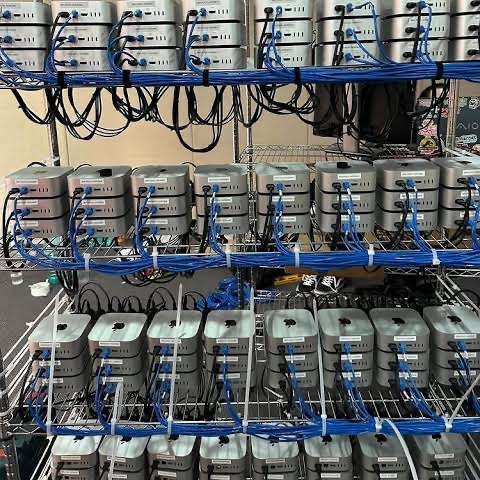
According to The Information, OpenAI has purchased tens of thousands of Apple Mac mini and Mac Studio computers in recent months to train AI systems capable of operating computers.
These Macs are not being used for large-scale pretraining of OpenAI’s foundation models. Instead, they are primarily handling reinforcement learning tasks. During this training process, AI agents must repeatedly practice completing various tasks in real computer environments.
OpenAI is reportedly purchasing Mac products equipped with large amounts of unified memory and using these devices to run models and training workloads related to “computer-use AI agents.”
This hardware provides AI models with real computer environments in which they can learn to navigate software interfaces, interact with applications, and complete various computer tasks. In these environments, AI agents can be repeatedly trained and evaluated.
OpenAI’s large-scale Mac purchases also reflect rapidly growing demand across the AI industry for Apple computers with large amounts of memory.
Mac mini and Mac Studio models with high-capacity memory are currently difficult to purchase, with some models having remained out of stock for months. AI companies are particularly interested in these configurations because Apple’s unified memory architecture allows the CPU and GPU to access the same large memory pool.
Apple does not disclose specific sales figures for individual Mac models. However, Apple’s overall Mac business generated a record $9.4 billion in revenue in the quarter ended in June (Note: approximately RMB 63.316 billion at the current exchange rate), up about 29% year over year.
In fact, Apple had already felt the impact of AI-driven demand on sales of small desktop computers during the quarter ended in June, resulting in supply constraints.
Apple CEO Tim Cook said during the earnings call in July this year: “We’re seeing more and more customers take advantage of these capabilities, from using Mac mini as a powerful platform for running agentic AI, to deploying clusters of Mac Studio systems to run frontier-level models locally.”
Cook also said that Mac products faced supply constraints during the quarter because market demand was “very strong.”
Recently, Apple launched new Mac mini models powered by the M6 and M5 Pro chips, while also updating the Mac Studio lineup with new machines featuring the M5 Max and M5 Ultra chips.
OpenAI is not the only AI company taking a similar approach.
According to reports, Anthropic has been renting Mac mini computing capacity through Amazon Web Services (AWS). As more AI developers seek hardware suited to specific AI workloads, Apple’s custom silicon, with its large unified memory configurations, is becoming an increasingly prominent choice in the AI industry.