

The BBC published a blog post today (August 7), reporting that researchers at Stanford University in the United States used AI technology to design entirely new viruses with complete, reproducible functionality in a laboratory setting.
Researchers said this was the first time AI had successfully designed complete genomes. The 16 new viruses produced in the study infect bacteria and pose no threat to humans.
In an interview with the BBC, Brian Hie, an assistant professor at Stanford University, said AI had previously been used to design new antibiotics. However, from a technical perspective, designing viable viruses from scratch is more difficult.
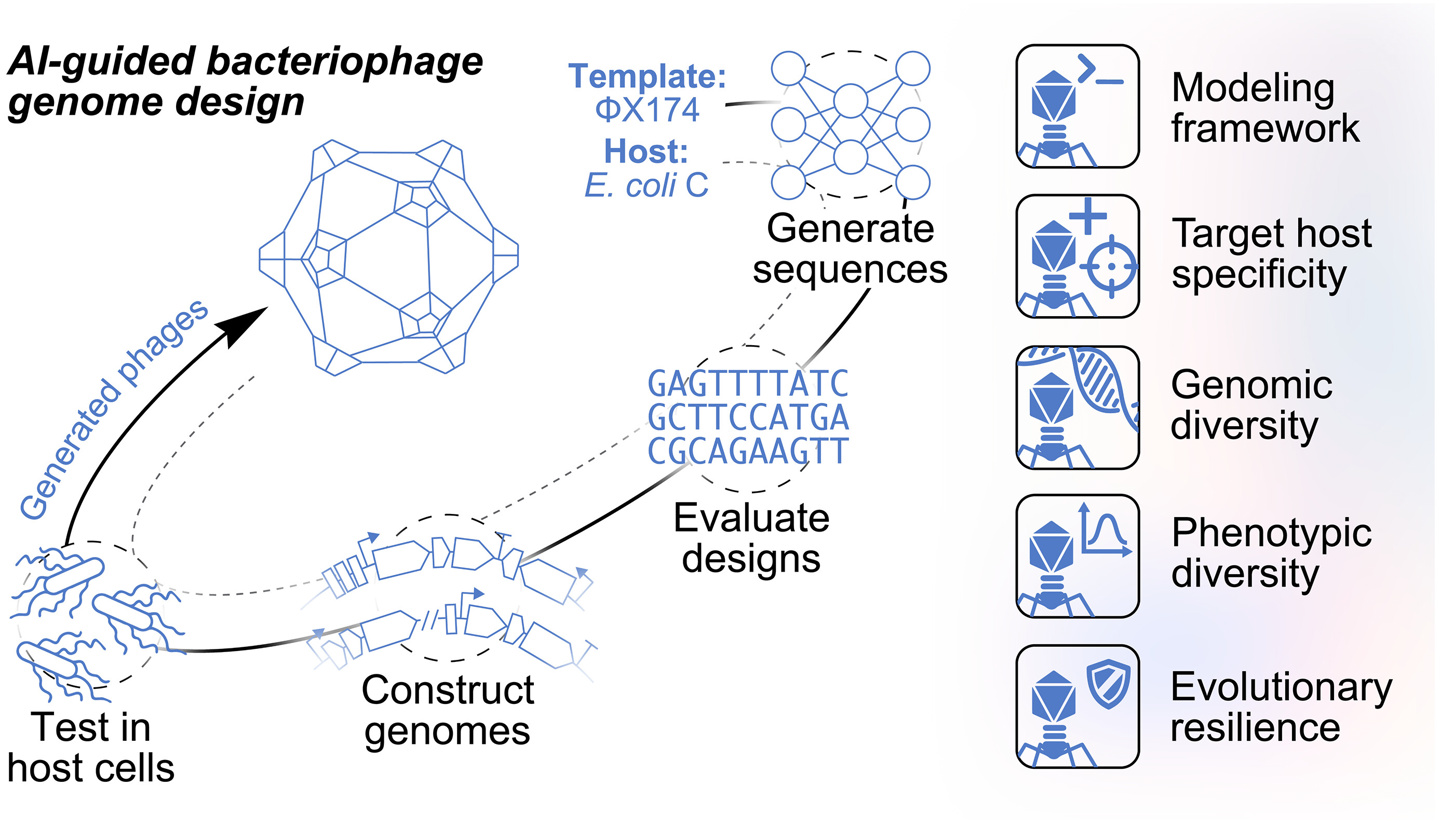
The research team said its approach is similar to that of large language models such as ChatGPT. The difference is that large language models predict text sequences, while the Evo1 and Evo2 models developed and used by the team predict the “language of life.”
For model training, the research team said the relevant data came from the genetic codes of viruses, bacteria, plants, and humans. The team then fine-tuned the models to design bacteriophages, viruses that infect only specific bacterial species.
Note: In the context of large language models, fine-tuning means using task-specific datasets to further train a pretrained large language model. A pretrained model has already learned a broad range of general information, while fine-tuning helps it specialize in a particular field.
To verify whether the AI designs were effective, Stanford researchers selected the 302 most promising designs and synthesized them in the laboratory. The results showed that 16 of the designs could effectively kill Escherichia coli (E. coli).
Developing new phages could provide a new treatment pathway for antibiotic-resistant infections. The report noted that phage therapy is regarded as a potential approach to the growing threat of bacterial infections, particularly those that cannot be treated with antibiotics.
The breakthrough also shows that AI can design new biological systems beyond those found in nature. Hie believes this capability could significantly improve human health through the development of new drugs and therapies.
The phage genetic codes in this study were approximately 5,400 base pairs long. By comparison, the genome of the smallest living cell is about 500,000 base pairs, while the human genome contains 3,000,000,000 base pairs.
Hie said that attempting to design some simple organisms “may require a great deal of work, but it is not impossible.” He also said the team “is indeed interested in working toward this goal.”
Marc Güell, a professor at the Laboratory for Synthetic Biology at Pompeu Fabra University in Spain, said the study marked a “very important turning point” because “for the first time in history, humans are beginning to design biology on computers.”
He said this makes it possible to imagine more ways to address major human challenges, including developing phages to treat diseases, enzymes to treat genetic disorders, and antibodies for use in immunotherapy.
Reference
Generative design of bacteriophages with genome language models