

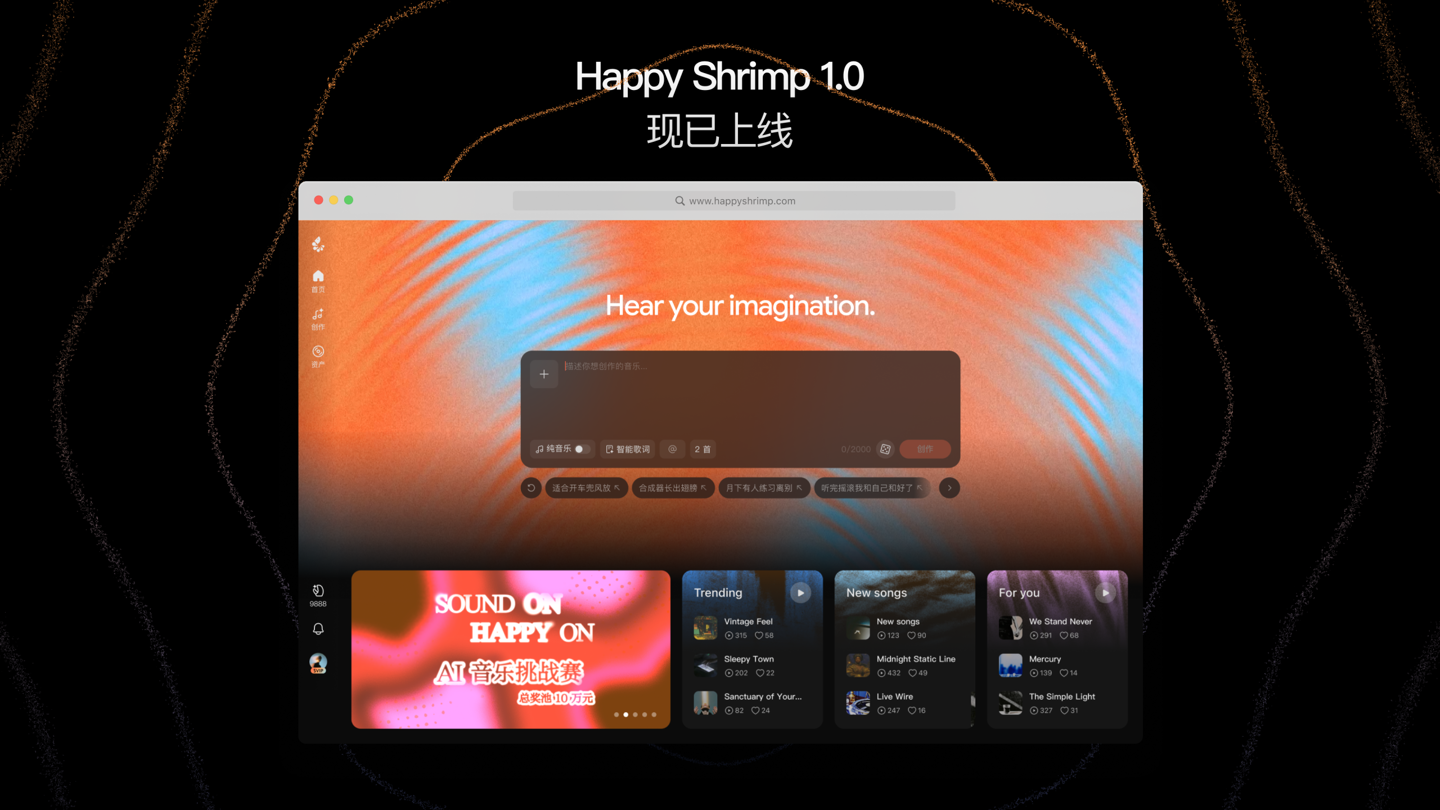
Alibaba announced today (the 17th) via its official account that its AI music model HappyShrimp 1.0, known as 快乐虾米 in Chinese, has officially launched. HappyShrimp can accurately understand natural language and turn an emotion, story, or memory into a complete piece of music.
According to the introduction, HappyShrimp set out from the beginning to lower the barrier to music creation. Beyond professional terms such as music theory and arrangement, it accurately understands natural language so everyone can enjoy the fun of creating music. In response to common problems with AI music, including mechanical-sounding vocals, mismatches between lyrics and melodies, and noisy audio, HappyShrimp has made breakthroughs in sound detail and musicality.
HappyShrimp can generate an entire song end to end, treating music as a special language with grammar, semantics, and context. For user requirements involving language descriptions, lyrics, musical styles, emotions, eras, and vocals, the model does not process them separately and then stitch the results together. Instead, it plans holistically, creates synchronously, and accounts for long-range structure, producing a complete song as an integrated whole.
In addition, HappyShrimp aims to address the situation in which “AI music tools are generally good at handling standardized music tags but struggle to understand the cultural context, aesthetic sensibilities of an era, and emotional intent expressed in natural language.” For example, it can understand professional terms such as “Lo-fi R&B,” as well as emotions, settings, and narratives.
Starting today, HappyShrimp is launching simultaneously on the PC web in China and overseas markets.
Experience: Happy Shrimp