

Researchers from the University of Birmingham in the UK, Aarhus University in Denmark, and Linnaeus University in Sweden published a study last month (August 2026) suggesting that users who interact with customer service AI exhibiting human-like behavior over extended periods may gradually adjust their language and behavioral patterns, reshaping their self-perception.
The paper was published on August 19 in the open-access journal AI & Society. The researchers proposed the concept of “robotoid humanness,” pointing out that during AI interactions, AI becomes more “human-like,” while users may appear more “machine-like” through continued exposure.
The study focuses on four service scenarios: retail, hospitality, tourism, and healthcare. The team noted that adaptive learning, personalized communication, and empathetic responses make robots appear more human, while users may imitate machine-like forms of expression to obtain smoother and more positive algorithmic feedback.
In terms of the underlying mechanism, customer service robots simulate human gestures, speech, and emotional cues. Systems also use machine learning to adjust their responses based on user input. Their usual goals are to build trust and increase user engagement.
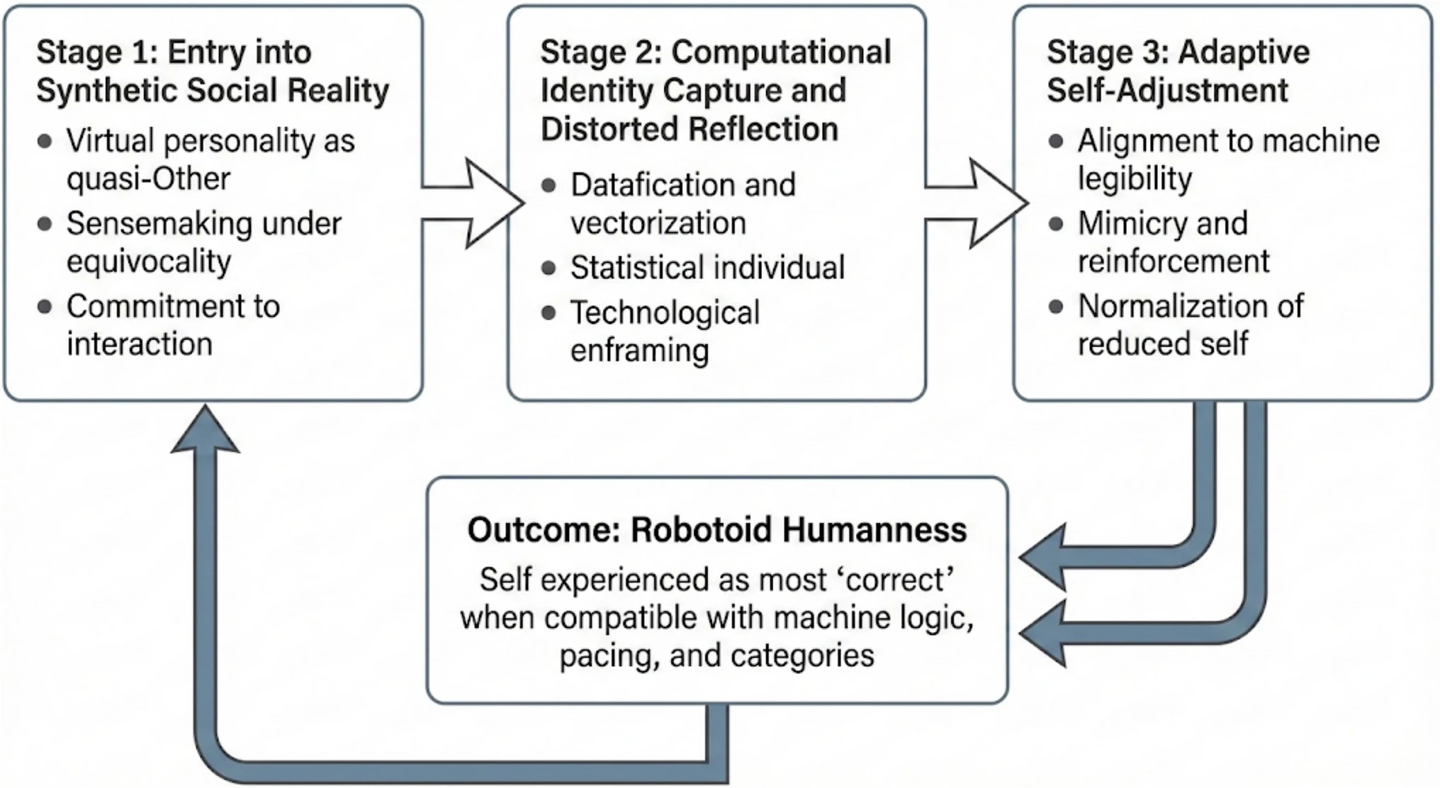
Humans have a tendency to “mirror” others in social interactions, often unconsciously imitating the other person’s movements, facial expressions, and manner of expression. The researchers identified a three-stage mirroring mechanism:
The first stage is entering a “synthetic social reality.” Generative systems create an interaction environment resembling a social relationship through natural language, emotional cues, and adaptive responses. During the interaction, users judge how to respond and express themselves, and may also assign social meaning to the system’s feedback.
The second stage is “computational identity capture.” The system generates a predictive profile from users’ behavior, preferences, and interaction traces, then returns it to users through recommendations, segmentation, or personalized responses.
The third stage is adaptive self-adjustment. Users may tend to use forms of expression that the system can more easily understand and reward. Repeated interactions reinforce this alignment, allowing machine-generated statistical abstractions to gradually become an important reference point for how users understand themselves.
The framework identifies four key factors: the service context, consumer expectations, the robot’s appearance and language, and the interactional investments made by both humans and machines. The study suggests that these factors jointly determine how users understand the service relationship and influence the direction of changes in their self-perception.
For example, systems with adaptive learning, personalized communication, and empathetic interaction capabilities may shape the user experience more strongly. Each time a user submits an input, the system immediately adjusts its response. Repeated interactions may create an ongoing loop of imitation and feedback.
Reference address above
Robotoid humanness: when selfhood becomes machine-legible