

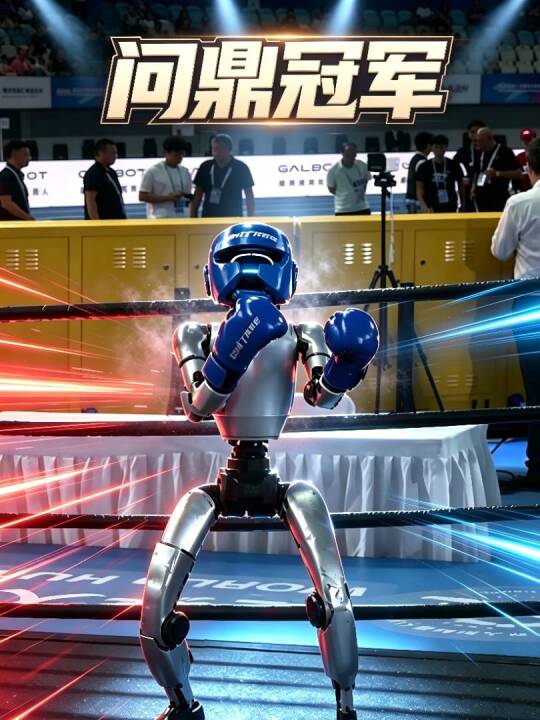
The first gold medal in this event was awarded today during the sanda competition at the 2nd World Humanoid Robot Games.
The 40-kilogram final featured a “student defeating the teacher” storyline: The North China Electric Power University team remotely operated a G1 robot manufactured by Unitree Robotics and used superior algorithms to defeat Unitree Robotics’ own team, winning the championship.
A major highlight of the competition was that different teams used identical robot platforms. What they actually competed on was the quality of their secondary development in areas such as algorithms.
According to Beijing Daily, the two robots moved nimbly around the ring, dodging left and right while looking for attacking opportunities. Hooks and flying kicks appeared frequently during the match. In the intense exchanges, the North China Electric Power University team’s robot adjusted more quickly. Even when kicked off balance, it could rapidly regain its balance and stand back up without touching the ground with its body. After three rounds, the referee announced North China Electric Power University as the winner.
After the match, Gao Xin, captain of the North China Electric Power University team, said: “We used a Unitree robot, and we also received support from Unitree.” He believed the two sides were evenly matched, with his team’s advantage coming from its performance under pressure and control precision.
Gao Xin also noted that the robot’s stability during the match was the key to victory: “No matter what moves were used, or during exchanges of kicks, it could get back up quickly. This gave us an edge in momentum.”
At the previous Games, sanda was still an exhibition event held outside the main competition. North China Electric Power University was the runner-up in the 40-kilogram category. This year, the event was upgraded to an official competition, with multiple weight classes including 40 kilograms, 58 kilograms, and 80 kilograms. Each match consists of three rounds, with each round lasting 2 minutes. The event tests not only the robot’s overall structural impact resistance, but also the real-world performance of its motion control and offensive and defensive strategy algorithms.
Gao Xin believes that the Robot Games help improve fundamental athletic capabilities: “The striking movements, rapid reactions, and adjustment abilities demonstrated in robot combat are also necessary for robots to perform complex tasks in the future. They have practical significance for future commercial applications.”