

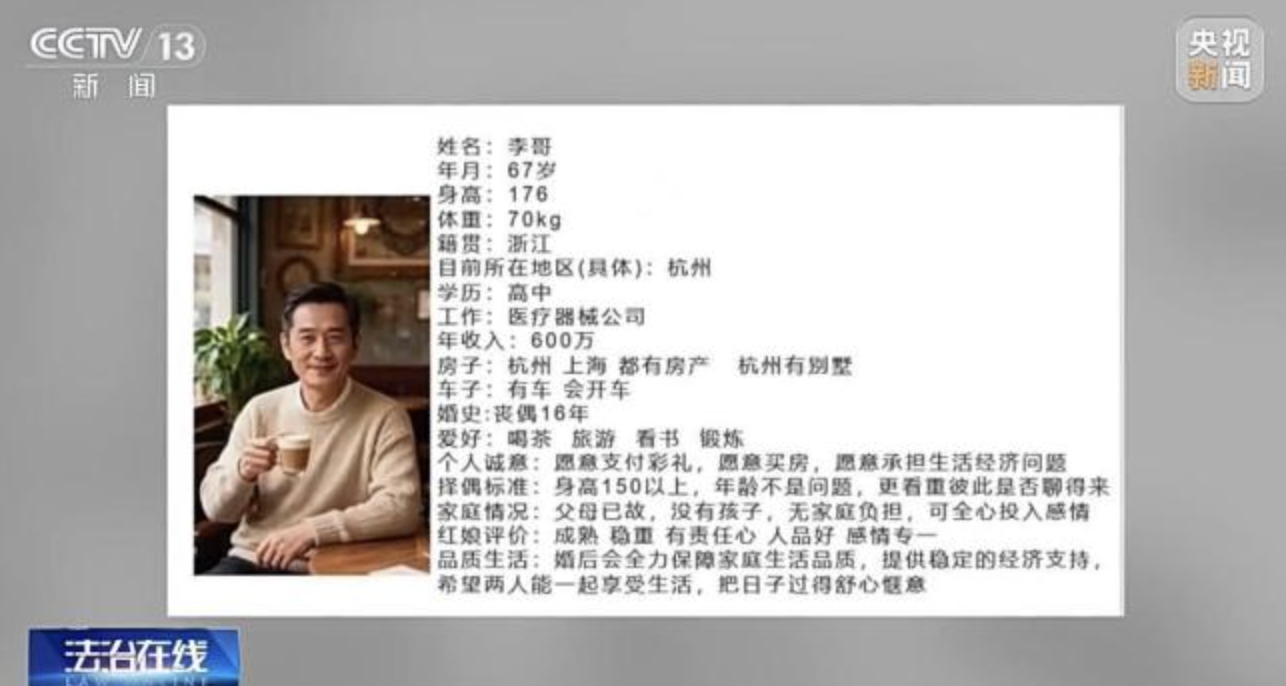
According to CCTV News, an AI dating scam targeting middle-aged and elderly women has recently emerged. Criminals use AI-generated so-called matchmaking prospects to defraud victims. Recently, police in Chengdu, Sichuan, dismantled an “AI matchmaking” scam gang and arrested 28 suspects, including Wang.
According to the report reviewed by IT Home, a woman surnamed Bian came across a matchmaking company on an online video platform. After expressing her interest in finding a match, a person using the account name “Director Wang of the Matching Center” sent her a profile of “Brother Li,” which detailed his personal information and included a photo. Bian paid a total of 2,000 yuan in matchmaking service fees, but she could not contact “Brother Li” at all, and “Director Wang” on the other end of the screen also began ignoring her messages.
Through their investigation, the police discovered that the company that had signed a contract with Bian did not exist. However, an on-site check revealed a highly similar company. Its main business was matchmaking, but there were no matchmaking consultants or supposed “matchmakers” on site, only sales, editing, and livestreaming positions. On the editors’ computers, police saw AI-generated images identical to the profile of the male dating prospect provided by the complainant.
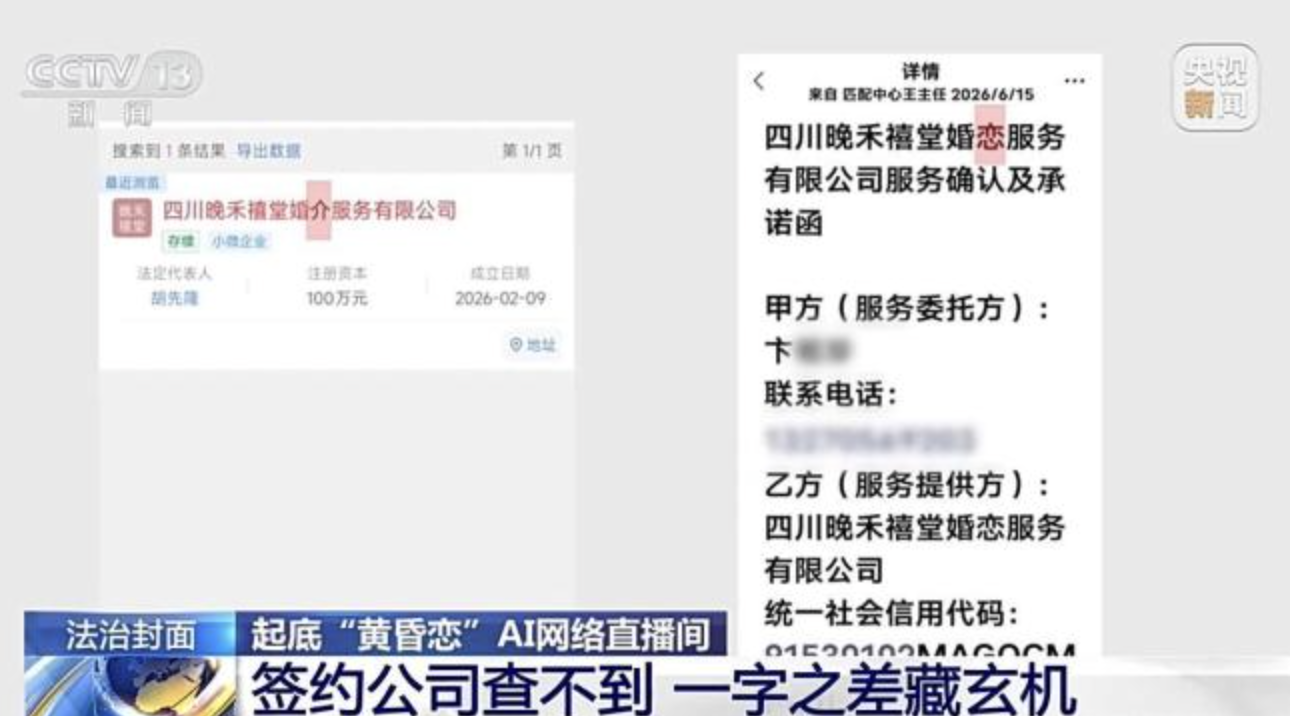

These anomalies led the police to realize that this was not an ordinary matchmaking service company. Police then contacted the company’s owner, Wang, through an employee at the site. During a phone call, Wang said he was willing to refund the money but consistently evaded questions about the contract. Although Bian’s refund request was resolved, the investigators did not stop there. By monitoring Wang’s livestream account for several days, police discovered that the supposed image of “Brother Li” frequently appeared on screen.
After obtaining conclusive evidence, police arrested 28 suspects, including Wang. At the time of the arrests, the group was still livestreaming with AI-generated male personas and had prepared numerous scripts and talking points. Every aspect of the livestream, from creating the AI persona to the scripted interactions, had been carefully designed.
To deepen viewers’ trust, the online hosts also used voice changers to impersonate “high-quality men seeking matchmaking” during livestream connections. Investigators found that this so-called matchmaking company never provided genuine matchmaking services. After victims paid the service fees, the people chatting with them were not the supposed high-quality men, but after-sales staff at the company continuing to perform a coordinated deception.
In less than a year, the gang’s crimes involved more than 1 million yuan, and approximately 50 people suffered property losses. At present, the 28 suspects, including Wang, have been placed under criminal coercive measures in accordance with the law by public security authorities.
CCTV News stated that the harm caused by scams using AI to fabricate personas is obvious. More concerning is that such scams still exist on short-video platforms. Platforms should strengthen detection and alerts and establish a risk-tiered response mechanism. When they detect livestreams or short videos that appear to be AI-generated and show signs of attracting users to matchmaking or social interactions, while also exhibiting fraud indicators such as誘cing users to move off-platform or soliciting service fees, platforms should not stop at labeling the content. They should impose restrictions in stages and, as required, transfer fraud-related leads to competent authorities such as public security and cyberspace administration departments.
Experts suggest that updating technical tools and strengthening cross-platform coordination could help find a solution. Platforms must strictly fulfill their obligation to label AI-generated content, improve AI-content identification and risk-control systems, strengthen monitoring, alerts, and coordinated responses for high-risk fraudulent content, block distribution through algorithms, and reduce the space for false information to survive at its source. Ordinary users also need to build stronger risk awareness. When faced with suspected AI-generated content, they can likewise use technical tools to verify its authenticity.