

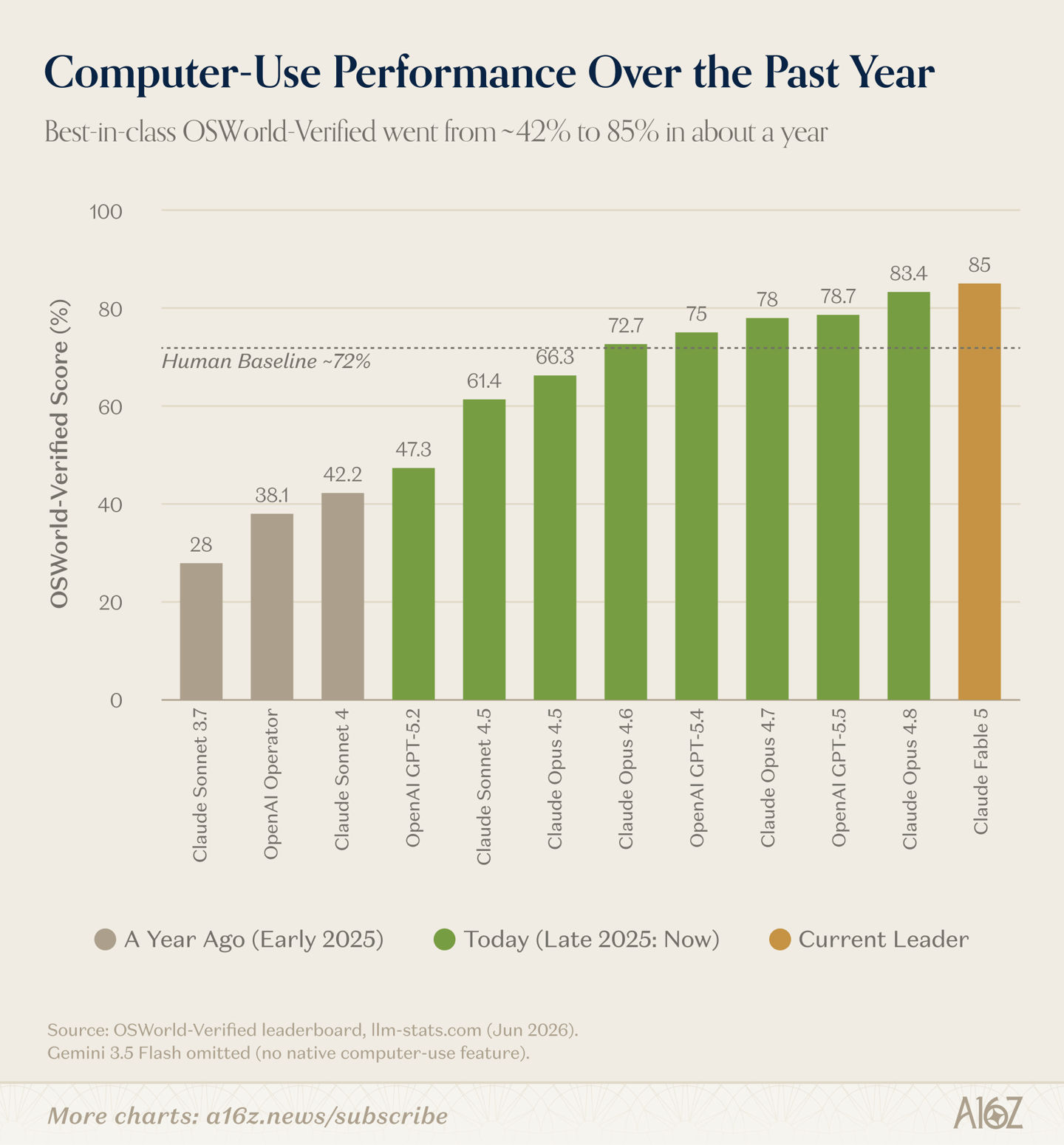
On August 10, Fabrizio Serafini, a partner at Silicon Valley private venture capital firm Andreessen Horowitz (a16z), published a blog post reporting that the cost of AI agents has fallen below that of offshore Indian outsourcing labor.
Serafini argues that AI agents are moving from the demonstration stage into the deployable stage. Their core capabilities include reading screenshots, clicking interfaces, entering text, recovering from errors, and completing repetitive work in software systems without clear APIs (application programming interfaces).
The article cited OSWorld-Verified benchmark data, which evaluates how agents operate Ubuntu, Windows, and macOS workflows in real desktop environments, scoring them according to the proportion of tasks completed.
In early 2025, the strongest computer-use models scored 42%; by June 2026, the current leading model, Claude Fable 5, had reached a score of 85% (meaning that an AI agent could complete 85 out of 100 everyday tasks), exceeding the approximately 72% level achieved by human testers.
The article says that current Computer Use agents are best suited to tasks that follow clearly defined procedures. Typical scenarios include updating CRM records, quality checks, logging into government and insurance portals, extracting data from databases and regulatory websites, retail order processing, contract processing, and handling IT tickets in ServiceNow.
Interviewed teams provided several production examples: one CPG (consumer packaged goods) data platform runs approximately 15 million to 20 million automated portal interactions each month, using agents as a self-healing fallback for hand-written crawlers.
When a retailer's portal interface changes, the agent diagnoses the failure, repairs the automation workflow, and keeps data flowing before engineers intervene. The company said that after deployment, the engineering team dedicated to maintaining crawlers was cut in half, allowing staff capacity to be reassigned to other workflows.
Another case came from a global systems integrator. The organization already has 27 live workflows using computer agents, processing approximately 1,500 to 2,100 IT tickets per day. Its ultimate goal is to redeploy 20-25% of its workforce from low-margin managed-services contracts.
One other organization said it had automated its recruitment process end to end, immediately populating its applicant tracking platform with data after candidate interviews concluded.
In addition to increasingly meeting the office-skill requirements of enterprises, AI agents also offer significant cost advantages. The fully allocated cost of Computer Use agents is approximately $6-8 per hour (note: approximately 40.6-54.1 yuan at the current exchange rate), while the fully allocated cost of offshore Indian BPO workers is approximately $10 per hour (approximately 67.6 yuan at the current exchange rate); U.S. back-office employees cost $30 to $45 per hour after benefits and administrative expenses are included (approximately 202.8 to 304.1 yuan at the current exchange rate).
U.S. costs start with the BLS median wage of $20.59 per hour for customer service representatives (approximately 139.2 yuan at the current exchange rate), with benefits and administrative overhead added; benefits account for approximately 30% of total compensation.
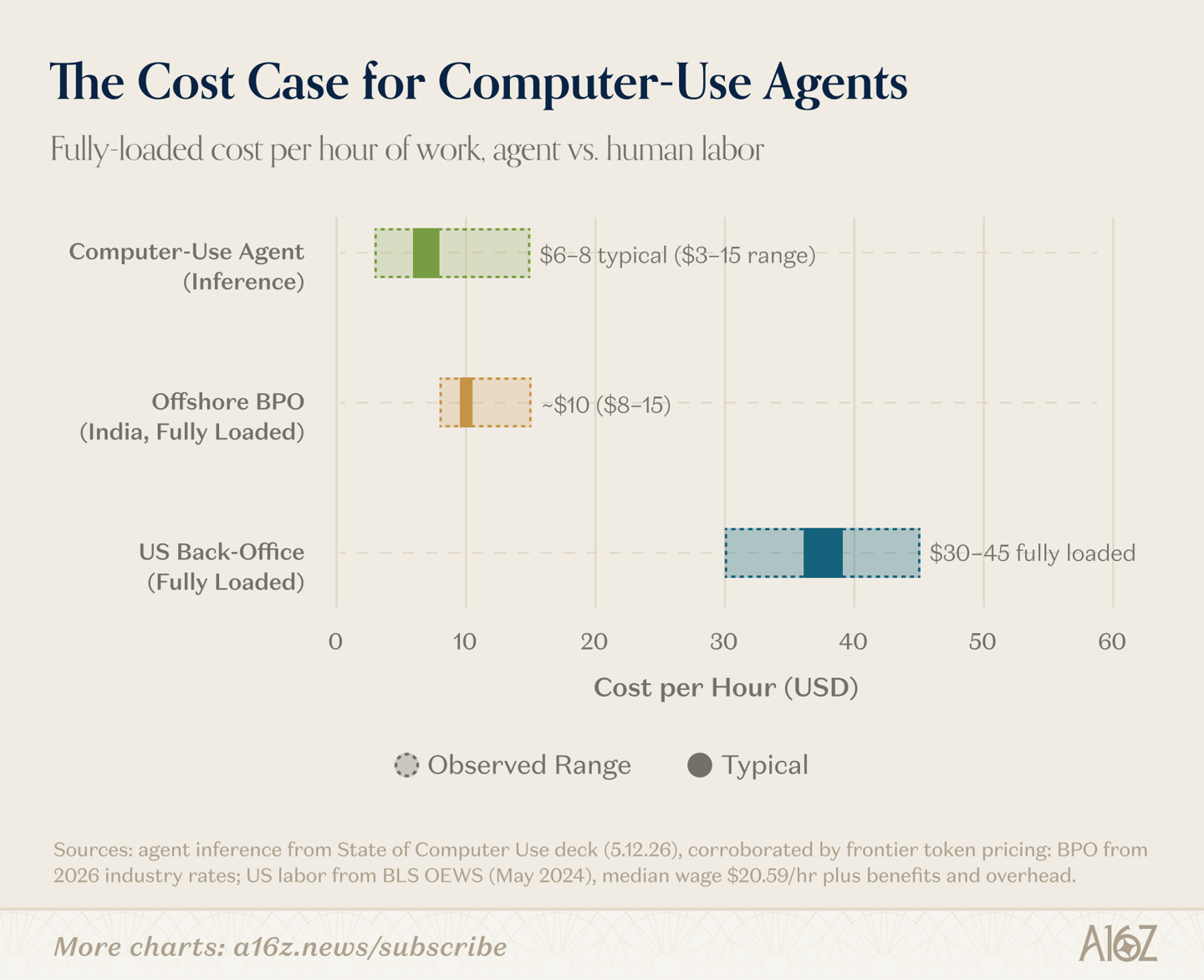
Serafini cautioned that the above data should be viewed as an order-of-magnitude estimate. Well-designed systems reserve expensive model calls for tasks requiring judgment, while assigning repeatable steps to low-cost deterministic code, further reducing total costs across the entire lifecycle of a workflow.