

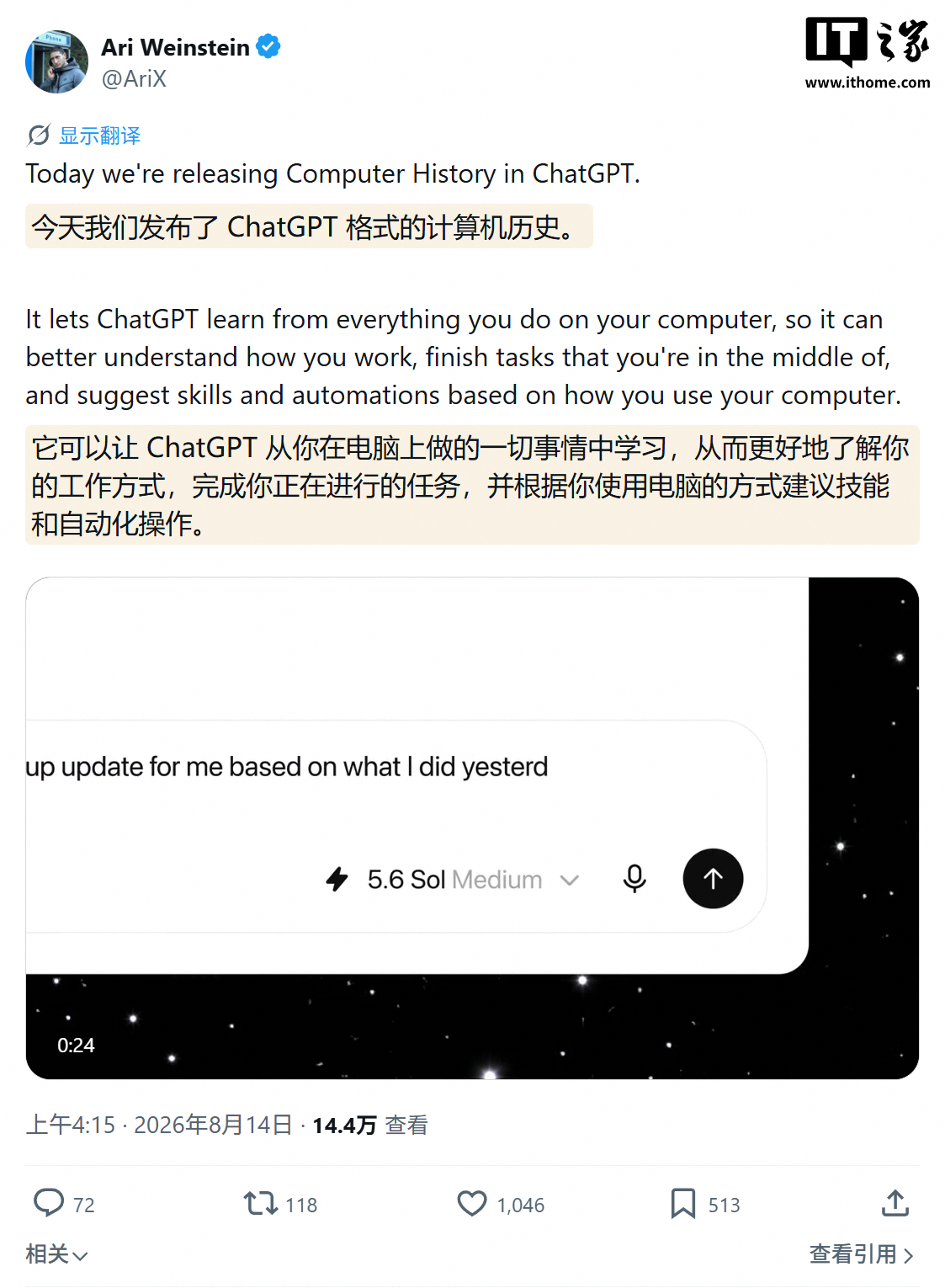
OpenAI published a blog post yesterday (August 13) announcing the optional rollout of Computer History, replacing the previous Chronicle research preview and bringing activity memory and timeline support to the ChatGPT desktop app for Mac.
Chronicle built a memory bank through screen captures, allowing Codex to use these memories as contextual references for subsequent tasks. This enabled it to understand what users were referring to, which tools they were using, and what projects they were working on without requiring them to explain everything again each time.
Computer History, by contrast, no longer relies on screenshots. Instead, it uses Apple macOS Accessibility to record interaction events, including clicks, text entry, keyboard shortcuts, and app switching. It turns users’ Mac activity into memories and timelines for ChatGPT and Codex, enabling them to quickly generate work summaries or retrieve recently viewed files.
For privacy, Computer History automatically excludes private browsing activity. Interaction events are temporarily stored locally for up to 48 hours and deleted after memories are generated on the server. Text-only memories remain stored locally until the user manually clears them.
In terms of availability, OpenAI has invited ChatGPT Pro, Business, and Enterprise subscribers to try Computer History. Business and Enterprise administrators must enable the feature before workspace members can use it. The feature is initially unavailable in the European Economic Area (EEA), Switzerland, and the United Kingdom.