

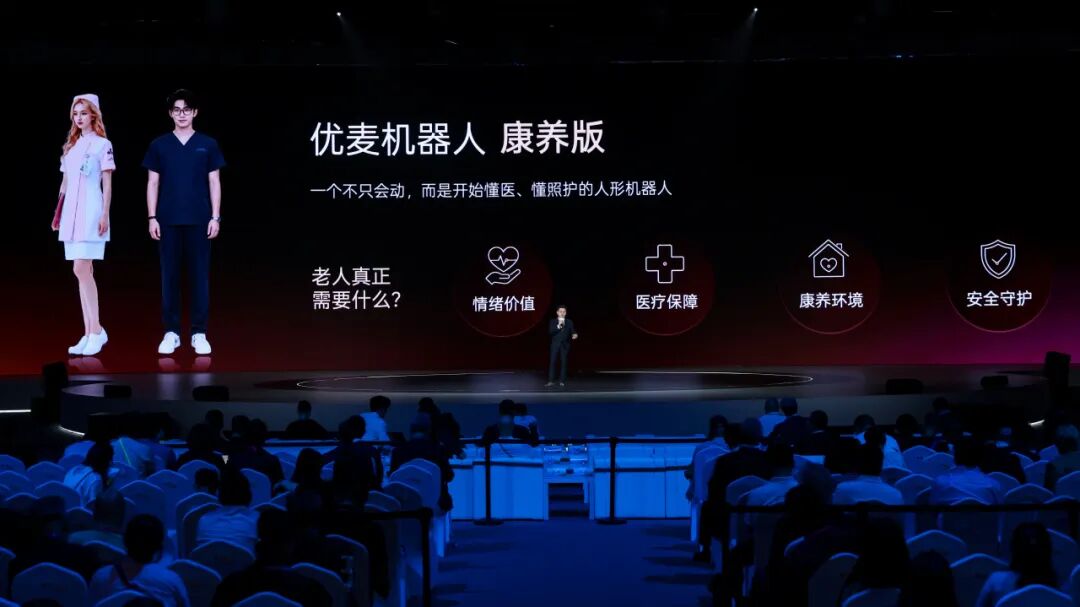
UBTECH today announced the launch of China’s first bionic medical robot, the Youmai Robot Wellness Edition, jointly developed with MedTech. The humanoid robot integrates professional medical service capabilities, further expanding UBTECH’s deployment in the medical and elderly-care sector.
According to the official PPT, the Youmai Robot Wellness Edition is a humanoid robot that understands medicine and caregiving, and is available in male and female appearance options.
ITHome found that the robot first appeared at UBTECH’s 2026 Global Technology Conference in June this year. Unlike traditional service robots, the product is said to deeply integrate bionic interaction through humanoid hardware with a standardized clinical medical AI system, addressing two major pain points in elderly-care settings: a lack of medical expertise and insufficient human-centered interaction.
At the hardware level, the robot is built on UBTECH’s proprietary full-size humanoid robot technology. It features a high-precision facial micro-expression module and a multi-degree-of-freedom limb structure, enabling it to provide more human-centered medical services to older adults through humanlike interaction.
In terms of medical capabilities, MedTech has integrated its self-developed complete CGA comprehensive geriatric assessment question bank into the device. It covers 10 core dimensions of chronic disease management for older adults, spanning disease monitoring, medication safety, and chronic pain assessment. The robot can conduct intelligent consultation and assessment throughout the process, including disease awareness, blood pressure and blood glucose monitoring, follow-up management, adverse drug reaction screening, and medication risk alerts.
The two parties have defined a long-term three-stage product evolution path:
For knowledge evolution, the system will continuously collect data from home-based elderly-care scenarios to iterate its AI chronic disease models and expand its professional elderly-care knowledge base.
For capability evolution, multimodal assisted diagnosis is planned to launch within three years, expanding home nursing and primary-level health screening capabilities and creating a digital family general-practice service platform.
For network evolution, a cloud collaboration platform will connect data from devices across the entire network, balance the supply of regional elderly-care resources, and promote standardized chronic disease management services for older adults nationwide.