


A quadruped robot equipped with a robotic rider became one of the most popular exhibits at the 2026 World Robot Conference in Beijing.
DaxAI Robotics showcased the Qiji X1 at the conference. By combining a quadruped robot platform with a saddle and handlebars, it allows users to control the robot much like riding a horse.
The Qiji X1 can be understood as a large, human-carrying quadruped robot. Unlike conventional mobile devices that use wheels or tracks, it walks on four jointed mechanical legs and has an overall form resembling a robotic horse. The rider sits on the saddle on top and controls it using the handlebars in front.
According to IT Home, it uses a pure quadrupedal biomimetic design without wheels. The entire machine weighs 300 kg and precisely replicates the walking gait of a real horse. It can reach a top speed of 7-10 km/h. The product is equipped with a 165V high-voltage power battery pack, providing a range of 40 km and 8-10 hours of operating time. Its maximum joint torque reaches 1,400 Nm, while its dynamic load capacity is as high as 300 kg.
There is also the more advanced Qiji XS high-speed wheeled-legged robot horse. It uses an integrated wheel-leg hybrid structure, weighs 320 kg, and has a top driving speed exceeding 40 km/h, with a range of up to 60 km. It combines high-speed travel with off-road capability. The product supports intelligent mode switching: on flat roads, its wheel structure enables stable high-speed cruising; when it encounters complex terrain such as gullies, dirt slopes, and rough ground, it automatically switches to legged off-road mode.
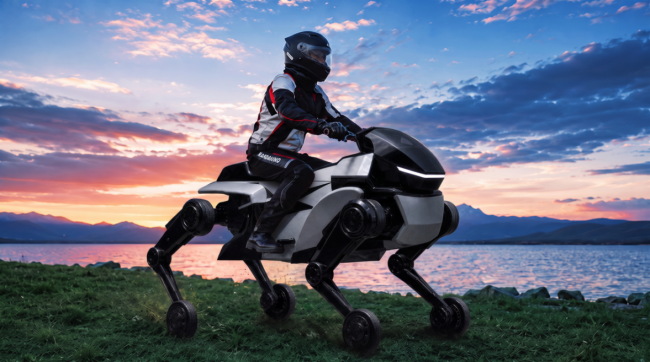
According to the introduction, both Qiji series robot horses come standard with practical features such as high-voltage fast charging and riding data monitoring. They support continuous OTA updates, allowing gait libraries to be updated and riding plans to be optimized through the cloud, so product performance can keep evolving while remaining useful and retaining value over the long term.
The series is primarily intended to validate the feasibility of rideable quadruped robots. The team hopes to combine robotics technology with autonomous systems to create machines capable of adapting to complex environments, enabling robots to operate in scenarios that are difficult for conventional wheeled equipment to access.