

Embodied intelligence company Dyna Robotics has released its latest robot foundation model, DYNA-2, trained on more than 1 million hours of first-person human video, with a task success rate of up to 90%.
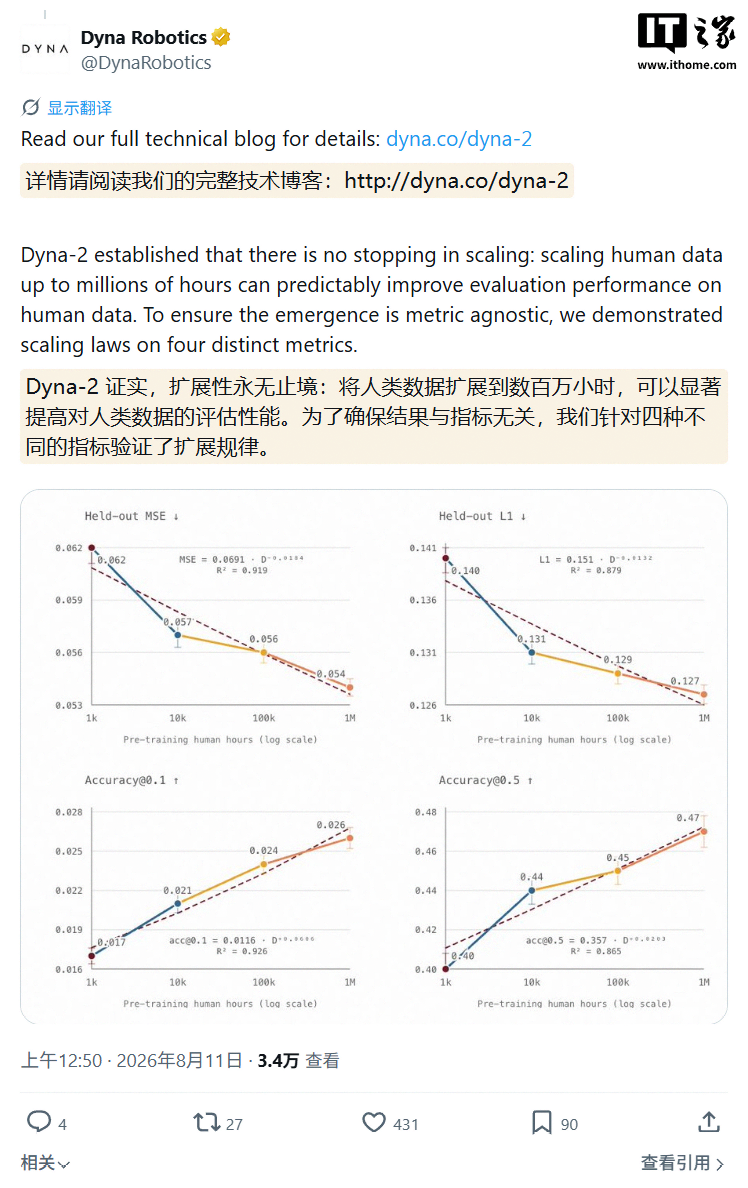
In terms of positioning, DYNA-2 is officially described as a World Action Model, designed to learn how actions change the physical world by observing human activities. Relevant screenshots are shown below:
For training, DYNA-2 relies entirely on human video data during pretraining, using more than 1 million hours of first-person human video, equivalent to 170 years of human experience.
Jason Ma, the company’s co-founder, said that general-purpose robots have long been constrained by data bottlenecks. Manually collected physical teleoperation data is difficult to scale to general intelligence, while the DYNA-2 model learns how actions change the physical world by observing human activities.
The company believes that DYNA-2 predicts how the physical world will move before taking an action, giving robots the spatial reasoning and contact physics capabilities lacking in traditional vision-language models.
The model uses two training objectives: predicting the content of the next video frame and the action that should be taken. Through this process, it acquires information about spatial relationships, patterns of motion, and how objects respond after contact.
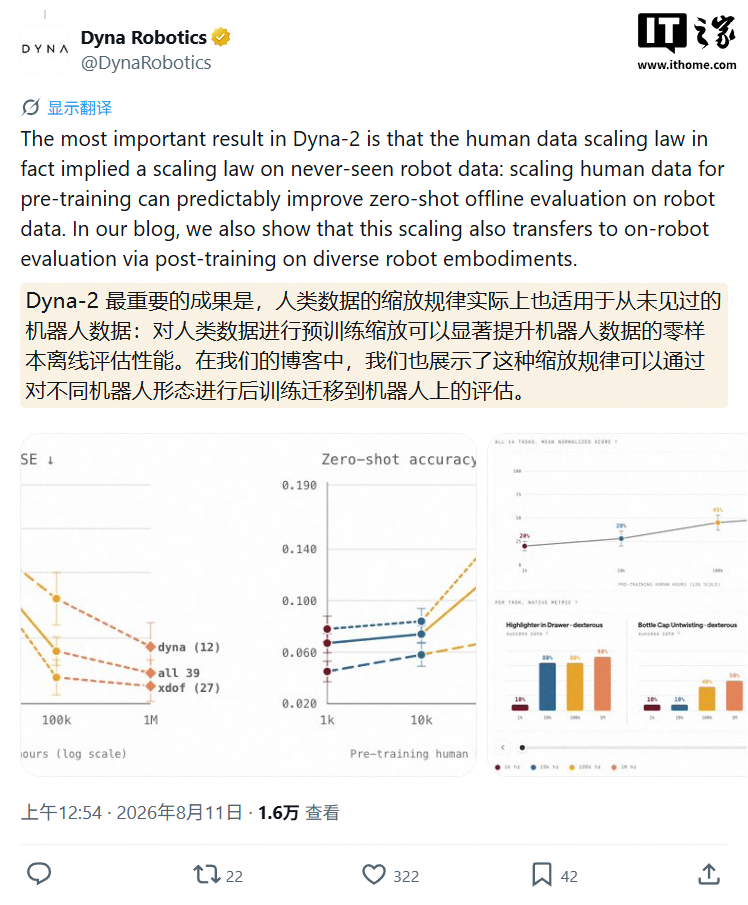
Results released by Dyna Robotics show that as more human video data is added during pretraining, robot performance improves across 15 benchmark tasks. The company calls this phenomenon the human-to-robot scaling law and says performance grows in a relatively predictable manner as the training data scale expands.
In one experiment, 13 minutes of robot-specific data was enough for two 5-fingered robotic hands to learn to twist off a bottle cap. For manufacturing tasks, with the post-training dataset unchanged, the success rate increased from approximately 20% to 80%–90% as the pretraining scale grew.
Dyna Robotics also said that Dyna-2 achieved an 87% quality pass rate in one customer deployment, compared with 46% for the previous-generation Dyna-1. In tasks requiring different actions based on user instructions, video co-training increased the score by 133%.