


DeepSeek-V4-Pro-0813 is now officially open source. It has also released a developer preview of its open-source coding agent framework Harness (based on Cordis), while simultaneously opening its accompanying plugin ecosystem.
As of IT Home's publication, the related GitHub repository was still private (update: it is now public). Interested users can install it via npm:
npm i @deepseek-ai/dshRun it via npm:
npx @deepseek-ai/dsh webThis command launches the Web UI, available by default at http://127.0.0.1:3080 .
To run it from the repository source code:
git clone https://github.com/deepseek-ai/deepseek-harness.gitcd deepseek-harness
pnpm install
pnpm run build
pnpm dsh web
In simple terms, a “Harness” is a tool that transforms a model into an agent. Beyond the large language model itself, Harness manages context, tools, task status, feedback, and boundaries, bringing the model's capabilities into real-world environments and completing the full loop from understanding requirements to delivering code. DeepSeek previously presented the formula “Model+Harness=Agent” in an official job listing.
In terms of product positioning, DeepSeek Harness directly targets OpenAI Codex and Anthropic Claude Code, aiming to become an AI productivity tool focused on programming and office-work scenarios.
Team lead Cui Tianyi publicly recruited global users for Harness internal testing on August 2. After the recruitment post was published, it attracted applications from dozens of developers worldwide within a short period.
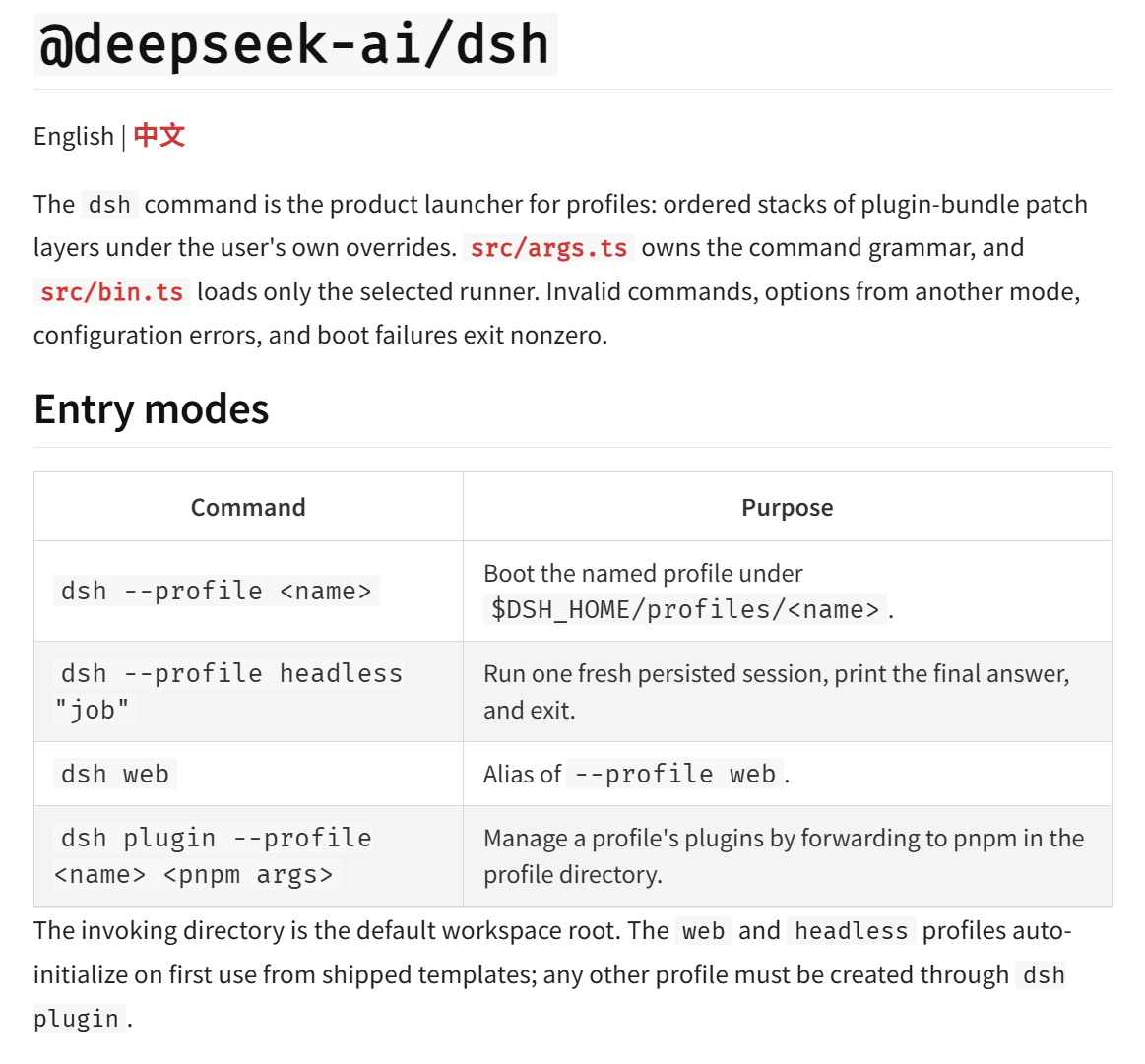
DeepSeek Harness (DSH) provides the dsh command-line tool for product configuration and startup. Its core command, dsh --profile <name>, is used to launch a specified configuration file. The tool supports multiple operating modes, including Web and Headless, and can be extended through a plugin mechanism.
DeepSeek-V4-Pro-0813 is a Mixture-of-Experts (MoE) model with a total of 1.6 trillion parameters, of which only 49 billion are activated for each token during inference. The model has a context window of 1 million tokens and supports a maximum output length of 384,000 tokens.
For interaction modes, V4 Pro offers “thinking mode” and “non-thinking mode,” with thinking mode enabled by default. In addition, V4 Pro fully supports advanced features including JSON structured output, Tool Calls, the Responses API, and the Anthropic API.
According to DeepSeek's internal evaluations, the official release represents a significant improvement over the preview version, approaching or even surpassing Claude Fable 5 in multiple tests. For example, it scored 87.9 in Terminal Bench 2.1, far above the preview version's 72.1. In other tests, DeepSWE rose from 12.8 to 62.7, while DSBench-Hard doubled to 67.2.
Notably, the weights of DeepSeek-V4-Pro-0813 have now been officially released. DeepSeek's weights are offered under the MIT license. This move has been interpreted as decoupling the model foundation from dependence on specific computing hardware: developers can download and deploy it themselves instead of relying on a single cloud service; domestic GPUs and general-purpose accelerator cards can run it directly without vendor customization. This lowers the barrier to private deployment for government and enterprise users while improving supply-chain resilience.