

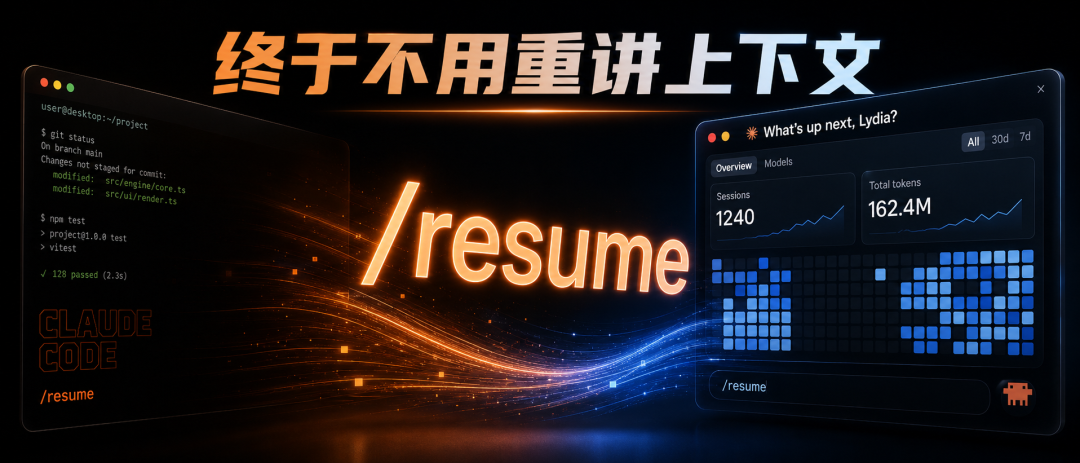
Work started in the terminal used to require starting over in another window. Today, that ends.
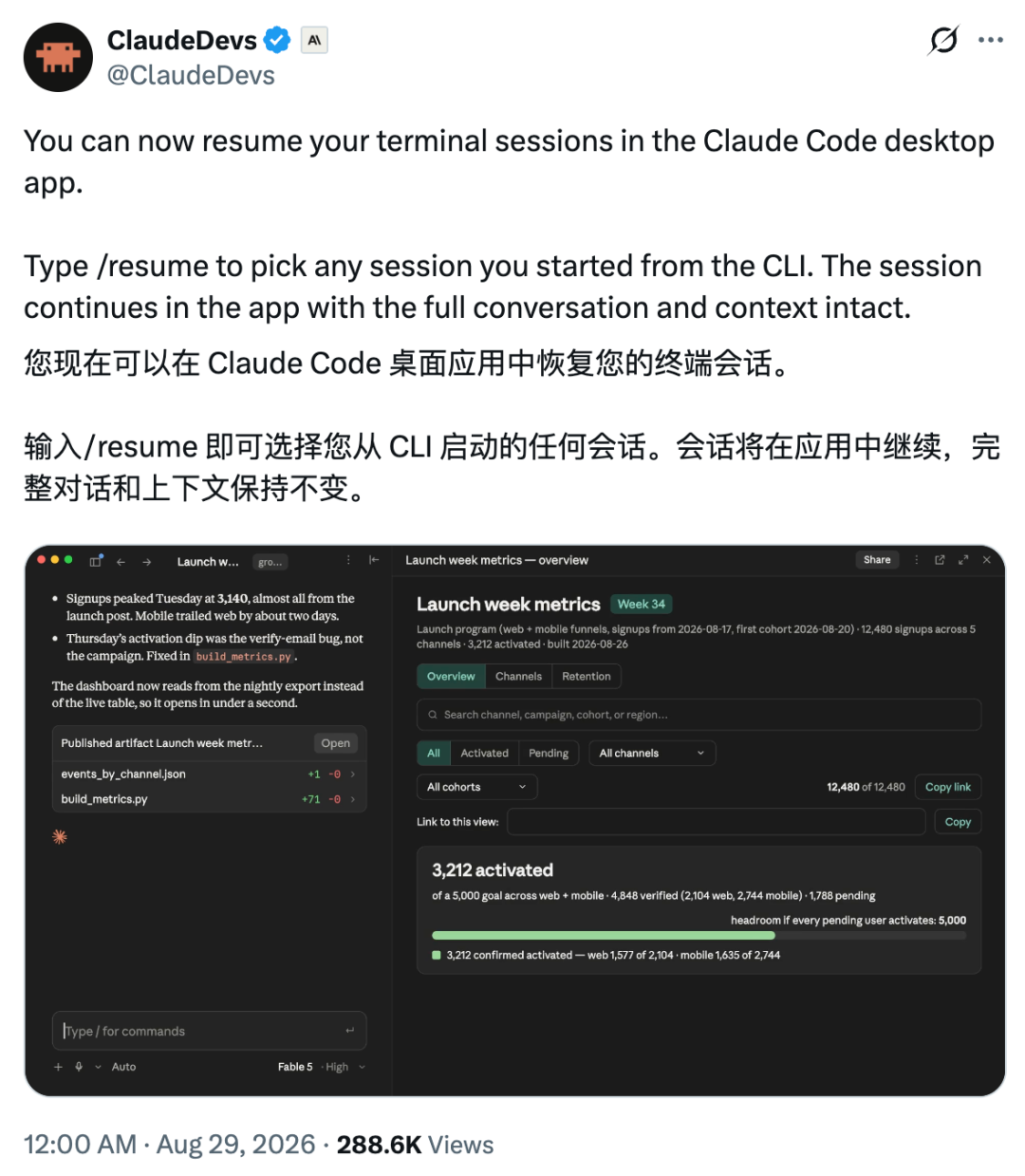
Just now, Anthropic announced that Claude Code desktop now connects with terminal sessions. Type /resume on desktop and a list of historical sessions appears. Click any work session previously opened in the CLI terminal, and it is brought over intact so you can continue on desktop.
The complete conversation history, code snippets, and all the context you previously worked out together are transferred without leaving anything behind.
Even more eye-catching was the Dashboard shown in the official demonstration video.
Lydia Hallie, an engineer on the Claude Code team, had 1240 sessions and 162.4M tokens, or 1.624 hundred million tokens.
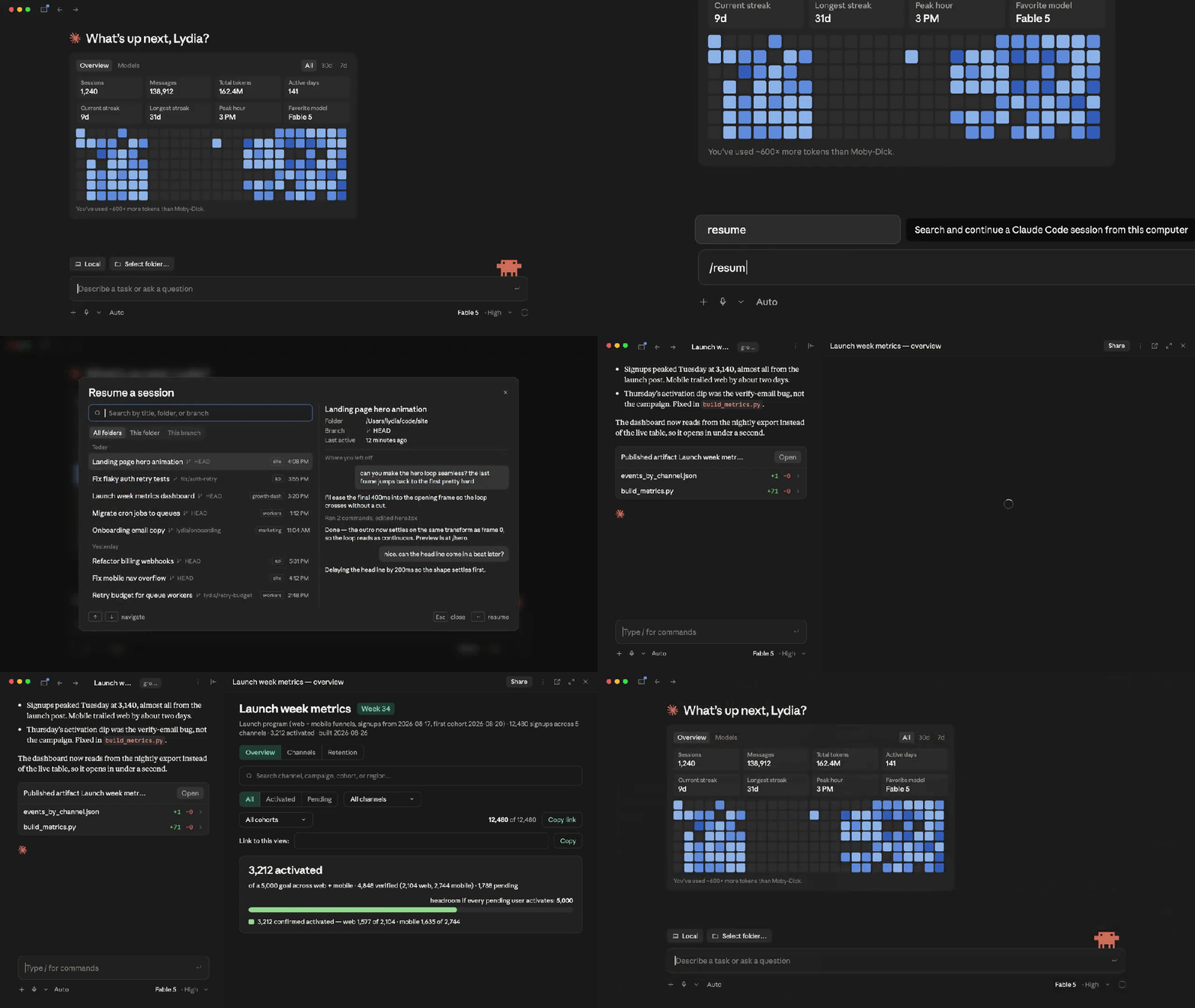
The people who build this tool have accumulated a substantial asset in their own sessions.
Yet before last night, even she was blocked by the walls between platforms.
The invisible tax paid every day
Anyone who spends time in Claude Code has paid this tax.
You start a task in the terminal and step away halfway through. The next time you want to switch to desktop and continue, you have to feed it the entire conversation all over again.
The project structure, approaches you already tried, and the conventions you had established with it all have to be explained again.
If the task has already gone through dozens of rounds of conversation, rebuilding the context often costs more than simply continuing the work.
Now, context starts following the person instead of being pinned to a single window.
The terminal itself has not had this problem for a long time. The command to resume a session has always been available, and session records are stored locally so they can be retrieved and continued at any time.
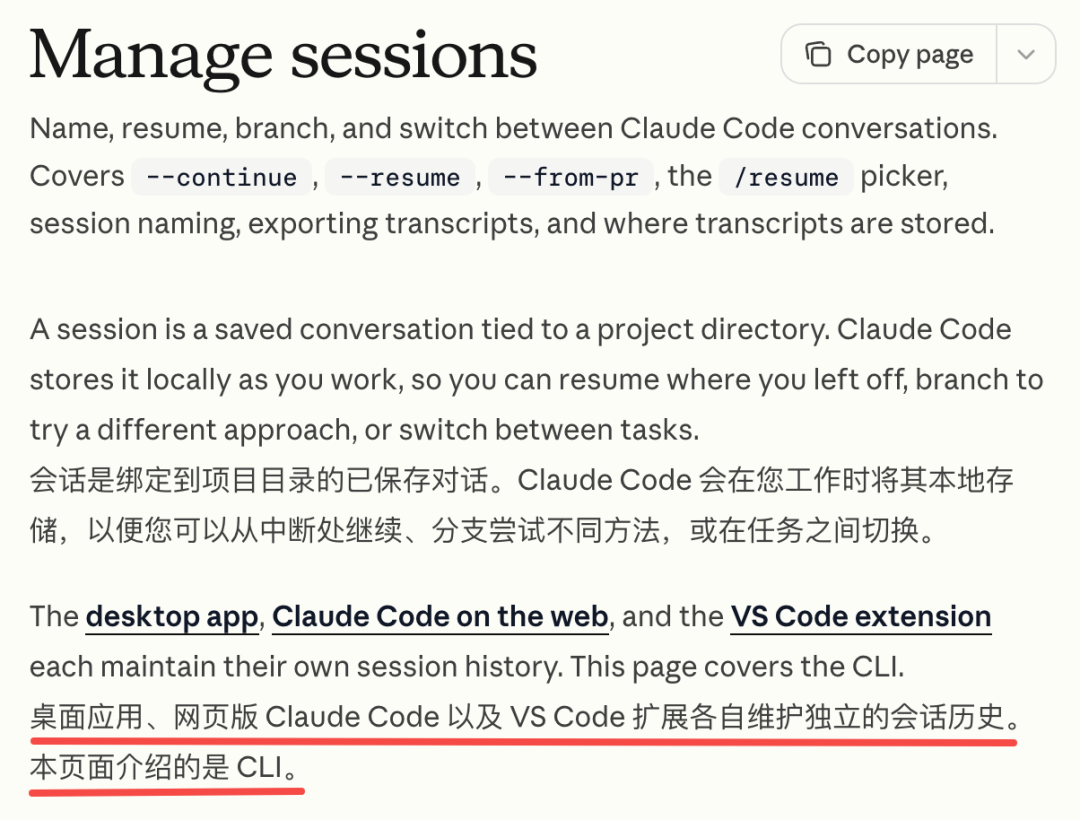
The desktop was the bottleneck. The official documentation is clear: desktop, Web, and VS Code each manage separate session histories and cannot see one another's. Work done in the terminal was completely unknown to the desktop app.
In April this year, someone formally requested the feature on GitHub: the terminal could resume sessions, but desktop did not even have a selector, so switching platforms meant losing context. The Claude Code team discussed how to address it at the time, but did not manage to implement it smoothly.
At the end of August, the official team finally added it.
The implementation is carefully designed. Half an hour after the announcement, Claude Code engineer Lydia Hallie posted an explanation that tied together the product logic.
The terminal already had /desktop, allowing the command line to hand the current session over to desktop. The new /resume works in the opposite direction: from desktop, you can retrieve sessions previously started in the CLI.
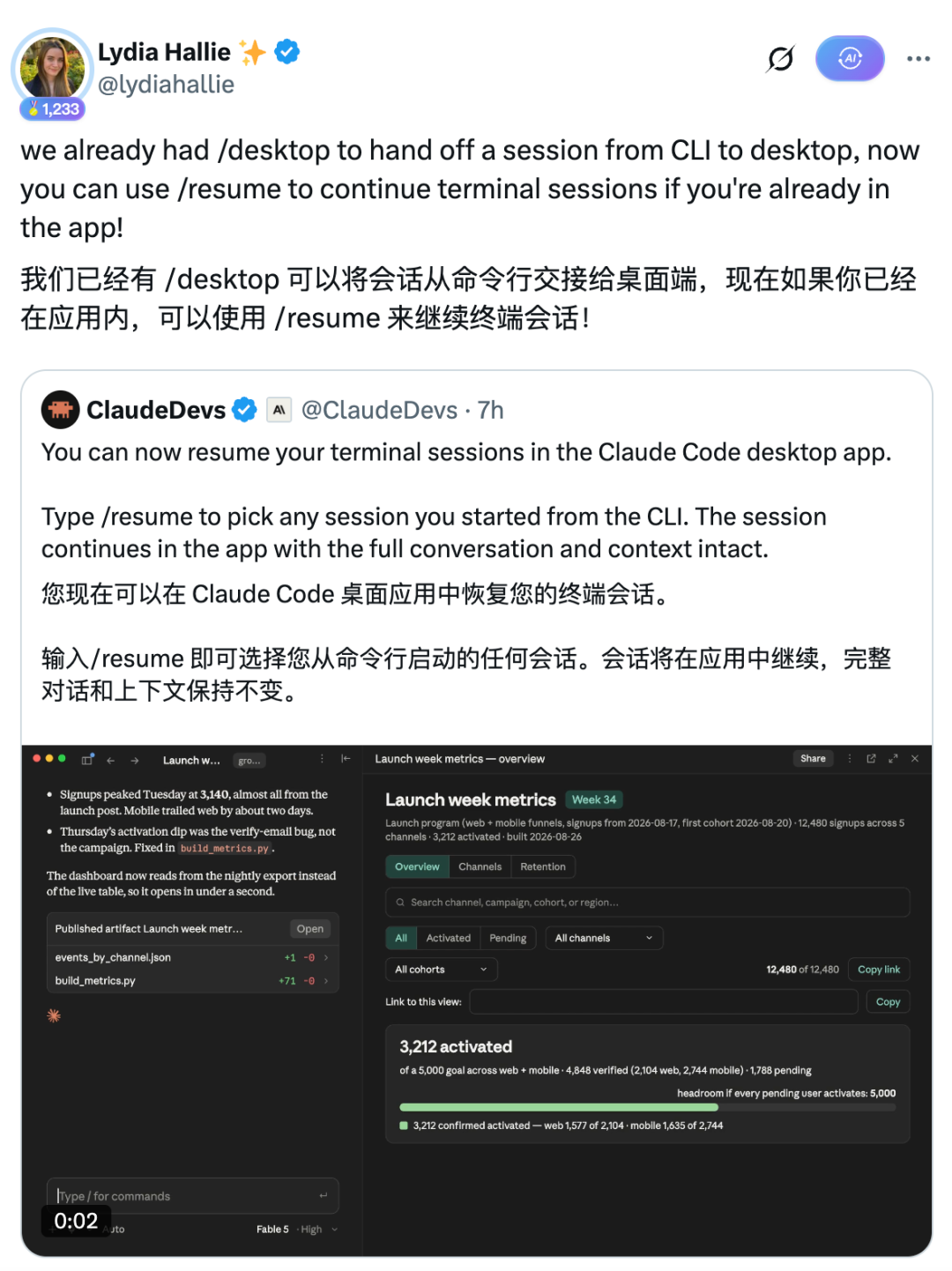
Handing off and retrieving sessions now work in both directions.
Retrieved sessions remain active. The checkpoint system works as usual, so you can still use /rewind to return to any previous step without worrying that taking over across platforms will damage the work already done.
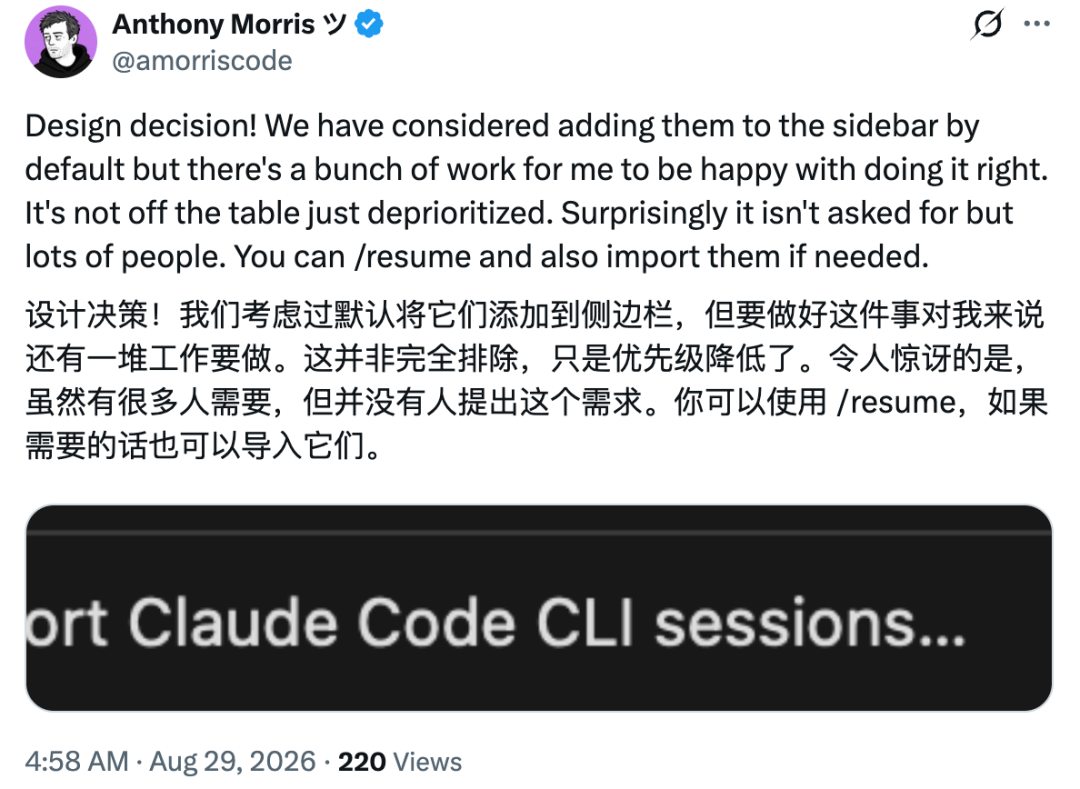
Claude Code engineer Anthony Morris also explained the team's deliberations: they had considered a simpler solution that would place terminal sessions directly in the desktop sidebar, but the interface was not yet satisfactory, so /resume is being used as an interim solution.
The more ideal solution has not been abandoned; it has simply been pushed back.
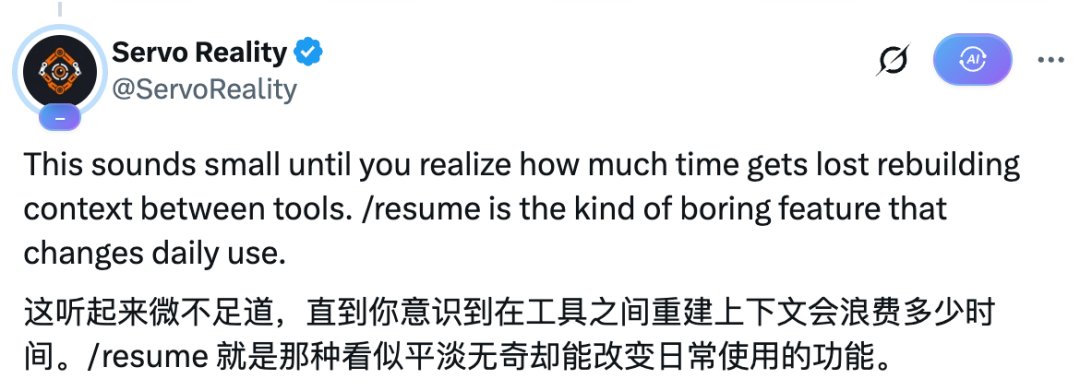
User @ServoReality put it most accurately: this sounds like a small thing until you realize how much time is wasted rebuilding context between different tools. /resume is the kind of boring feature that changes everyday use.
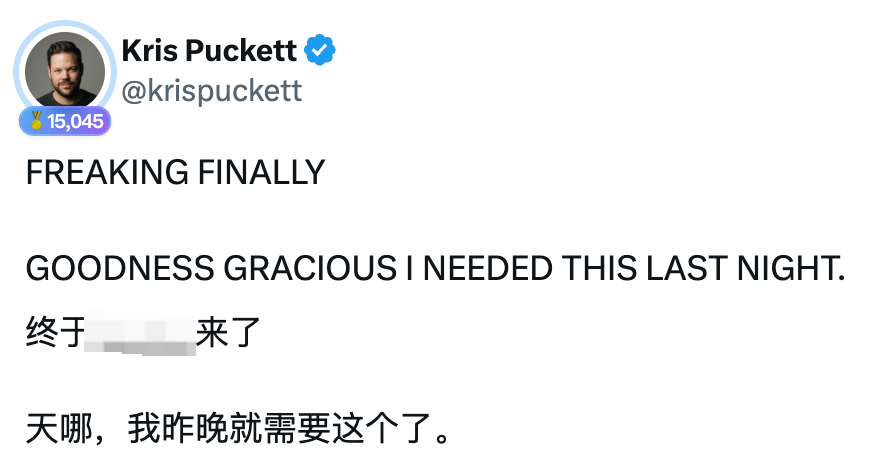
Stripe design manager @krispuckett had a more direct reaction.
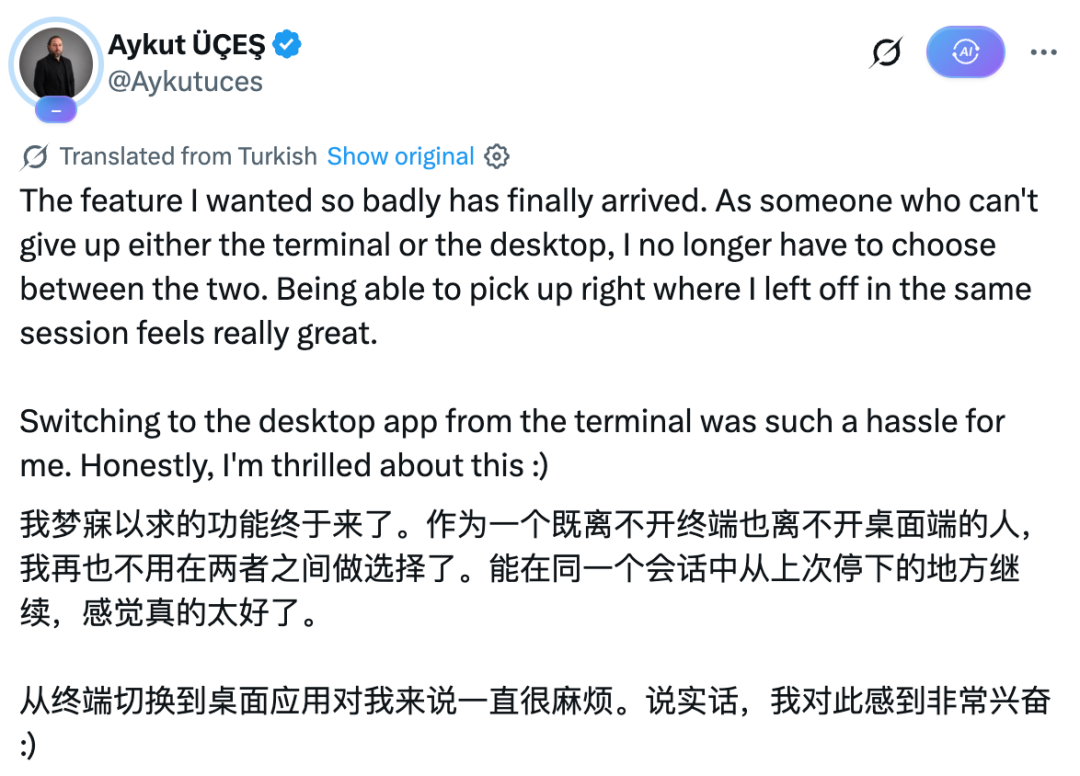
User @Aykutuces said that terminal and desktop finally no longer require choosing one over the other.
Looking at Anthropic's August updates together, /resume did not appear in isolation.
Earlier this month, Claude Code desktop added an automatic continuation feature: when the usage limit runs out, no one needs to stand by. Once the quota is restored, it resumes the work automatically.
It also fixed two bugs: conversation titles could mysteriously disappear after chatting for too long, and sessions older than 30 days were automatically deleted.
The direction is clear: sessions must not be lost, titles must not be lost, and the time spent waiting for a quota to return must not be lost either.
One blogger described it well: this is another step toward the desktop app becoming a control center. Once every session can be retrieved from desktop, it is no longer just a chat window.
For now, however, the connected sessions are all tasks started in the terminal. Whether they are pushed from the terminal or pulled from desktop, the sessions themselves were opened in the terminal.
What about sessions started from scratch on desktop? They cannot yet be moved back to the terminal. The community is already pushing for that capability.
But the direction is already clear.
In a tool like Claude Code, the most valuable thing is the context you build together with the model. It is harder to reconstruct than any individual file.
When the things you work out with the model can follow you, you have a conversation that can be picked up again at any time.
We have used the term “resume” for transferring files for two or three decades. Now it is beginning to transfer work.
References:
https://x.com/ClaudeDevs/status/2093368017304371503