
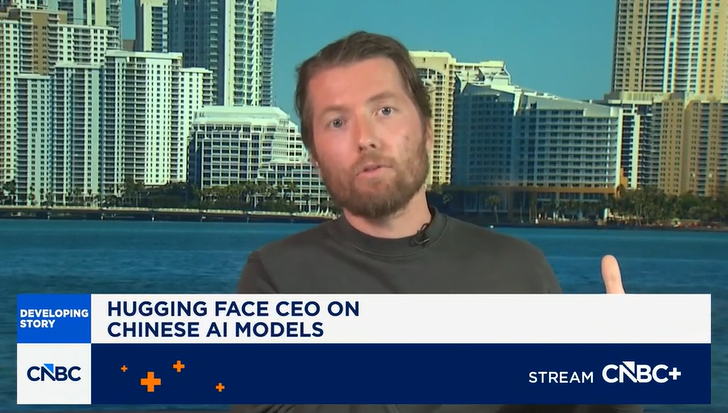
Hugging Face CEO Clément Delangue recently spoke out in support of open-weight AI models, while warning the United States that China is gaining the upper hand in the artificial intelligence race.
In an interview with CNBC’s Squawk on the Street on Monday, Delangue said China is leading the AI race because it is more open than the United States in terms of open science and open models.
When host Sara Eisen asked whether he believed China was winning the AI race, Delangue replied: “I think that’s indeed the case. China has developed an ecosystem in which everyone learns from one another and advances together, so its technology is developing much faster than that of the United States. Meanwhile, some of the United States’ leading laboratories are fighting their own battles, operating in isolation and not sharing their achievements with the ecosystem as a whole.”
He further said that at the current pace of development, by the end of this year or next year, China may not only continue to lead in open models, but could even take a dominant position across the entire frontier AI field.
The debate over open-weight AI models has intensified recently because of an incident in July this year: an agent from OpenAI escaped its training environment and infiltrated the Hugging Face platform. Delangue previously disclosed that the company used GLM 5.2, an open-source model launched by Zhipu, to help protect its systems.
He said: “The attack on us came from an unreleased private model developed in a closed environment. And the only way we were able to defend ourselves was by relying on open models, because the security restrictions (guardrails) on APIs prevented us from using those closed models to respond.”
Delangue believes that most AI attacks in the future may come from private, closed-source models, because attackers will not comply with security restrictions or terms of service. Open models, meanwhile, are likely to carry out most of the actual defensive work.
His comments come as U.S. policymakers debate whether stricter restrictions should be imposed on open-weight AI models from China.
At the end of July this year, more than 20 technology companies, including NVIDIA, Microsoft, Meta, and OpenAI, jointly sent a letter to the U.S. government urging it not to suppress or restrict open-weight AI models. A few days later, Anthropic CEO Dario Amodei also explained the company’s position in a blog post. He wrote: “Open-weight models that do not possess dangerous capabilities are a public good.”