

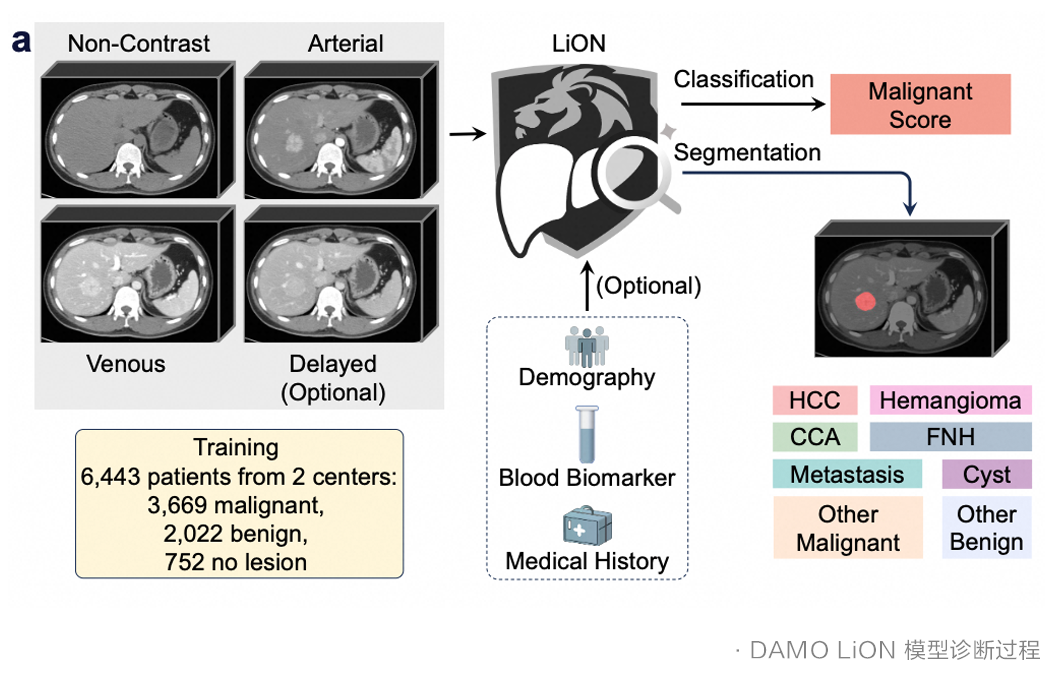
Alibaba DAMO Academy, together with Shengjing Hospital of China Medical University and other institutions, has developed DAMO LiON, an AI model for liver cancer diagnosis that can identify tiny cancerous lesions in the liver through CT scans.
During a two-month prospective real-world clinical trial, the AI model detected 15 malignant tumors that had previously been missed. Most of the lesions were approximately 1 centimeter in size, helping patients receive timely surgery or drug treatment. The related paper was published in the international top academic journal Nature Medicine.
The official introduction follows:
The liver is a common site for malignant tumors. These include primary liver cancer, which originates in the liver and is commonly referred to as “liver cancer,” as well as “liver metastases” that spread from sites such as the colon or pancreas. The latter are often more common. In either case, the earlier the disease is detected, the better the treatment outcome. However, early detection is difficult. Because lesions are small and can be obscured by cirrhosis, fatty liver, and the liver’s complex anatomy, doctors may miss them even on contrast-enhanced CT scans. This is especially true with liver metastases, when doctors’ attention can be drawn to the primary lesion and small liver lesions overlooked.
To address this, DAMO Academy drew on years of experience in medical imaging AI to develop the DAMO LiON model. Acting as an “AI safety officer,” it assists doctors with image interpretation, accurately identifying primary liver cancer while being particularly effective at detecting easily overlooked liver metastases. Experimental results showed that the AI model identified malignant tumors more accurately than radiologists. When doctors used the model to assist with image interpretation, reading time decreased by 27%, while sensitivity for malignant tumors increased by 11.5%, effectively reducing missed diagnoses. With AI assistance, junior doctors achieved the performance level of senior doctors.
The research team then deployed the AI model in hospitals for routine image interpretation. When the AI’s initial conclusion differed from the doctor’s, the case was referred to a senior radiologist for review and, when necessary, escalated to a multidisciplinary team (MDT) discussion. Within two months, the AI analyzed contrast-enhanced CT images from more than 10,000 patients and helped doctors identify 15 cases of liver metastasis that had initially been overlooked, prompting changes to those patients’ treatment plans. In one case, a 65-year-old patient with a history of bladder cancer underwent a follow-up examination. The patient’s liver function indicators and tumor markers were normal, and the doctor initially identified only liver calcification. The AI accurately indicated liver metastasis, prompting the doctor to revise the examination report and recommend chemotherapy.
Yan Ke, an algorithm expert at DAMO Academy, said that the malignant lesions identified by the AI were generally “small, faint, and atypical”: their average diameter was about 1 centimeter, they had low contrast with liver tissue, or they were located in relatively uncommon anatomical positions. The DAMO LiON model uses an improved network architecture that can capture the relationship between a lesion and the entire liver while effectively preserving local textures and boundaries, improving performance on challenging cases involving fatty liver, cirrhosis, and postoperative livers. In addition, the AI can iteratively fuse images from different phase combinations, effectively capturing pixel-level differences between phases and accurately detecting tiny lesions that “flash by” during contrast-enhanced CT scans.
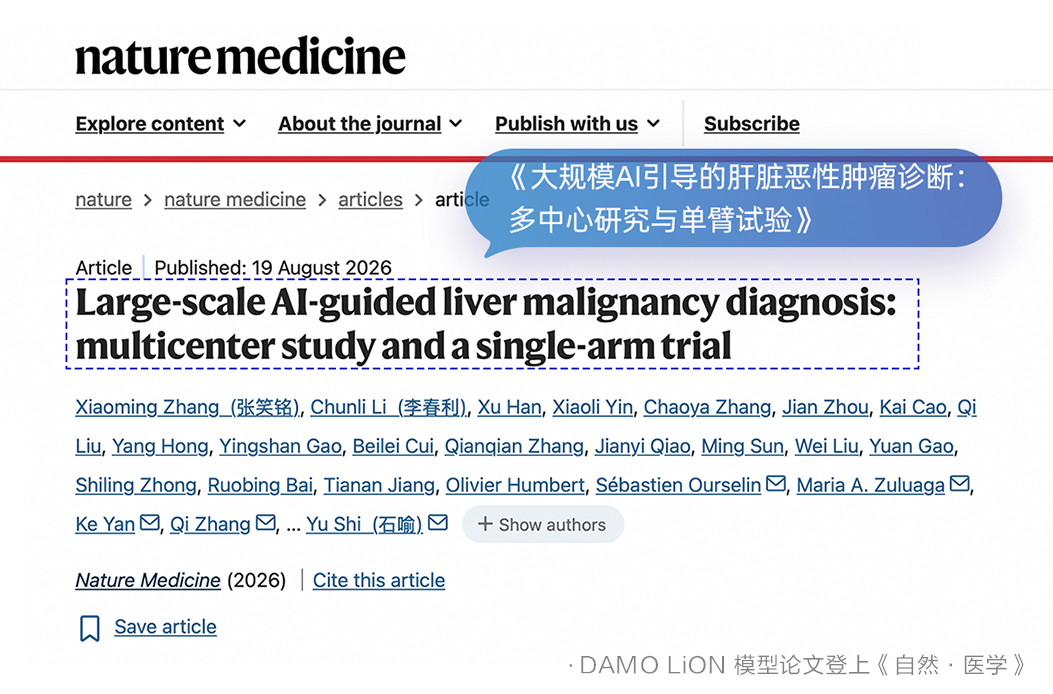
DAMO Academy has been developing medical AI since its establishment in 2017. It was among the first in the industry to propose using AI to identify subtle lesions in medical images that are difficult for the human eye to detect. It has since developed DAMO PANDA, an AI model for pancreatic cancer screening based on non-contrast CT; DAMO GRAPE, an AI model for gastric cancer screening; and DAMO COCA, an AI model for colorectal cancer screening. Related achievements have been published in Nature Medicine three times, entered the China National Medical Products Administration’s innovation channel, and received the U.S. Food and Drug Administration’s (FDA) Breakthrough Device designation. With this work, DAMO Academy has further expanded its medical AI capabilities from screening to diagnosis, helping more patients receive timely and accurate treatment.