

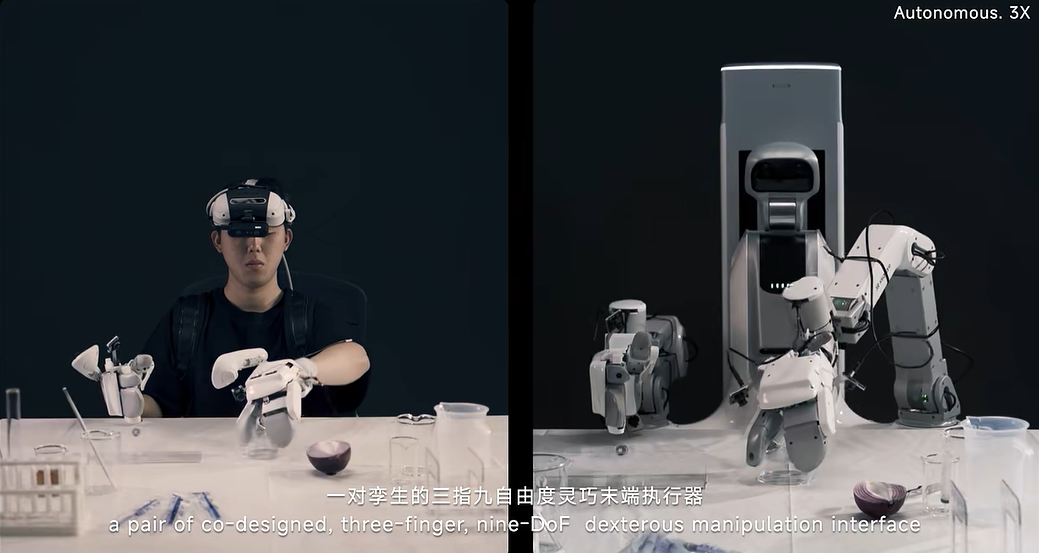
Embodied robotics company Zizai Robotics today launched a pair of twin three-finger, nine-degree-of-freedom dexterous manipulators, TwinDEX.
According to the company, one dexterous manipulator is wearable and used for data collection, while the other is installed on a robot for real-robot deployment. This marks the first implementation of dexterous operation driven entirely by non-embodied data, with zero real-robot teleoperation data.
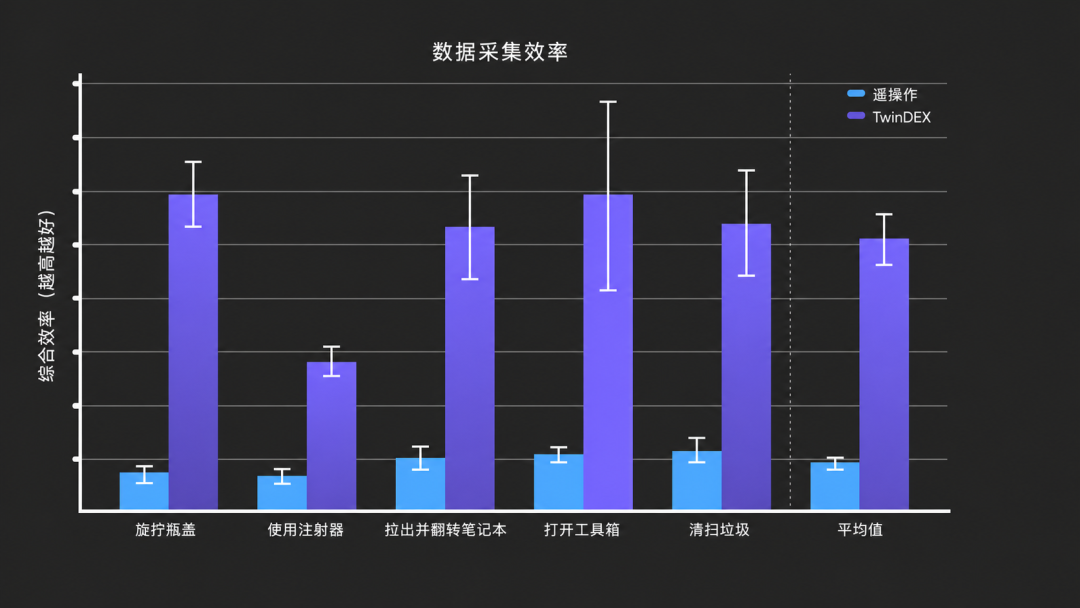
Evaluations show that TwinDEX's non-embodied data collection efficiency is 5.3 times that of real-robot teleoperation. When training models, non-embodied data can almost 100% replace real-robot teleoperation data.
The company says this reshapes the embodied intelligence industry's understanding of the “data pyramid.” In the past, real-robot teleoperation data was considered the most valuable and the most difficult to scale because it contained rich physical interaction information. TwinDEX innovatively maintains consistency between the collection and execution ends, while combining a complete data processing pipeline with a model training workflow, enabling non-embodied data to achieve training results comparable to real-robot data. This means dexterous-operation training is no longer entirely constrained by costly real-robot data. A new viable path has emerged for collecting non-embodied data at scale and improving robot capabilities.
The company's detailed introduction follows:
Reverse Engineering Solves the Dexterous-Operation Challenge: Three Fingers Can Handle Complex Tasks
For dexterous operation to truly scale, the hand must be dexterously designed, non-embodied data must efficiently train models, and data collection must be scalable. With these three goals in mind, TwinDEX was designed around dexterity, consistency, and scalability.
In terms of dexterity, TwinDEX uses a three-finger, nine-degree-of-freedom design, seven of which are active, balancing dexterity, reliability, and cost. Based on tests covering a variety of primitive operations, Zizai Robotics found that the thumb, index finger, and middle finger can work together to complete most operations in everyday scenarios, representing the “minimum viable solution” for dexterous operation. With a sufficiently capable foundation model, it can handle a wide range of complex tasks.
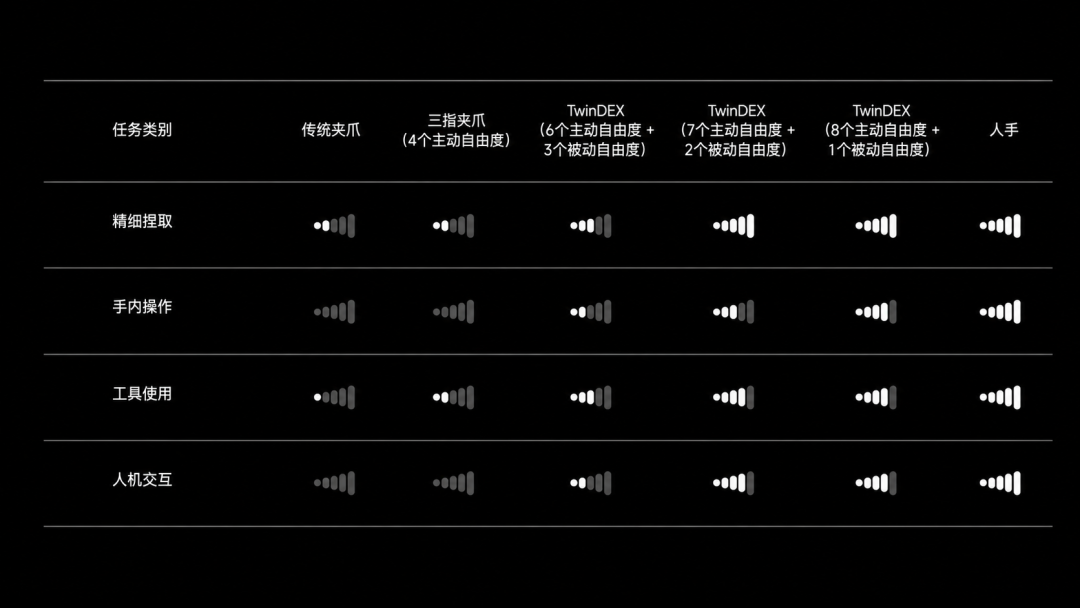
Consistency is the key to using non-embodied data directly for robot policy learning. Cross-body data collection often involves kinematic differences and precision loss between the collection and execution ends, making the data difficult to transfer directly and requiring real-robot data for alignment or fine-tuning. TwinDEX instead targets “pure non-embodied data training,” using final application performance as its anchor and reverse-engineering the consistency metrics required at the collection end.
Specifically, it maintains consistency in degrees of freedom, joint axes, and link proportions at the kinematic level; consistency in contact materials, geometry, and surface characteristics at the contact-mechanics level, together with corresponding tactile sensors; and visual consistency in appearance. It also optimizes key precision metrics involving joints, wrist positioning, jitter, and drift. On this basis, Zizai Robotics further improves the policy's tolerance for acceptable errors through targeted model and training-strategy design, reducing the impact of residual differences between the collection and deployment ends on task performance.
For scalability, TwinDEX uses a wearable three-finger exoskeleton as its collection end, freeing data collection from the robot body and fixed environments. “One operator, one table, and one exoskeleton make up a complete data collection unit.” The exoskeleton provides intuitive force feedback, helping operators perform natural and precise contact tasks. Its modular collection method supports parallel expansion by adding devices and operators, so data volume is no longer limited by the number of robots or fixed facilities.
Data Collection Efficiency Increased 5.3x; Non-Embodied Data Can Fully Replace Real-Robot Data
In the past, non-embodied data usually had to be combined with real-robot data to compensate for missing real-world physical information. Today, the industry is beginning to explore using non-embodied data directly for policy training and robot execution. TwinDEX improves both the collection and utilization efficiency of non-embodied data.
For data collection, real-robot teleoperation is constrained by the number of robots, available space, and equipment operating time, making rapid expansion difficult. TwinDEX can collect data in parallel by adding wearable collection devices and operators. In relevant tasks, TwinDEX achieved an hourly data collection efficiency 5.3 times that of real-robot teleoperation.
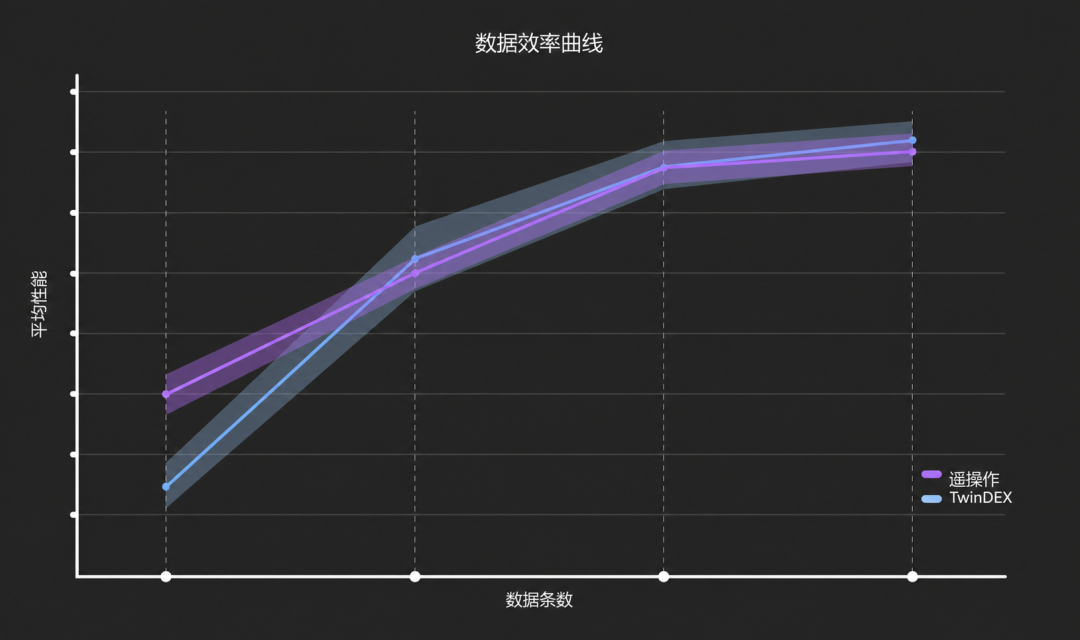
For data utilization, Zizai Robotics found on a multitask benchmark that policies trained on the two types of data improved at the same rate as data volume increased and eventually converged, meaning that non-embodied data can almost 100% replace real-robot teleoperation data in training effectiveness. In other words, real-robot teleoperation data is no longer essential for training dexterous operation. Easier-to-collect non-embodied data can achieve comparable training results, providing a new path toward scaling dexterous-operation data.
Breaking the “Impossible Triangle” of Dexterous Operation, Making Emergent Intelligence Within Reach
The data challenge in dexterous operation has long involved an “impossible triangle”: data quality, dexterity, and scalability are difficult to achieve simultaneously. High-precision teleoperation data offers high quality and strong dexterity but is expensive to collect. Low-cost collection is easy to scale but often struggles to maintain data quality. Five-finger systems offer a higher operational ceiling, but their hardware costs also increase, making large-scale collection difficult.
TwinDEX has achieved the combination of all three for the first time worldwide: by maintaining a high degree of consistency between the collection and execution ends in kinematics, contact mechanics, and visual appearance, it delivers dexterous operation while preserving data quality and raising data collection efficiency to more than five times that of real-robot teleoperation.
This means non-embodied data can now replace real-robot data for training challenging dexterous operations. Next, Zizai Robotics will further expand the data scale, moving from a single tabletop to open environments and from fixed scenarios to long-tail distributions, providing richer and more diverse data sources for robot-model training. TwinDEX's wearable, non-embodied, distributed collection architecture is the infrastructure built for the next stage of scaling.
Zizai Robotics believes that when non-embodied data can be continuously produced at scale and lower cost and repeatedly transformed into robot capabilities, the scale of dexterous-operation data will cross a critical threshold, making the emergence of higher-level intelligence truly within reach.