

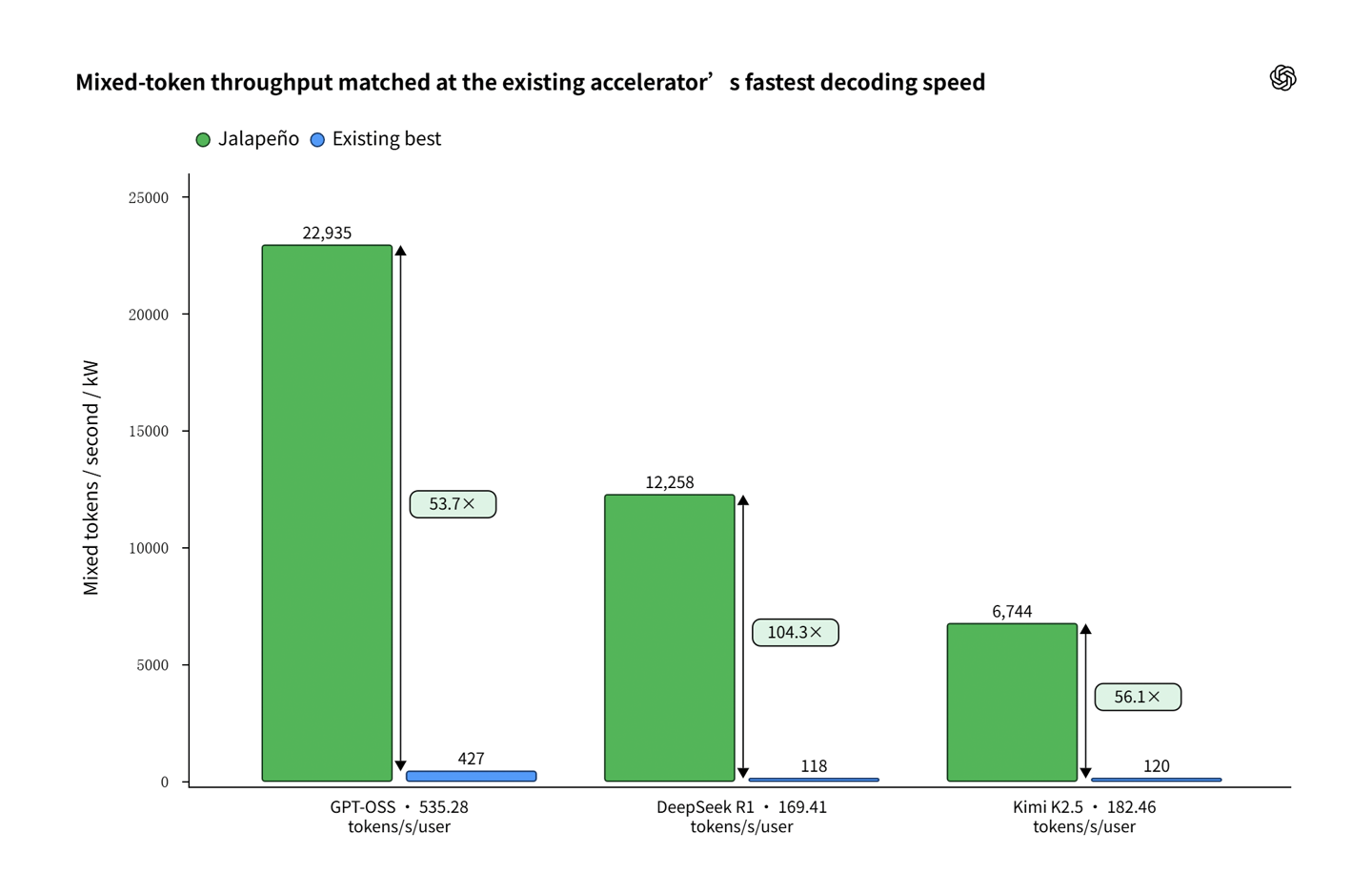
Yesterday (August 25), OpenAI published a blog post showcasing its first self-developed Jalapeño chip, stating that it outperforms today’s leading inference processors in both single-user token processing and throughput per kilowatt.
In the official blog post, OpenAI used InferenceX, a public benchmarking tool developed by semiconductor research firm SemiAnalysis, to test three models: GPT-OSS 120B, DeepSeek R1 670B, and Kimi K2.5 1T.
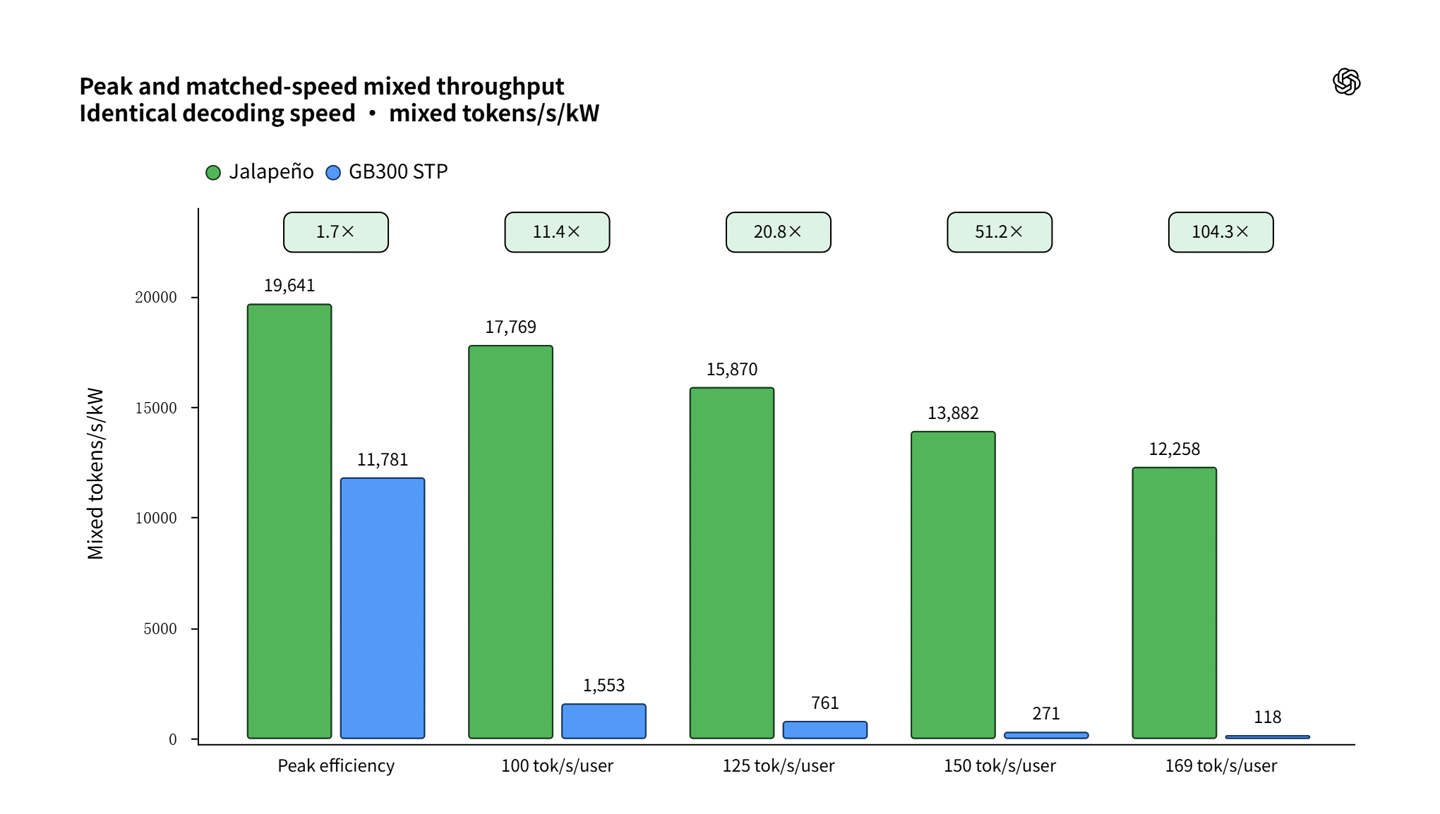
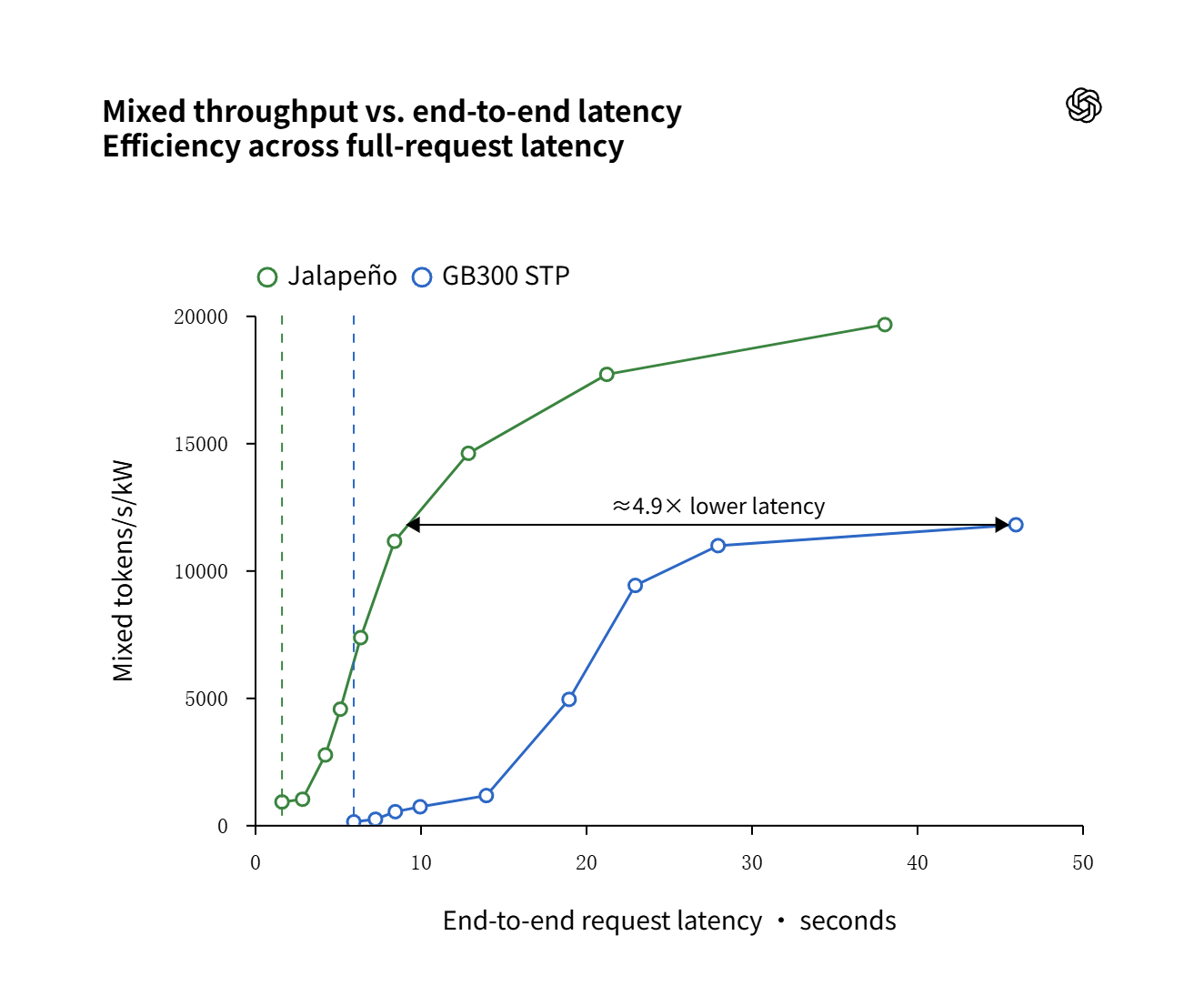
Tests show that compared with leading AI systems on the market, namely GB200 and GB300, it delivers 1.5 to 1.9 times the AI throughput per watt of the comparison systems, while end-to-end latency is approximately 28% to 59% that of the comparison systems.
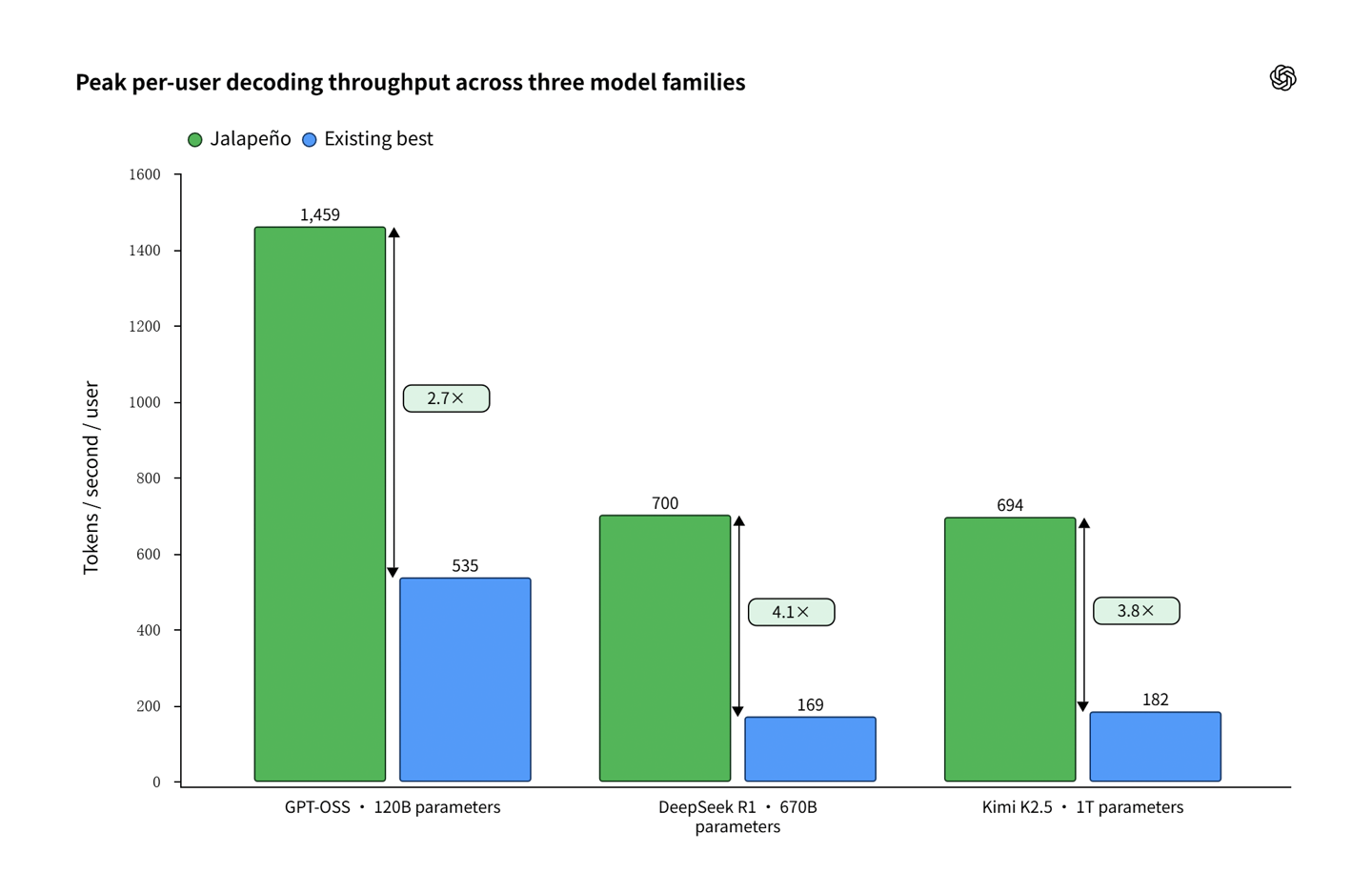
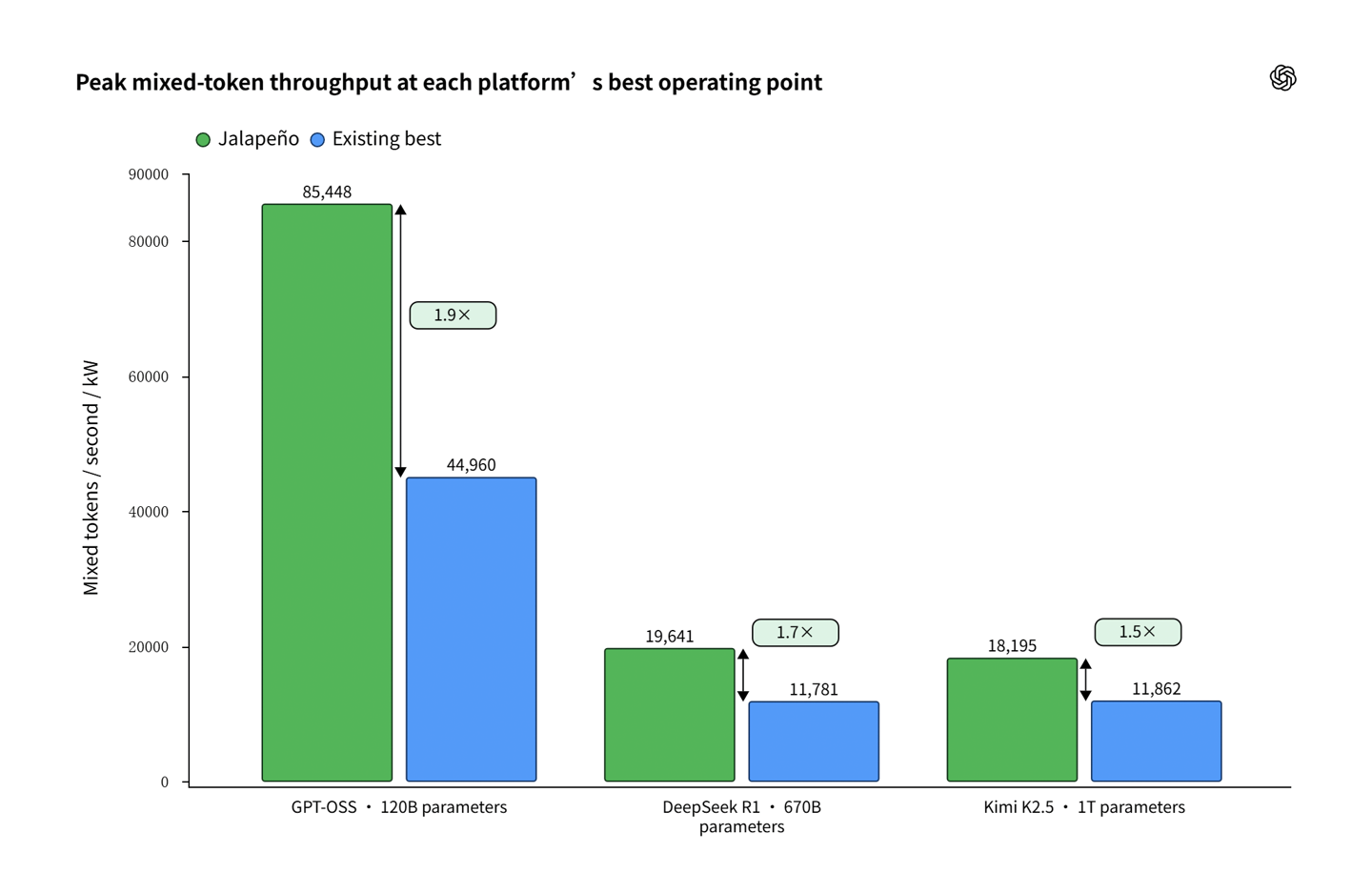
OpenAI said that when running GPT-OSS 120B, Jalapeño delivers approximately 1.9 times the peak throughput per kilowatt of a GB200 system.
On DeepSeek R1, its performance per watt is approximately 1.7 times higher than GB300’s; on Kimi K2.5, its performance per watt is approximately 1.5 times higher than GB300’s. Jalapeño has a rated power of 700 watts, but its sustained power consumption remained at or below 550 watts during the test workloads. The relevant images are shown below:
Jalapeño is OpenAI’s first self-developed AI inference chip, jointly developed by OpenAI and Broadcom and manufactured by TSMC using a 3nm process. It was first publicly showcased on June 24, 2026. The chip is an ASIC (application-specific integrated circuit) that uses a systolic array architecture and features HBM high-bandwidth memory. It is designed specifically for large language model inference and is not intended for model training. Neither the chip nor its supporting server systems will be sold externally; they are for OpenAI’s internal use only, with the goal of reducing its GPU procurement and computing operation costs. OpenAI hardware chief Richard Ho led the chip’s development. He previously worked at Google for nearly nine years and was a core engineer on the Cloud TPU project. From architectural design to tape-out, Jalapeño took only approximately 9 months. OpenAI called this one of the fastest ASIC development cycles ever in the field of high-performance advanced semiconductors. OpenAI’s own AI models also participated extensively in the chip design process, helping accelerate design optimization. The second-generation Jalapeño chip has now entered the late development stage and is expected to complete tape-out within the next few months. Conceptual design of the third-generation chip has also begun. OpenAI plans to deploy Jalapeño on a small scale by the end of 2026 and gradually expand deployment in 2027. It is worth noting that this Jalapeño test compared it with NVIDIA’s GB200 and GB300 systems; it has not yet been benchmarked against NVIDIA’s latest-generation Vera Rubin chip. OpenAI said NVIDIA remains an important partner and that it will continue using a multi-supplier strategy to meet its massive computing needs.