
Google DeepMind published a blog post yesterday (July 30), announcing the Gemini Robotics ER 2 model, its most powerful embodied reasoning model for robots.
In terms of positioning, the model can be viewed as a robot’s “advanced brain,” coordinating tasks such as communicating with humans, understanding the physical world, and planning multi-step tasks. The model will subsequently delegate tasks to lower-level vision-language-action (VLA) models and oversee their completion.
In terms of functionality, compared with the previous 1.6 version, the Gemini Robotics ER 2 model enables robots to track their own progress by continuously watching video, make adjustments when problems arise, and accurately determine when to proceed to the next step. The model can also natively call Google Search or developer-defined functions.
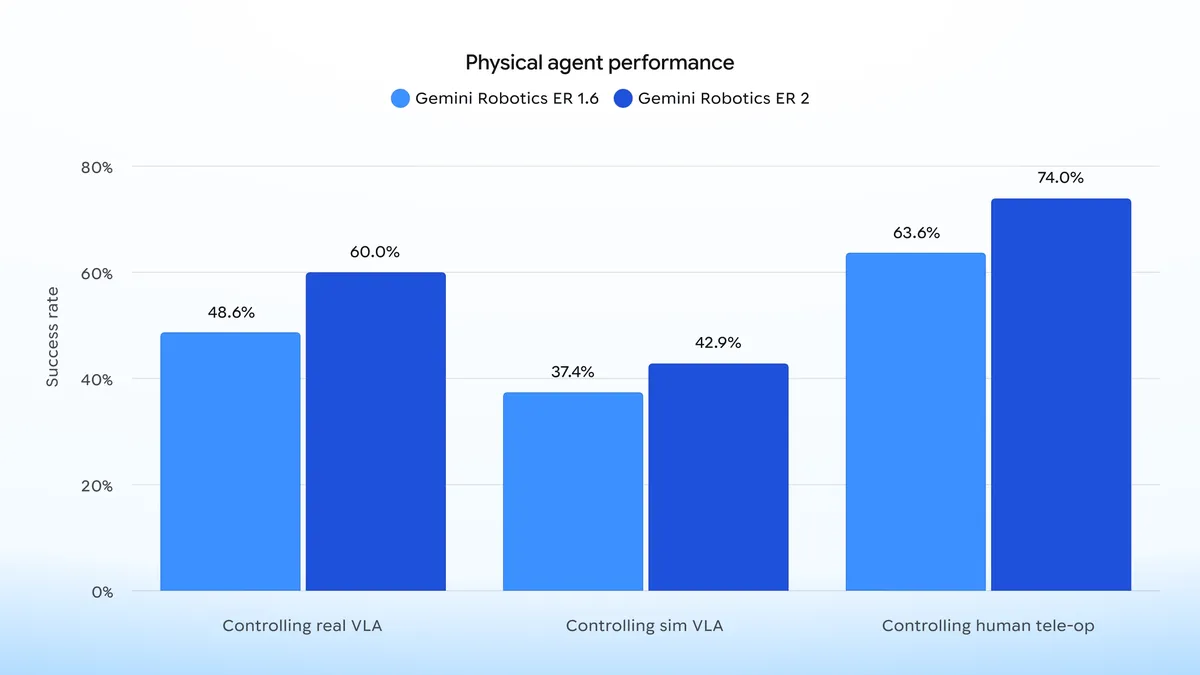
For physical agents, while a robot is executing a task, the Gemini Robotics ER 2 model can simultaneously reason about subsequent steps, reducing the pauses caused by the traditional robotic cycle of “stop — think — act again.” The model connects to the bidirectional streaming endpoint of the Gemini Live API, targeting latency-sensitive robotic tasks.
Compared with Gemini Robotics ER 1.6, ER 2 can analyze continuous video streams. Robots can use this capability to track their own task progress, adjust or retry when an action goes wrong, and determine when to move on to the next step.
In task-progress classification tests, Gemini Robotics ER 2 achieved an accuracy of 57.4%. This capability can help robots correct failed steps without restarting the entire workflow.
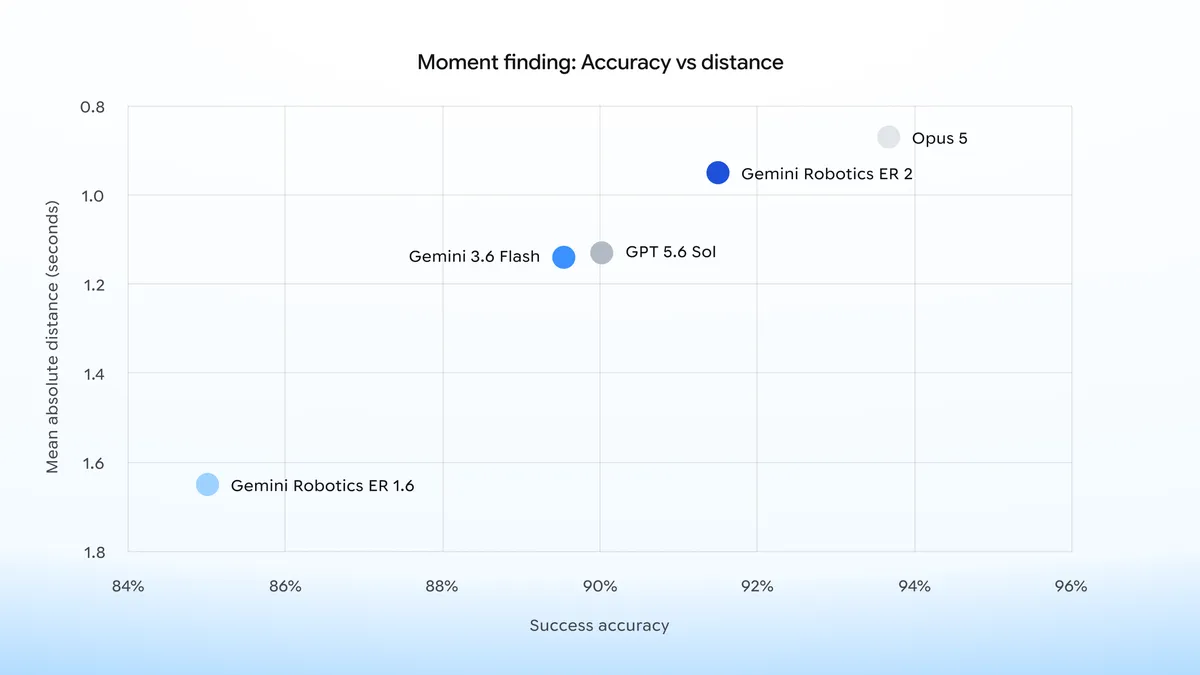
In moment-finding tests, the model must identify the precise video frame in which a key event occurs, such as determining when to stop pouring coffee into a cup. ER 2 achieved an accuracy of 91.3%, with a mean absolute temporal error of 0.96 seconds.
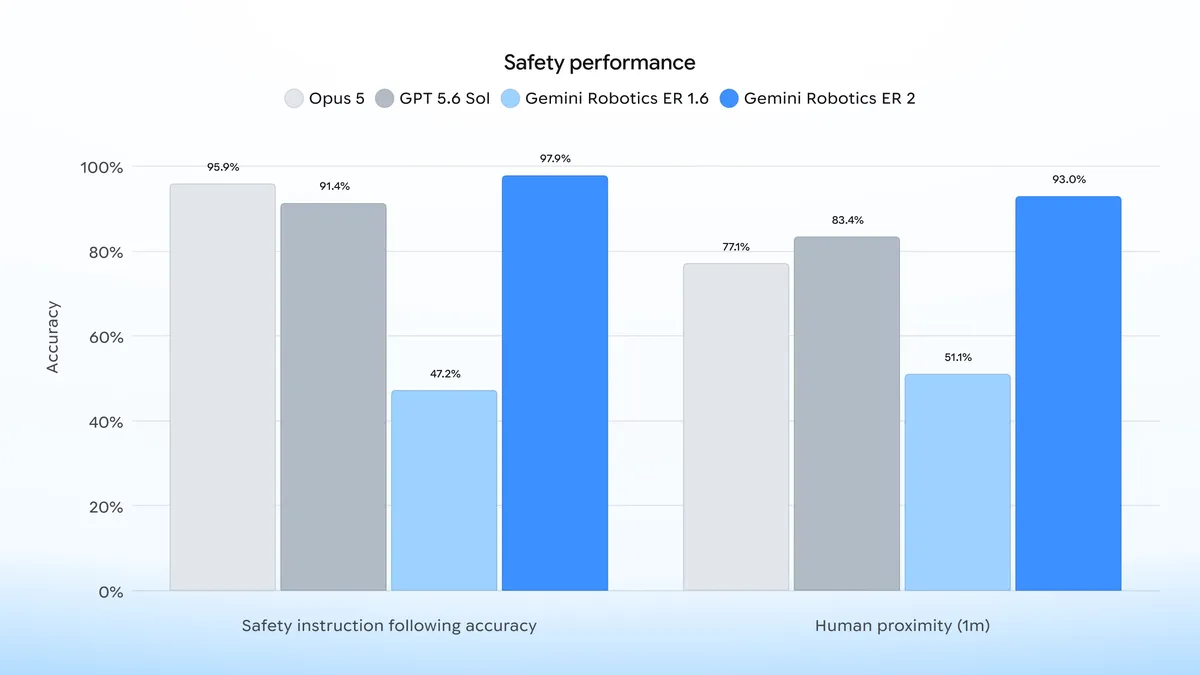
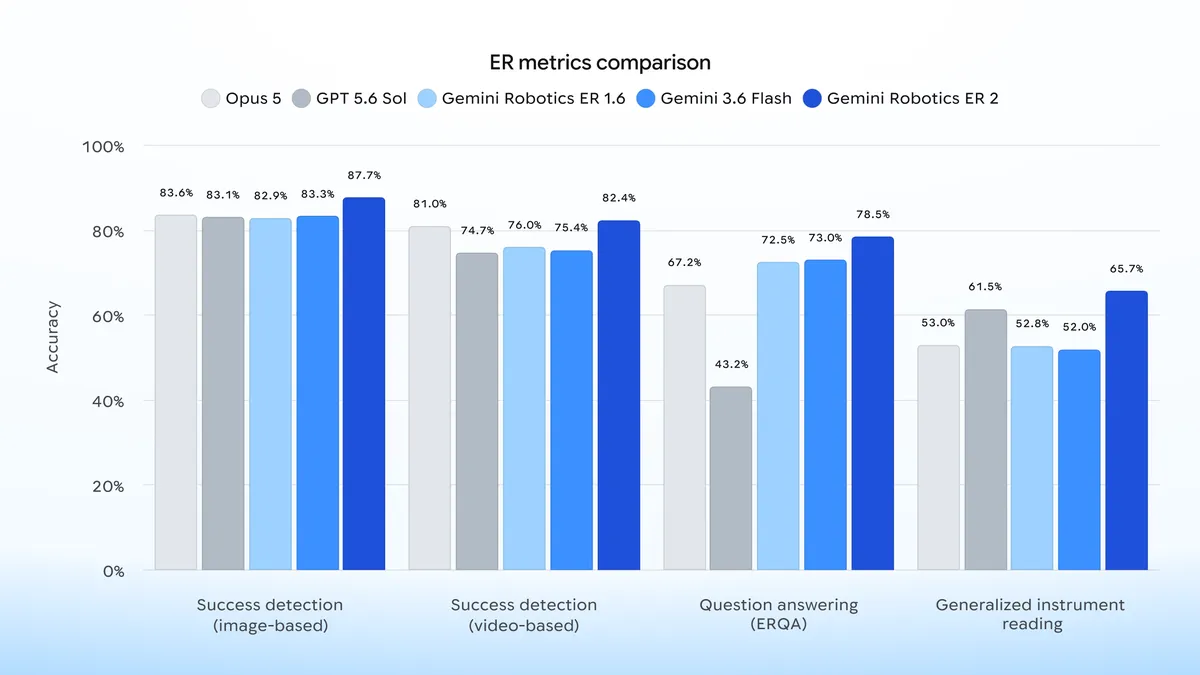
Google says the model achieves accuracy close to that of larger model classes at a lower computational cost, runs 4 times faster, and meets the sub-second latency requirements for safe operation in real-world robots.
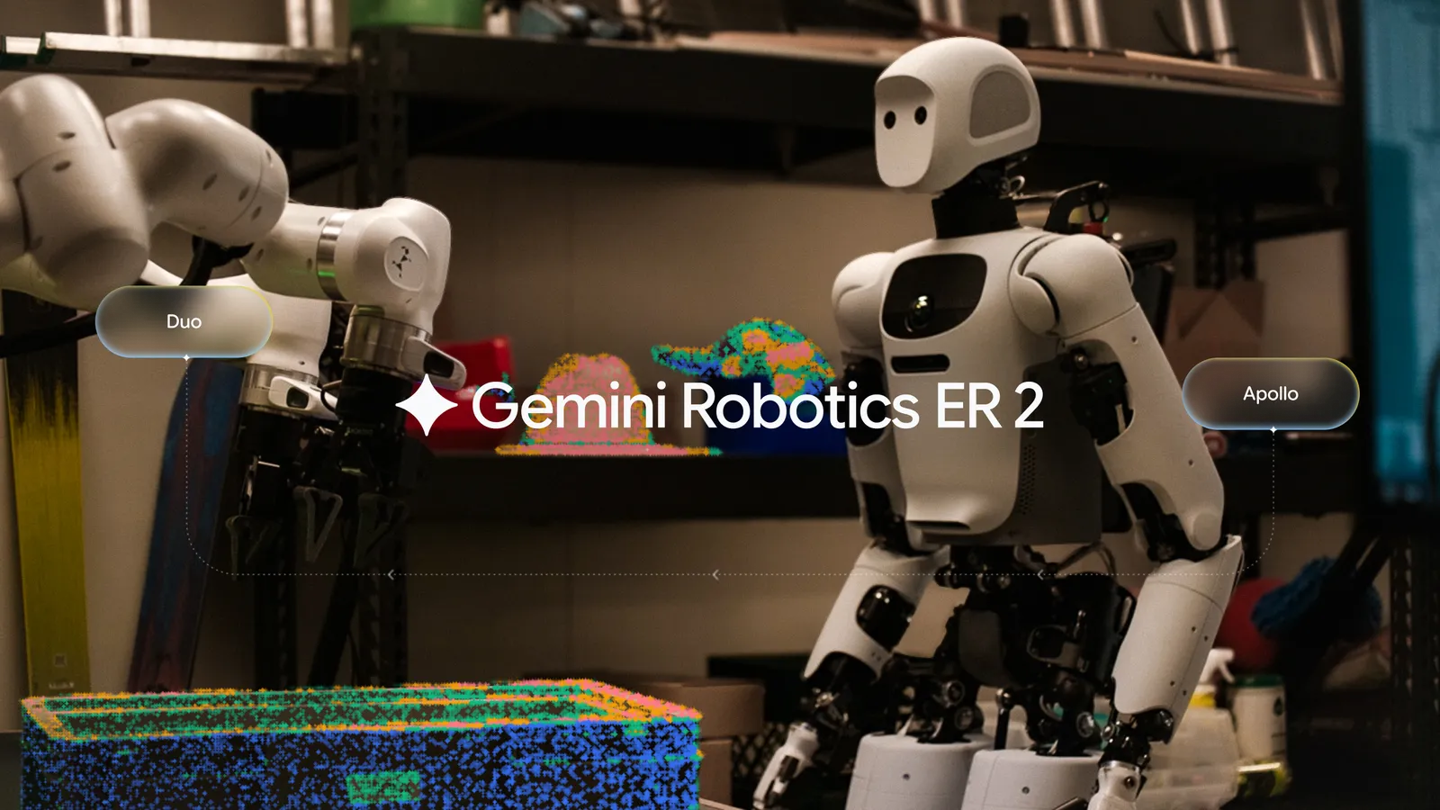
ER 2 also supports multi-robot collaboration. Different types of robots can communicate and hand off tasks through shared semantic understanding, completing complex workflows that would be difficult for a single device to accomplish independently. Google demonstrated a collaboration case involving Apptronik’s Apollo 2 and Franka’s FR3 Duo.
Gemini Robotics ER 2 is now publicly available to developers through the Gemini API and Google AI Studio; it is also available in private preview on the Gemini Enterprise Agent Platform. Google has also released sample code for model configurations and prompts.