

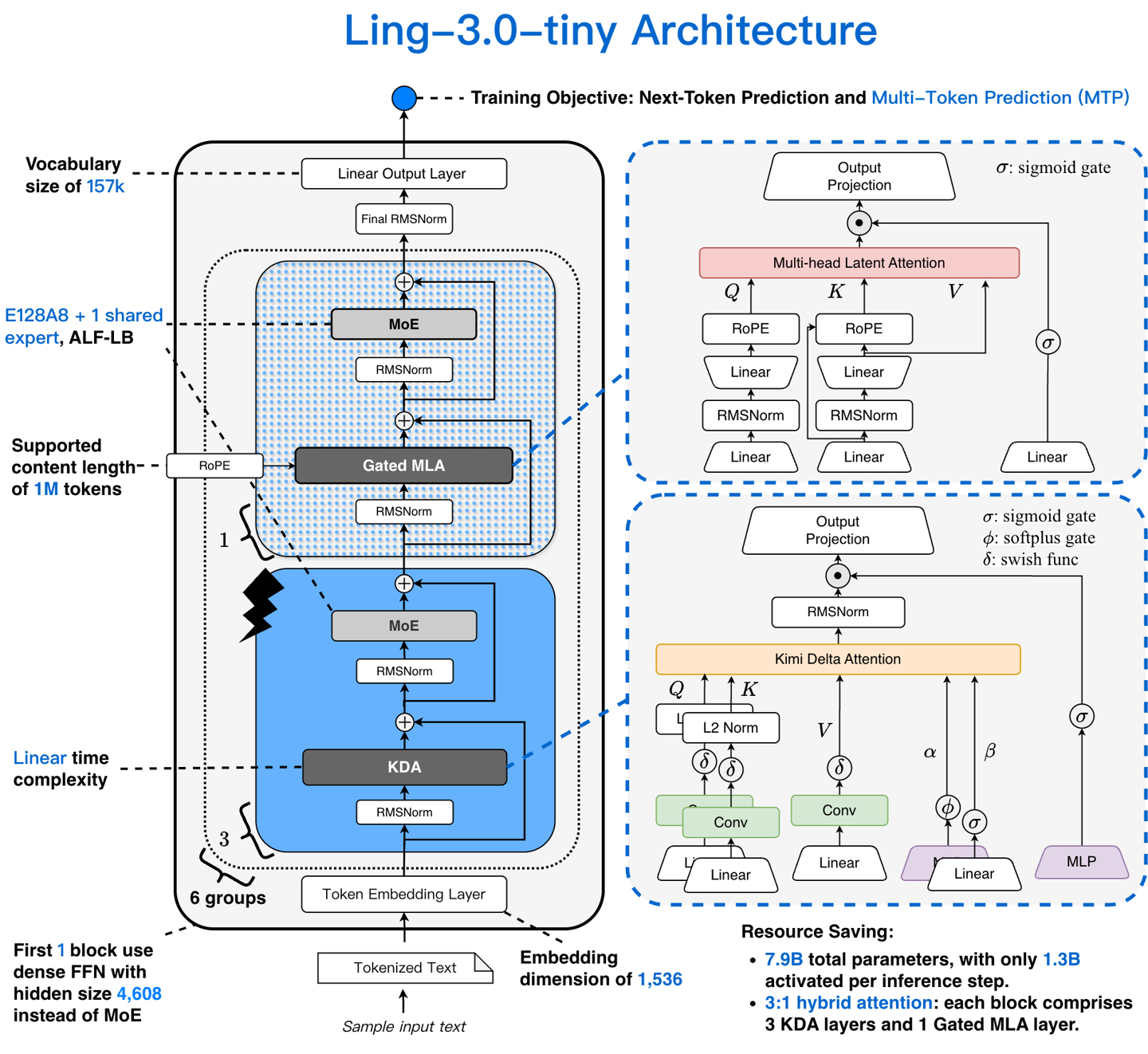
Ant Group's Bailing today open-sourced the Ling-3.0-tiny model on Hugging Face. The model uses a lightweight hybrid reasoning MoE architecture, with 7.9B total parameters and 1.3B parameters activated per token. Officially provided weight versions include BF16, FP8, and INT4 to meet the deployment needs of different platforms.
According to the introduction, Ling-3.0-tiny focuses on low-cost inference and uses an efficient hybrid linear architecture that alternately stacks KDA (Kimi Delta Attention) and MLA (Multi-Head Latent Attention) at a 3:1 ratio. It uses a sparse MoE feed-forward network (FFN) containing 128 routed experts, balancing context-processing capability and computing costs.
The model supports both fast-response and multi-step reasoning modes and is designed for local deployment. It has been officially validated on computers including the NVIDIA DGX Spark, Apple Silicon MacBook, and Mac mini. On an M4 Pro MacBook, it can achieve an inference speed of approximately 86-90 Token/s, with peak memory usage of about 8.34 GiB at an 8K context length.
Reference:
inclusionAI/Ling-3.0-tiny · Hugging Face