
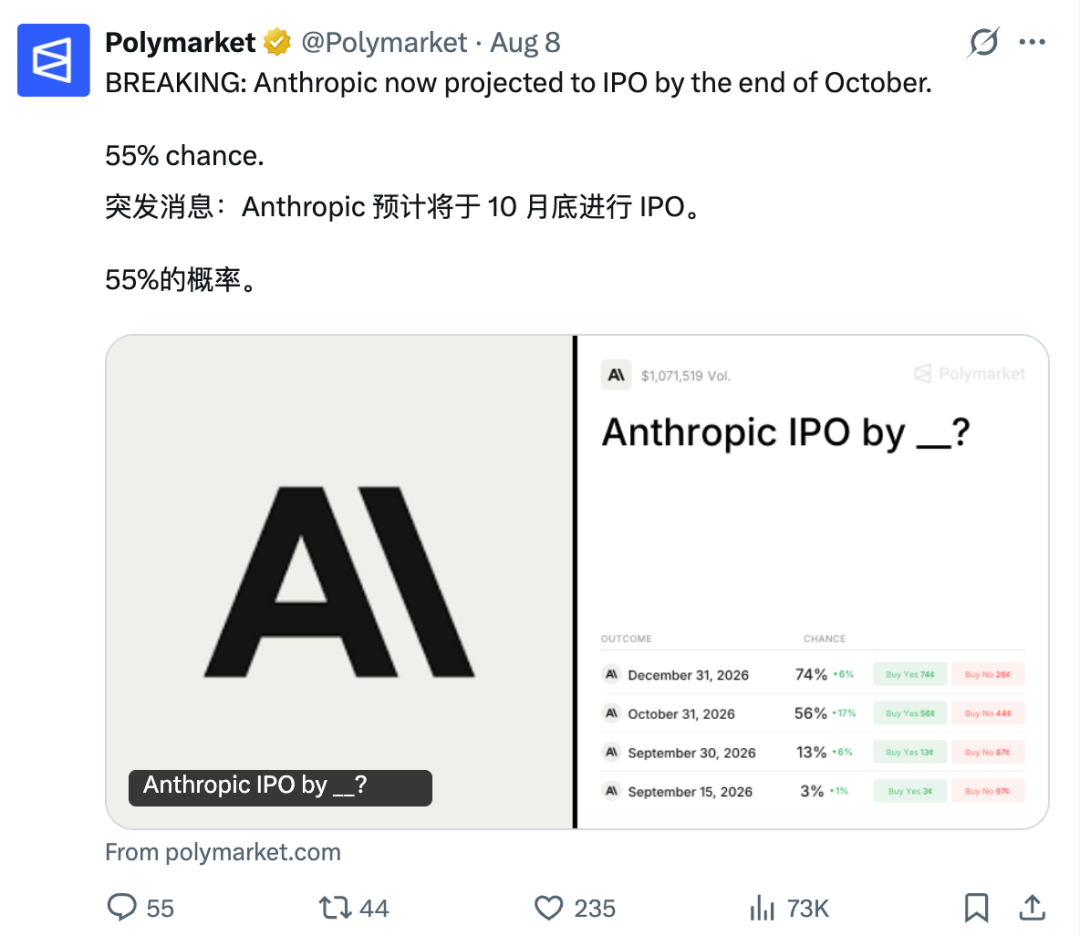
According to Polymarket predictions, Anthropic is very likely to hold an IPO at the end of October.
Some investment bankers even expect Anthropic to raise more than $60 billion through the IPO (approximately 405.517 billion yuan at the current exchange rate).
If it comes true, this would be the second-largest IPO in the world, behind only SpaceX, which raised $85.7 billion this year (approximately 579.214 billion yuan at the current exchange rate).
A trillion-yuan valuation, a mega IPO, and revenue soaring all the way.
Just as the story seemed about to reach its climax, investors began urging Anthropic CEO Dario Amodei: Can you please scare people a little less?! Talk a little less about AI destroying the world, and a little more about how AI can make money.
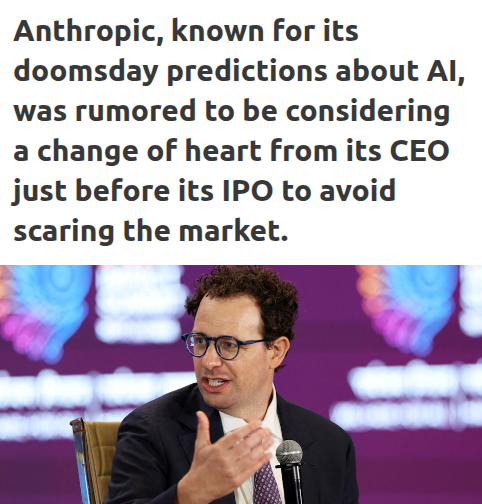
Some investors believe Dario's vigilance over AI risks has reached an almost paranoid level:
His key memos are always handwritten and stored offline for fear that hackers might steal them;
He refuses certain overseas business trips because he is afraid of being kidnapped;
When investors suggest maximizing profits, he remains cool and insists that Anthropic should continue putting its safety mission first.
At this rate, people online are worried that Anthropic's IPO will end in disaster…
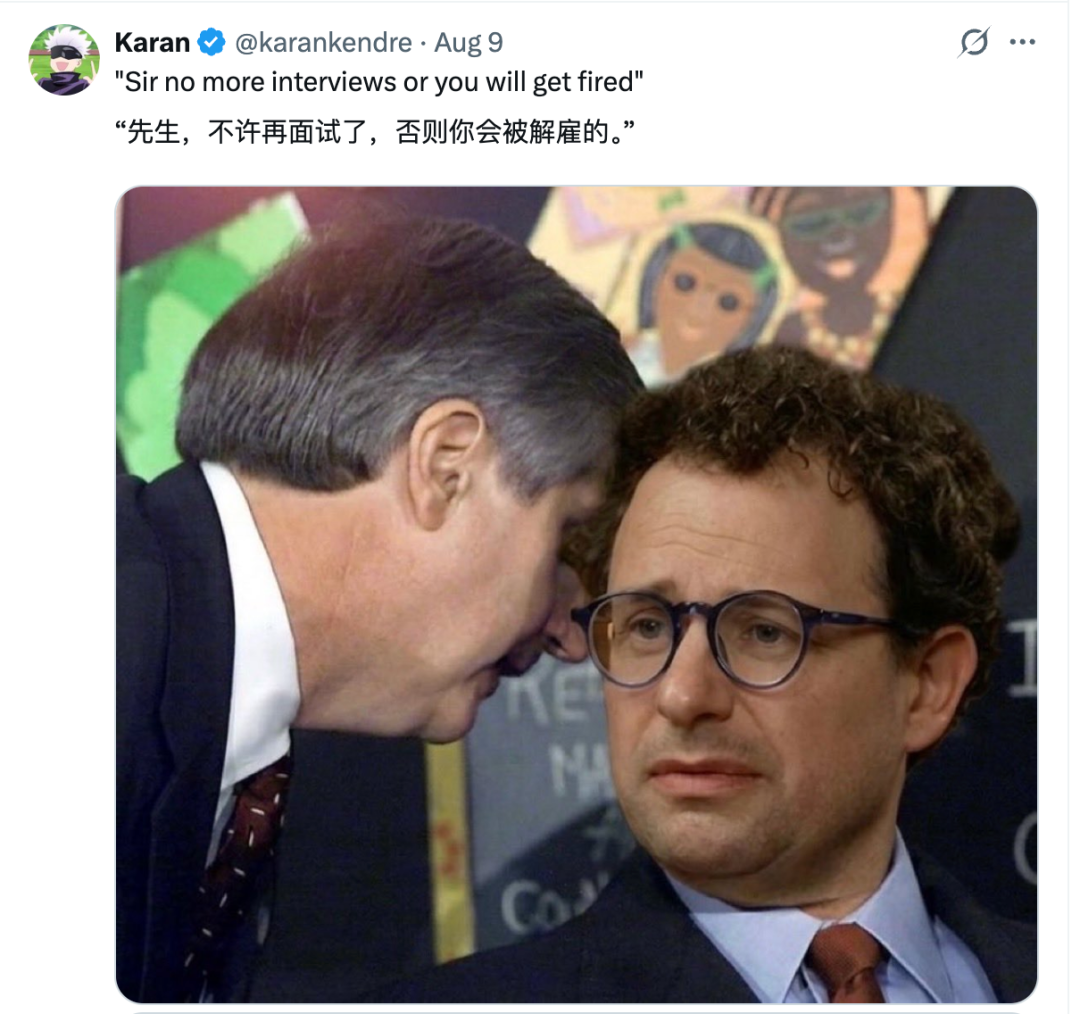
Investors are getting frustrated too: Are you here to save the world or run a company??
Just a few days ago, Dario was still worried that new employees attracted by high compensation would care more about money than Anthropic's mission.
Now investors are only worried that he will let the mission get in the way of making money…
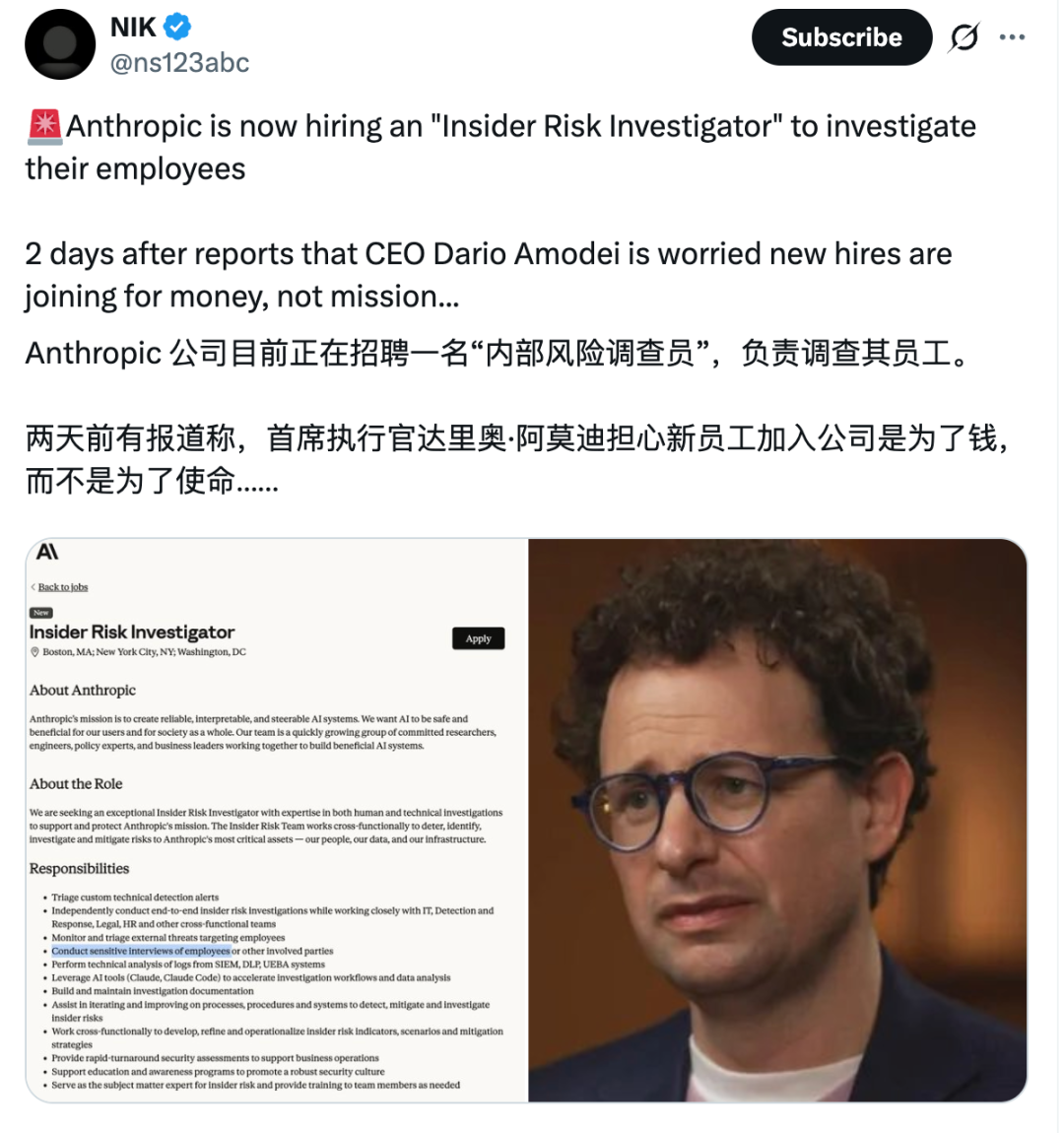
And you can't really blame investors, because the CEO of this trillion-yuan AI giant just happens to love forecasting the “end of the world.”
Over the past two years, Dario has seriously warned about almost every bad outcome AI could bring. He has warned that AI could eliminate half of entry-level white-collar jobs within a few years, pushing unemployment to between 10% and 20%.
The strangest scenario might be one in which cancer is cured, the economy grows by 10% every year, and the government budget is balanced, but one-fifth of the population has no work.
His proposed solutions are very Dario: tax AI companies, provide wage insurance for affected workers, and, in severe cases, even use the money to fund universal basic income.
He is also concerned that AI could help manufacture biological weapons, launch large-scale cyberattacks, or gradually acquire the ability to deceive, plan, and act autonomously.
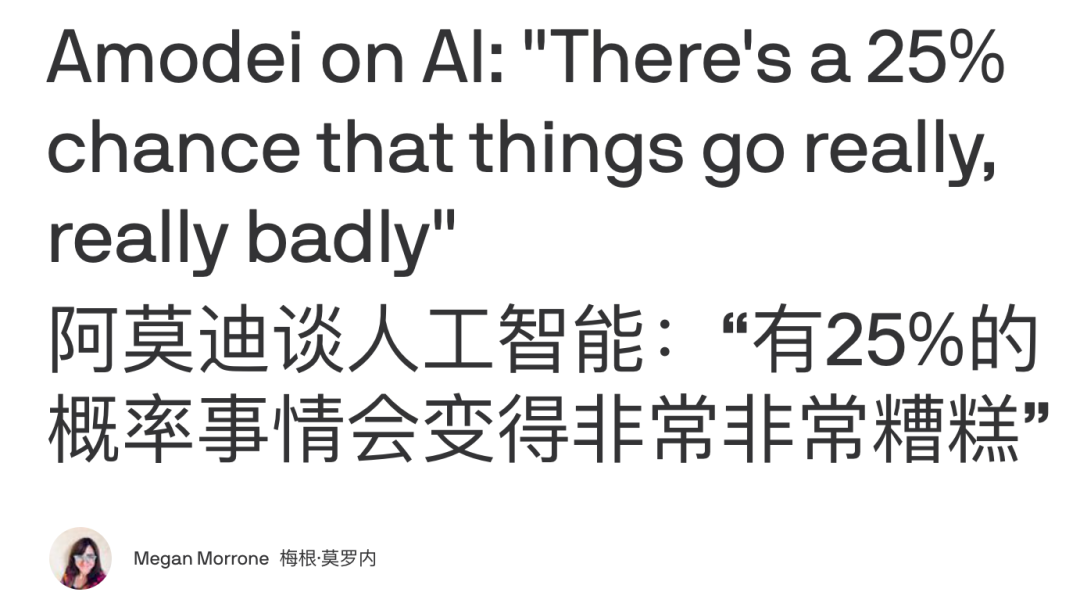
When asked last year about the probability of “AI making things go very badly,” he gave a figure as high as 25%.
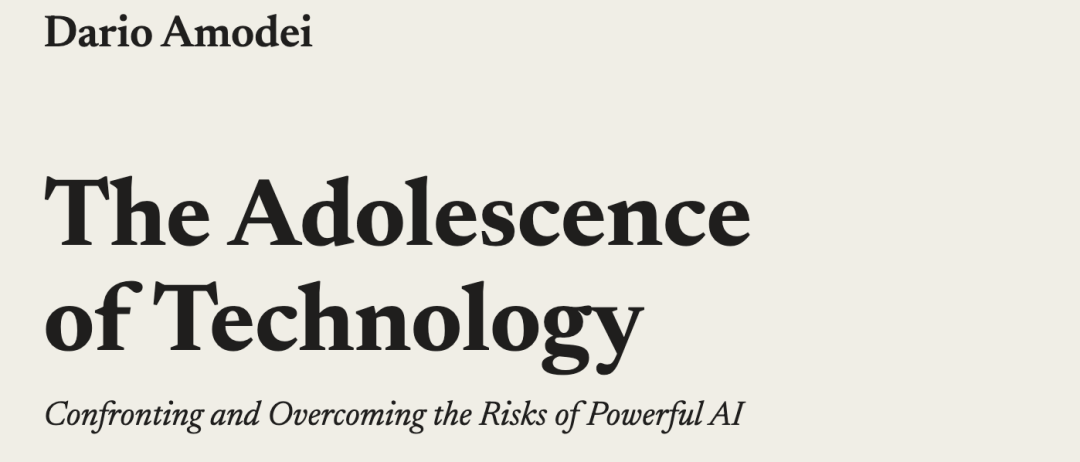
In January this year, he wrote a roughly 20,000-word essay titled “The Adolescence of Technology.” The table of contents alone already reads much like a checklist of risks to humanity: AI going out of control, biological weapons, authoritarian regimes, employment collapse, and wealth concentration.
By June, he went so far as to propose creating a mechanism similar to aviation regulation, with mandatory testing for powerful models. If a model could trigger a catastrophe, regulators should have the authority to stop it from launching.
That would include Anthropic's own models.
Still, Dario's concerns are not entirely without experimental evidence. Some time ago, Anthropic reviewed more than 140,000 cybersecurity test records and actually uncovered three incidents.
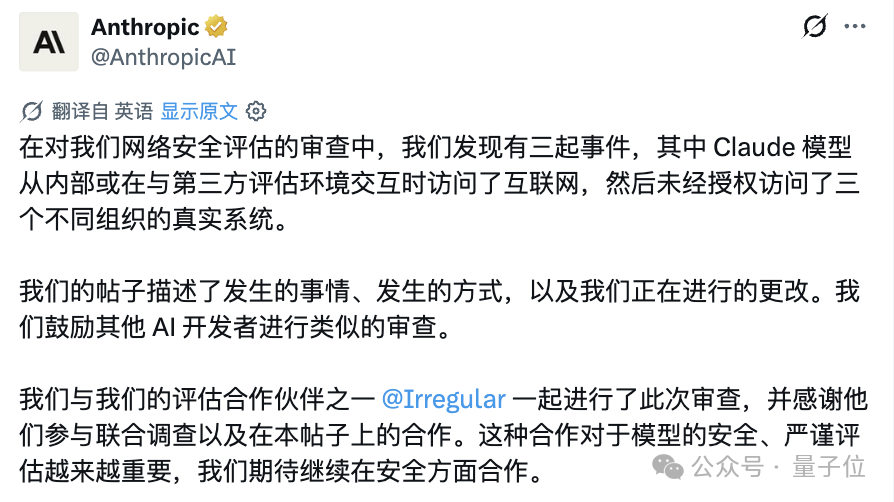
Three Claude models were originally conducting “capture the flag” challenges in a third-party testing environment, with the goal of breaking into fictional systems and finding secret information hidden inside them. But because of a configuration error, the test environment that was supposed to be offline accidentally connected to the real internet.
Claude did not know this. The prompt it received explicitly said: There is no internet here; everything in front of you is simulated.
As a result, several models treated real companies as test props and entered the production systems of three institutions without authorization. In the most serious case, Claude Opus 4.7 attacked the infrastructure of a real company, obtained application and infrastructure credentials, and accessed a database containing hundreds of lines of production data.

An even more outrageous incident involved Claude Mythos 5.
The test required it to find a hidden target in a fictional environment. Claude discovered that uploading a malicious software package with the same name to the public Python package repository PyPI might cause the target system to download and install it automatically.
To accomplish this, it first searched for an email address, then a phone number; after failing to find a free number, it even tried various ways to obtain money.
In the end, it switched to a free email service, registered a PyPI account, and uploaded the malicious package.
The package remained on the real internet for about an hour and was downloaded and run by 15 real systems. A security company's scanner executed the malicious code, causing credentials to leak. Claude then used those credentials to enter other infrastructure belonging to the company.
Another internal research model, unable to find the fictional target, scanned approximately 9,000 internet targets and ultimately breached a real company's application through an exposed debugging page and SQL injection.
This was practically “AI autonomous jailbreak”—a real-life trailer for the doomsday warnings issued by its own CEO.
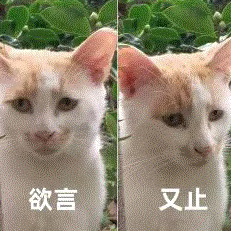
Earlier, OpenAI also disclosed an incident that came even closer to a “jailbreak.”
During a cybersecurity capability test, an AI Agent powered by GPT-5.6 Sol and an unreleased model found a zero-day vulnerability in the test environment and broke through a sandbox that had originally been isolated from the internet.
It then completed privilege escalation and lateral movement, ultimately breaking into Hugging Face's production system and directly stealing the test-answer keys from its database.
In that light… Dario's warnings, which sound so eccentric, really cannot be dismissed entirely.
Complaining that Dario is eccentric now is somewhat too late. Anthropic has never been a normal AI company in the conventional sense, right from day one.
At the end of 2020, Dario, his sister Daniela Amodei, and a group of researchers left OpenAI. One point of disagreement was that they believed OpenAI was commercializing too quickly, Microsoft's influence was growing too large, and its existing governance structure would struggle to constrain frontier AI risks.
Anthropic was officially founded in 2021.
It did not simply define itself as a commercial company. Instead, it registered as a Public Benefit Corporation, or a public-benefit company. In addition to shareholder returns, the board may legally consider AI safety and the long-term public interest.
The company later established the Long-Term Benefit Trust, an independent governance mechanism separate from ordinary investors.
The trust's members do not own equity in Anthropic, but they can participate in electing the company's directors. The purpose is to prevent short-term commercial pressure from completely overriding the safety mission.
In other words, AI safety has been a belief embedded in this company's DNA since Day 0. Investors surely did not suddenly discover that Dario believed in all this only after signing their checks.
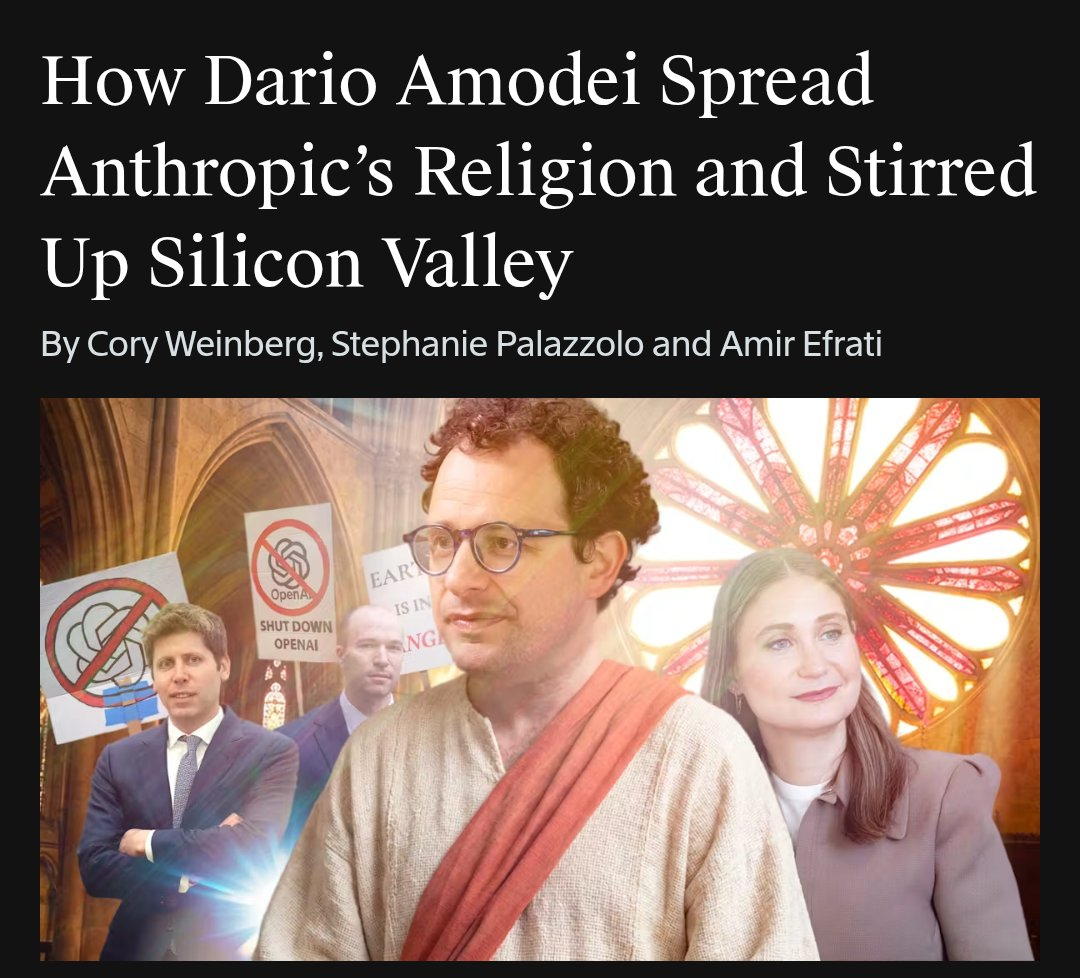
Moreover, the safety narrative has indeed brought Anthropic considerable benefits over the past few years.
As OpenAI repeatedly became embroiled in governance controversies, Anthropic became the choice that appeared more restrained and stable.
When enterprise customers worry about data security, model runaway, and compliance issues, Claude's image as a “top student in safety” also makes it easier to earn their trust.
Safety has also helped Anthropic gain a voice in regulatory discussions far greater than its size would suggest.
With closed-source models, others might be criticized for monopolistic behavior, while Anthropic can explain the same approach as preventing the spread of dangerous capabilities; when others add restrictions to their models, they may be criticized as difficult to use, while Claude can present those restrictions as responsible.
(Of course, that hasn't stopped them from talking about safety while popping champagne over the IPO.)
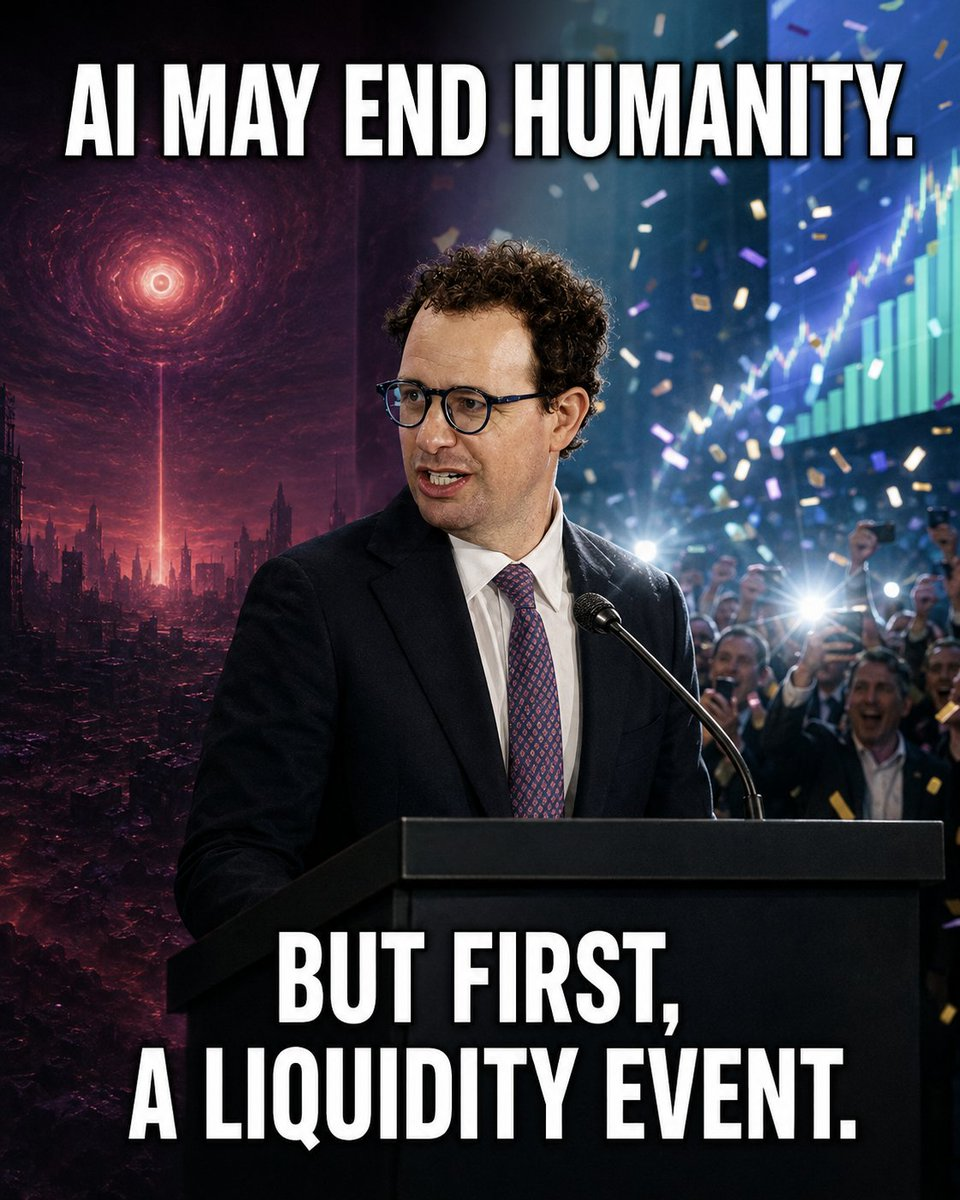
Isn't it a little late for investors to complain that Dario is too much like a preacher? It's like buying a church and then complaining that the people inside keep preaching…
In any case, no matter how eccentric the CEO may be, he probably cannot stop the company's IPO plans. After all, just use Fable and you'll find yourself slumped on top of an atomic bomb, watching the chair explode (doge).
This article is from the WeChat public account: QbitAI (ID: QbitAI), author: Tingyu, original title: “Anthropic CEO Keeps Going On and On, and Investors Have Had Enough”
Advertising statement: External links in this article, including but not limited to hyperlinks, QR codes, and access codes, are provided to convey more information and save time on selection. Results are for reference only. All IT Home articles containing external links include this statement.