

While the industry is still waiting for the release of Gemini 3.5 Pro, Google has launched another model in the 3.5 series first. The company announced Gemini 3.5 Transcribe today, an AI model designed to improve the voice-input experience. It can automatically remove filler words such as “um” and “uh,” as well as content that speakers correct after misspeaking, ultimately generating smoother, cleaner text.
The model currently powers the “Rambler” feature in the Gboard keyboard on the Pixel 11, and will gradually be introduced to more Google products and services.
Google says Gemini 3.5 Transcribe improves both speed and accuracy compared with the speech-to-text engine formerly known as Chirp 3. From the time a user speaks to the generation of the final transcript, overall speed is expected to improve by about 70%. In real-time speech scenarios, its error rate has fallen to 5.5%.
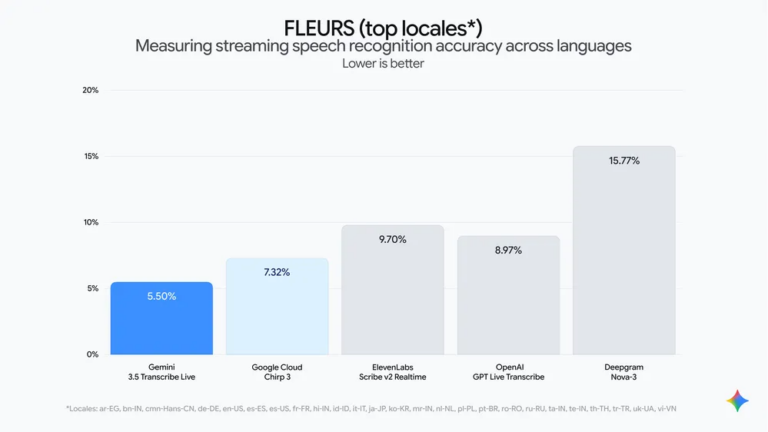
However, the improvement in accuracy is not particularly large. According to Google’s data, Chirp 3 had an error rate of 7.32%. For users who frequently rely on voice input, though, even a few fewer typos mean less content to correct manually afterward, so this remains a practical improvement.
Gemini 3.5 Transcribe is capable of more than simply “hearing” what users say; it also attempts to understand what they actually mean. During speech, the model can automatically remove filler words such as “um” and “uh” that affect the fluency of a sentence. If a user immediately corrects something they said incorrectly, the model can also adjust the text it has already generated in real time. In addition, users can provide a custom vocabulary so the model can better recognize technical terms and words from specific fields.
The model currently supports 85 languages and can process prerecorded audio containing up to 3 speakers.
Of course, this capability also presents an obvious issue: users must trust AI to accurately understand what they really intend to say. At least with shorter texts, based on hands-on experience with the Rambler feature, the model can indeed clean up inconsistent phrasing and verbal stumbles fairly well, making the text appear more natural.
At the same time, Gemini 3.5 Transcribe does not simply convert speech into text. In organizing the content, the AI may actually change the user’s original wording. Therefore, this kind of “intelligent polishing” may not be suitable in scenarios where the exact words must be retained and phrasing cannot be modified freely.