

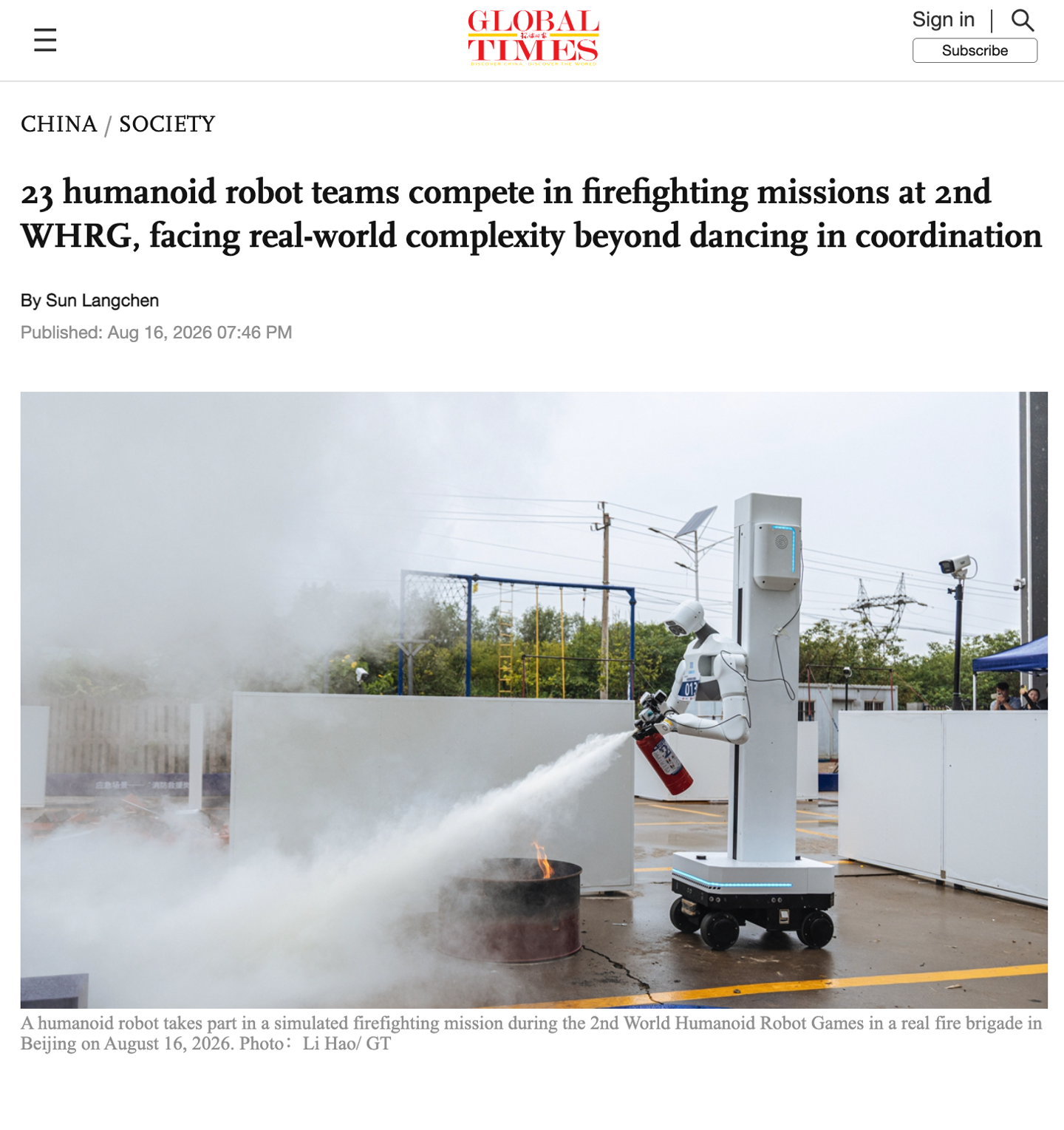
On August 16, the Second World Humanoid Robot Games held a simulated firefighting and rescue competition in Beijing. A total of 23 teams participated, with the event focusing on testing robots' ability to perform practical tasks in complex real-world environments.
This exercise was a test event designed by the Games to assess adaptability to real-world environments. Unlike controlled simulated scenarios built indoors, the emergency management event was moved directly into a real fire station, requiring robots to operate autonomously and complete specific tasks in an environment close to actual working conditions.
The simulated firefighting task was intended to test whether robots could reliably perform operations in real-world environments. According to the English-language edition of the Global Times, this year's scenario-based competition placed greater emphasis on “realistic simulation” than last year's event. Each robot had to complete three tasks within 30 minutes: identifying hazardous materials, closing valves, and extinguishing a fire.
Two types of simulated hazardous materials will be randomly placed at the competition site. Robots must identify them and report their types through images, then find and close three randomly designated valves, and finally locate a fire extinguisher and continue spraying until the flames are extinguished.
Human firefighters are responsible for igniting the fire at the site and observing whether the robots can use the fire extinguishers correctly. The competition revealed the practical difficulties robots face when moving from controlled laboratory environments into the real world. Rainfall, changing light conditions, and outdoor conditions can all interfere with visual recognition and mechanical operation.
UniX AI's (Youliqi's) robot completed the task within the allotted time, but its overall speed was far lower than that of human firefighters. Its mechanical hand also took two attempts to successfully aim the fire extinguisher at the target position. Of the 12 teams that competed that day, only 3 completed all the challenges.
Rainfall, constantly changing lighting, and outdoor environments can all affect visual recognition and operation. An error in any part of perception or motion planning could cause the entire task to fail. Robots must not only correctly identify objects and select the corresponding actions, but also precisely coordinate multiple joints while maintaining body balance.
The competition also demonstrated the complexity of humanoid robot hardware systems. Dexterous hand movements require high-precision joints, while force output, body stability, and movement depend on high-torque actuators. Different tasks often require multiple types of hardware to work together. Some participating robots did not use traditional two-legged designs, instead adopting omnidirectional wheels, while multi-joint robotic hands handled more delicate operations.
Teleoperation remains an important part of the humanoid robotics technology stack. Some teams used VR headsets to remotely control their robots shortly before the competition began or even during the task. Operators could obtain a first-person view through onboard cameras and guide the robots' movements in real time. Multiple teams also used Chinese-developed joint modules, with servo actuators covering different torque ranges required for everything from low-force precision control to high-force movements.
Experts said that competitions in real-world environments can accumulate large amounts of valuable failure data, which can be used to further improve robots' perception, motion planning, and AI systems.