

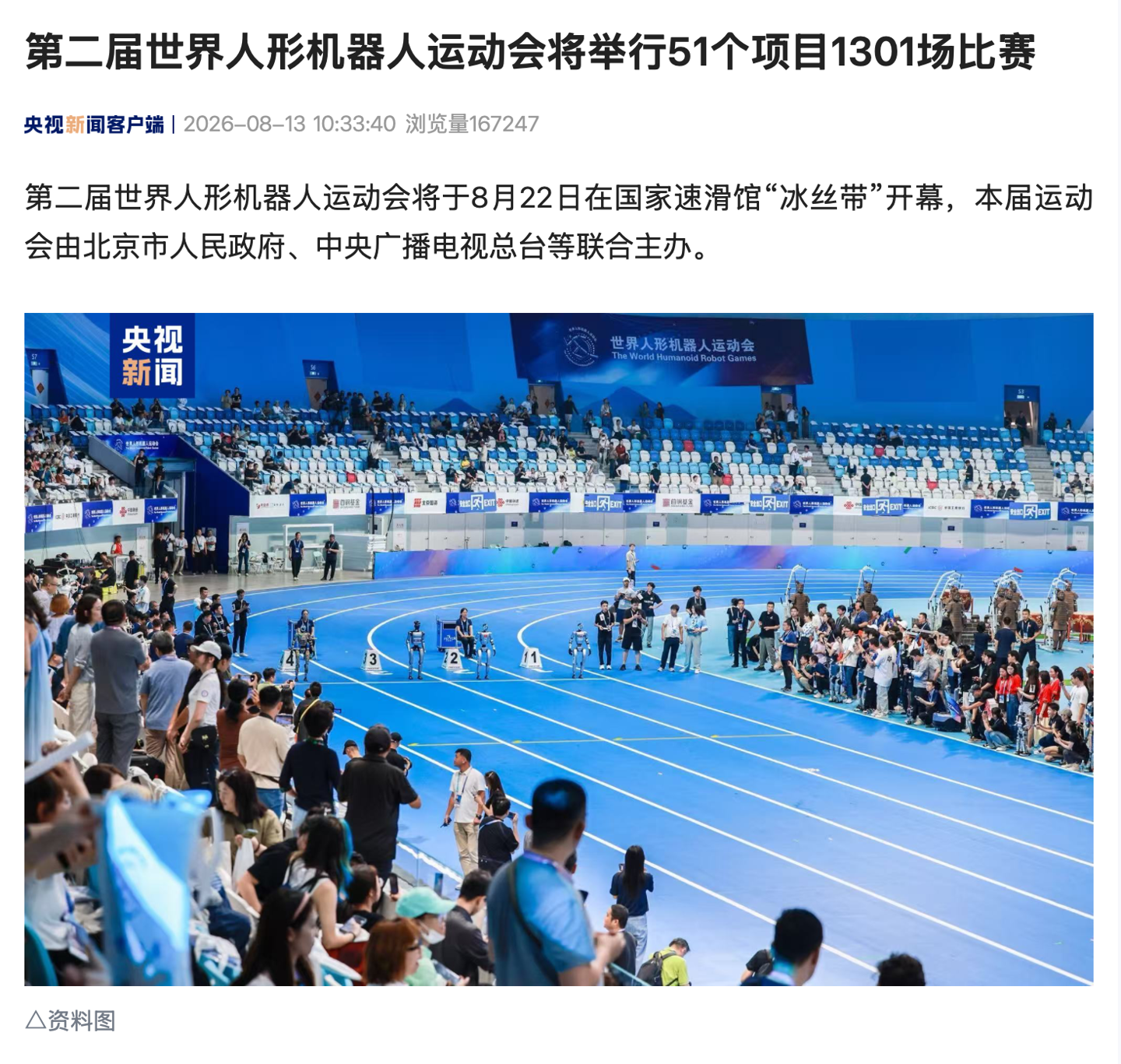
According to CCTV News, the 2nd World Humanoid Robot Games will open on August 22 at the National Speed Skating Oval, known as the “Ice Ribbon.” The event is jointly hosted by the Beijing Municipal People’s Government, China Media Group, and other organizations.
The event has attracted 666 teams and 2,056 robots from 16 countries across six continents to compete together. The total number of teams has increased 138% year on year, while the number of robots has quadrupled.
Internationally, robot teams from the United States, Germany, Japan, and other countries will all take part. Brazil has also brought together five champion teams from the Robot Soccer World Cup to form a national team for the competition.
Domestically, 157 companies, 641 teams, and 1,975 robots will gather at the venue. Nearly all leading companies are participating, along with 27 Project 985 universities. Domestic teams come from 30 provinces, autonomous regions, municipalities, and special administrative regions, achieving nationwide participation.
Compared with the inaugural Games, the 2nd World Humanoid Robot Games have significantly expanded and upgraded both the competition categories and participating teams. The main event will be held at the National Speed Skating Oval, the “Ice Ribbon,” from August 22 to 26, lasting five days.
According to the schedule, 51 events will be held (30 competitive events and 21 scenario-based events), with a total of 1,301 matches. The competition period has increased from three days and six sessions at the inaugural Games to five days and nine sessions. The schedule has shifted from morning and afternoon sessions to afternoon and evening sessions, with each session lasting three hours.
The Games have eliminated preliminary rounds and added more competitive and entertaining events, such as martial arts and dancing, to the competitive program. Soccer has added a 3V3 U19 category, while also including 5V5 large-team and 5V5 medium-team categories. Scenario-based events have grown from six to 21, covering nine major real-world scenarios, including homes, hotels, industry, and emergency rescue. Robots have progressed from “solo operations” to competing in pairs or even groups of four.
While the inaugural event focused more on “finishing as a victory,” this edition has comprehensively raised competition standards and strengthened officiating.
Shorter completion times: The time limit for the 100-meter event has been reduced from 3 minutes to 1 minute, the 400-meter event from 15 minutes to 5 minutes, and the 1,500-meter event from 40 minutes to 15 minutes.
Stricter autonomy requirements: Except for the 100-meter and 400-meter hurdles, robots must complete all track and field events and other competitive events fully autonomously. In scenario-based events, fully autonomous completion receives a final-score weighting coefficient of 1, while remotely controlled completion receives a coefficient of only 0.5.
Greater competition difficulty: For example, the difficulty coefficients for gymnastics, martial arts, and sports dancing have been increased. The obstacle race has changed from a single track to two tracks competing simultaneously, and the takeoff requirements for the standing long jump have been clarified.
More officiating personnel: The event has selected 223 outstanding officials, including 28 international-level officials, 75 national-level officials, and 120 first-level officials. The officiating team has increased by exactly 100 people compared with the previous edition.