
China National Radio of China Media Group today exposed the chaos surrounding AI-generated images in homestay listings.
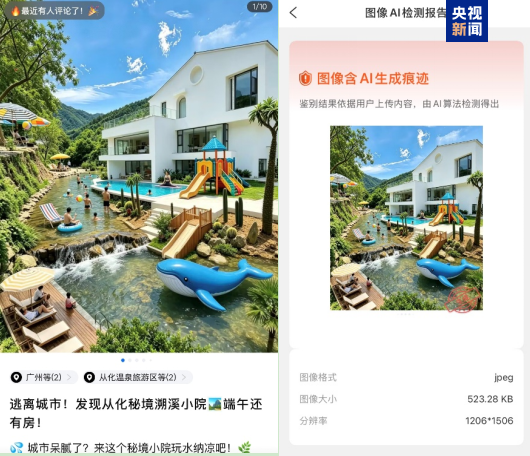
This summer, many people have likely come across homestay images resembling a “secluded paradise” while browsing social media, accompanied by captions such as “newly opened” and “rooms available during the summer vacation.” Yet the same image may appear in Qingcheng Mountain today, Anji tomorrow, and Changbai Mountain the day after that, because it is not a photo of a real property but is suspected to have been generated by AI.
What is even more suspicious comes next. When reporters showed the images to merchants and asked whether they could book a room, the merchants gave surprisingly consistent answers before the reporters had even mentioned a booking date: “Fully booked” and “No availability recently.” The merchants then changed the subject and began recommending other properties. It turned out that the image was fake, while the attempt to attract customers was real.
Multiple such images were tested using the “AI Content Identification” feature in the National Anti-Fraud Center app, and the results indicated that all of the photos contained traces of AI generation.
In addition, several posters used identical sales pitches. Even though the reporter did not mention any date, they said that the room types shown in the posts were already fully booked and would remain unavailable for a long time, after which they recommended several similar homestays.
Why have “AI fake photos” recently become so common in the homestay industry? Wang Peng, an associate research fellow at the Beijing Academy of Social Sciences, explained that homestays are non-standardized accommodation products, making it difficult for consumers to determine the actual condition of a property based solely on photos.
They use AI-generated fake images to attract customers, respond to inquiries by saying there are “no rooms available,” and then recommend other properties. How should such conduct be legally characterized? Zhao Jingwu, an associate professor at the School of Law of Beihang University, believes that such conduct is more appropriately characterized in law as false advertising.
Note: Article 28 of the Advertising Law of the People’s Republic of China defines false advertising, including situations in which the advertised goods or services do not exist or the effects of receiving the services are fabricated.
Zhao Jingwu said that using AI-generated images to promote homestays and saying there are no rooms available when asked about reservations constitutes typical false advertising. Whether it also constitutes fraud depends on the details of each case. For example, if a merchant attracts consumers to visit by claiming that no rooms are available and then promotes other homestays, this constitutes typical consumer fraud.
Why do such “AI fake photos” continue despite repeated bans? Ma Liang, a professor at the School of Government at Peking University, believes that the root cause is that it is difficult to hold the offending merchants accountable. Ma Liang said that the key to governance lies in the dissemination process. Large platform companies should have stronger technical capabilities, while regulatory authorities must also create a deterrent effect.