

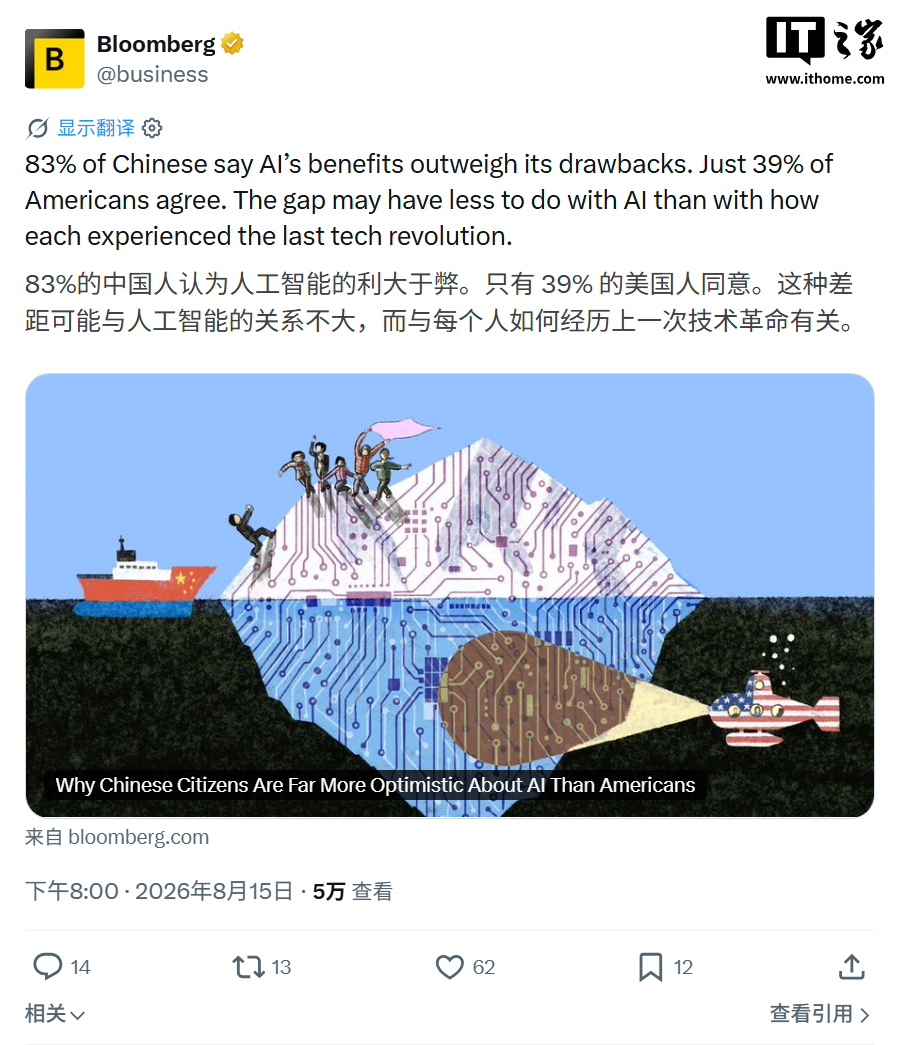
Stanford University's AI Index 2026 report shows that Chinese respondents have a significantly more positive attitude toward AI than Americans.
According to the data, 84% of Chinese respondents said they were excited about AI products and services, compared with 38% in the US. A separate Edelman Trust Barometer survey found that 72% of Chinese respondents trusted AI, versus just 32% in the US.
The Stanford report notes that the gap between the US and China in AI model performance has largely disappeared, with models from the two countries trading the lead since early 2025.
Based on multidimensional data analysis, the report covers technological progress, economic impact, and societal responses. In terms of technical capabilities, industry produced more than 90% of notable frontier models in 2025, while multiple models met or exceeded human baseline performance on benchmarks involving PhD-level science questions, multimodal reasoning, and mathematics competitions. On the key coding benchmark SWE-bench Verified, model performance rose from 60% to nearly 100% in one year. Organizational adoption reached 88%, and more than 80% of university students are already using generative AI.
Regarding AI adoption and public trust, generative AI reached a population adoption rate of 53% within three years, faster than PCs and the internet. As of early 2026, the annual value US consumers derive from generative AI tools was estimated at $172 billion (note: approximately RMB 1.16 trillion at current exchange rates), while per-user value tripled from 2025 to 2026.
At 31%, the US ranked lowest among the surveyed countries in public trust that the government can regulate AI. There was also a divide between public and expert perceptions: 73% of AI experts expected AI to have a positive impact on how individuals work, compared with just 23% of the public. A similar perception gap of about 50 percentage points existed regarding AI's impact on the economy and healthcare.
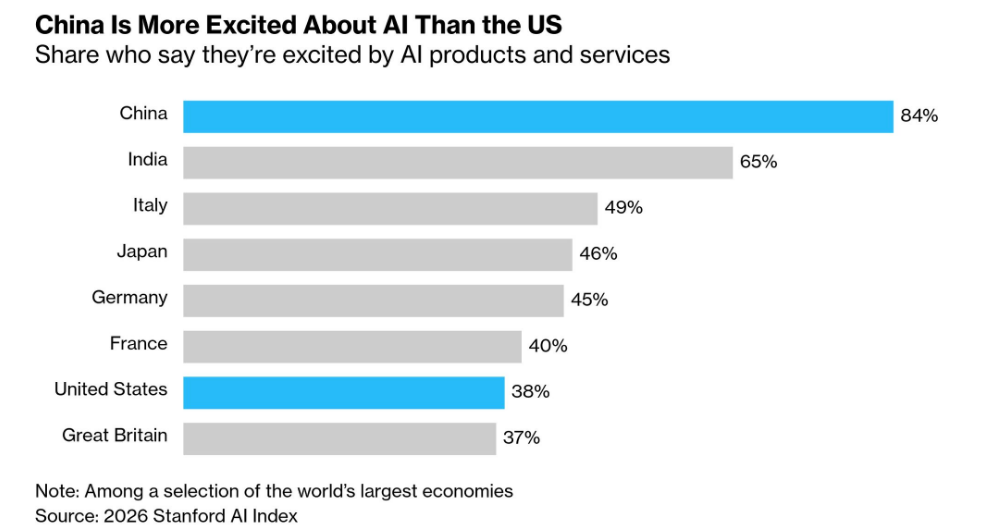
Bloomberg noted that the disparity between Chinese and US data does not mean Chinese people are unaware of AI risks, nor does it mean Americans use AI less. The main difference between the two countries' publics lies in whether they believe AI's benefits will reach them personally and whether they think technology companies will comply with the government.
In recent years, public discussion of AI in the US has focused largely on job displacement, misinformation, and the possibility that AI could surpass human capabilities. China also has concerns about AI's impact on employment, but overall acceptance of AI remains relatively high in Chinese society.
An analysis published by the Brookings Institution in June 2026 argued that China's AI priorities focus more on integrating the technology into manufacturing, education, healthcare, and scientific research, while the US technology industry is more focused on the goal of developing AGI, or artificial general intelligence.
Brookings Institution researcher Kyle Chan previously described this difference as “AI-pilled, but not AGI-pilled,” meaning that China places a high priority on AI but does not treat achieving AGI as its sole central objective. In his view, China places greater emphasis on using AI to increase productivity and applying the technology across the economy and society.
This difference is also related to the two countries' experiences with technological development over the past 20 years. For many Chinese consumers, technologies such as mobile payments, e-commerce, delivery logistics, short-form video, food delivery, and internet-based employment have expanded access to goods, services, and information. The widespread adoption of smartphones has also enabled more residents in remote areas to access online services. These experiences with technological development may shape how the public evaluates new technologies. When past technologies are widely seen as tools that improve lives and expand opportunities, the uncertainty associated with new technologies is more likely to motivate experimentation and adoption rather than resistance.
Meanwhile, the US has seen growing social controversy surrounding the technology industry in recent years, including the impact of social media on teenagers, online misinformation, data privacy, and the concentration of power among technology companies. These experiences have led some Americans to pay closer attention to whether companies are effectively regulated as AI develops.
There is also a clear difference in trust in regulation. Stanford University's survey found that only 31% of US respondents believed the government could effectively regulate AI, one of the lowest shares among the countries and regions surveyed in the report. By comparison, the figure was 81% in Singapore, 76% in Indonesia, and 73% in Malaysia.
Edelman's 2025 survey similarly found that trust in AI reached 72% among Chinese respondents, compared with 32% in the US. Edelman said the extent to which AI earns public trust will affect how quickly businesses and individuals adopt the technology.
Perceptions of the relationship between technology companies and the government also differ between the two countries. The US public may be more concerned that the government cannot rein in large technology companies quickly enough, while the movement of personnel and lobbying activities among corporate executives, investors, and the government can further intensify those concerns.
Moreover, Chinese society's acceptance of AI does not stem entirely from optimism about the technology's prospects. It also reflects competitive pressure and a fear of falling behind. In a highly competitive environment, people may choose to proactively learn about and use AI to avoid being left behind by technological change.
The situation in the US is different. A SurveyMonkey survey from the second quarter of 2026 found that 38% of Americans were already using AI weekly or daily, up from 30% in the second quarter of 2025; 70% of US adults said they had used AI at some point. Nevertheless, public concerns about AI have not disappeared, with 33% of respondents saying they were worried about it.