

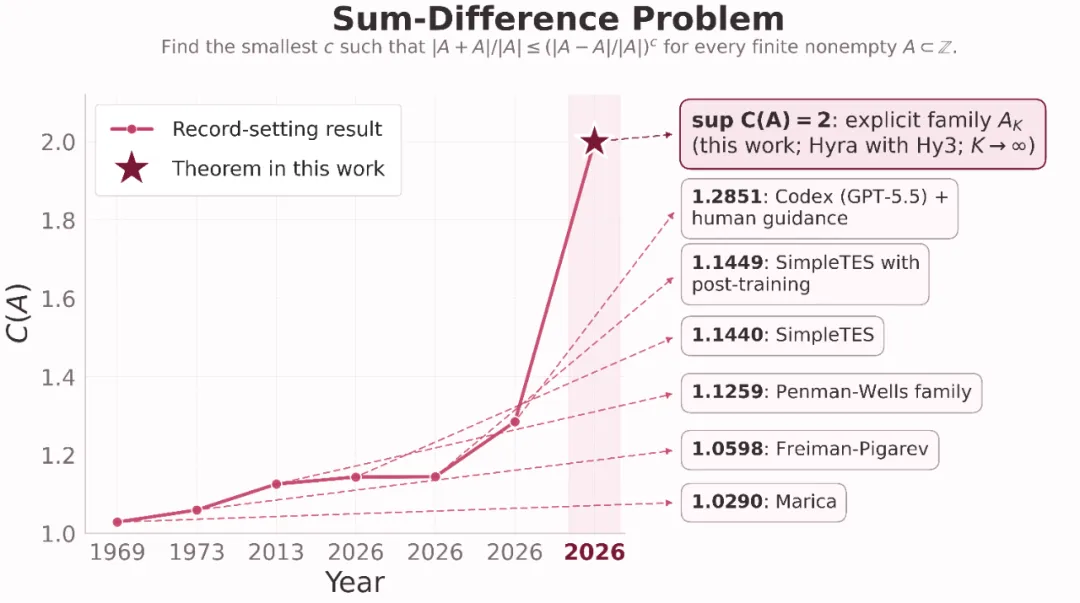
Tencent Hunyuan announced today that its research agent Hyra, based on the Hy3 model, has found a key construction, providing a complete answer to an open problem in additive combinatorics that had remained unresolved for more than half a century.
The paper preprint, explicit construction, and formal proof are now all publicly available:
Paper: https://arxiv.org/abs/2607.27199
Lean formal proof: https://github.com/linhaowei1/sum-diff-proof
The problem is as follows:
Take a finite set of integers containing at least two elements, denoted by A. Add any two elements in it and collect all distinct results to obtain the “sumset” (A+A); subtract any two elements and collect all distinct results to obtain the “difference set” (A-A).
Since duplicate results are counted only once, a natural question is: how much does this set expand after addition and subtraction, respectively?
Mathematicians use two quantities to measure this expansion:
The former is the expansion factor of the sumset, and the latter is the expansion factor of the difference set. The classical sum-difference set inequality states:
To measure this exponent, one can define
The classical inequality then gives . The real question is: Is 2 merely a loose upper bound, or is it the optimal exponent that can be approached arbitrarily closely?
For more than half a century, mathematicians have continually constructed new sets in an attempt to make C (A) as large as possible. An early construction in 1969 reached approximately 1.0290, rising to 1.0598 in 1973, while a 2013 construction further reached 1.1259. Over the past year, multiple AI-assisted searches advanced this value to 1.1449. In an internal exploratory experiment documented in the paper, Codex (GPT-5.5), with human guidance, raised it further to 1.2851.
Hyra and Hy3 took the decisive step. They produced a family of explicitly constructed finite sets of integers, satisfying
This means that no matter how close a given target is to 2, a corresponding set can be constructed whose exponent exceeds it. Therefore, 2 is indeed the supremum of this problem.
Previously, researchers including Georgiev, Gómez-Serrano, Tao Zhexuan, and Wagner used AlphaEvolve to optimize search algorithms and candidate sets. Such methods rely on the explicit enumeration of finite sets. As the scale grows, their computational and memory costs rise rapidly, and they also struggle to transition naturally to provable asymptotic constructions.
According to the introduction, Tencent Hunyuan first used Hyra to improve the best result in finite searches from approximately 1.14 to 1.21, then shifted to using natural language to propose mathematical constructions and arguments. An LLM judge was used to provide feedback during the exploration process.
After approximately 24 hours of operation, Hyra proposed the paper’s core idea: using the structure of duodecimal digits and an ingenious construction to control the difference set, then combining a symmetric additive basis on cyclic groups with the Chinese remainder theorem so that the sumset expands at a rate approaching quadratic. The official team independently checked and organized the complete proof, while also providing a Lean 4 formal proof.