


According to a post published on the 27th by the official WeChat account of Guoguang Quantum, the company's artificial intelligence research team has introduced relevant quantum technologies into the decision-making and reasoning processes of large language models. The team has launched the Xenomi large model family for scientific research and academic applications. In specific tasks such as scientific research outreach, routing, and agent decision-making, Xenomi demonstrates more stable professional understanding, clearer task judgment, and shorter decision paths than mainstream open-source models. It is also the industry's first quantum-enhanced large model.
According to the company, it hopes to obtain a large language model with better performance and higher efficiency for cutting-edge research fields represented by quantum computing. To this end, it adopted the industry's most advanced domain-specific model training methods, independently built massive datasets, and conducted in-depth training and inference tests based on SOTA-level open-source foundation models. After repeated validation in practical research, it ultimately developed the Xenomi large model family for different tasks.
In specific tasks such as scientific research outreach, routing, and agent decision-making, Xenomi demonstrates more stable professional understanding, clearer task judgment, and shorter decision paths than mainstream open-source models. In knowledge retrieval and content review, which are currently of greatest concern, the Xenomi model family also shows certain advantages, providing clearer professional judgments within defined task scopes.
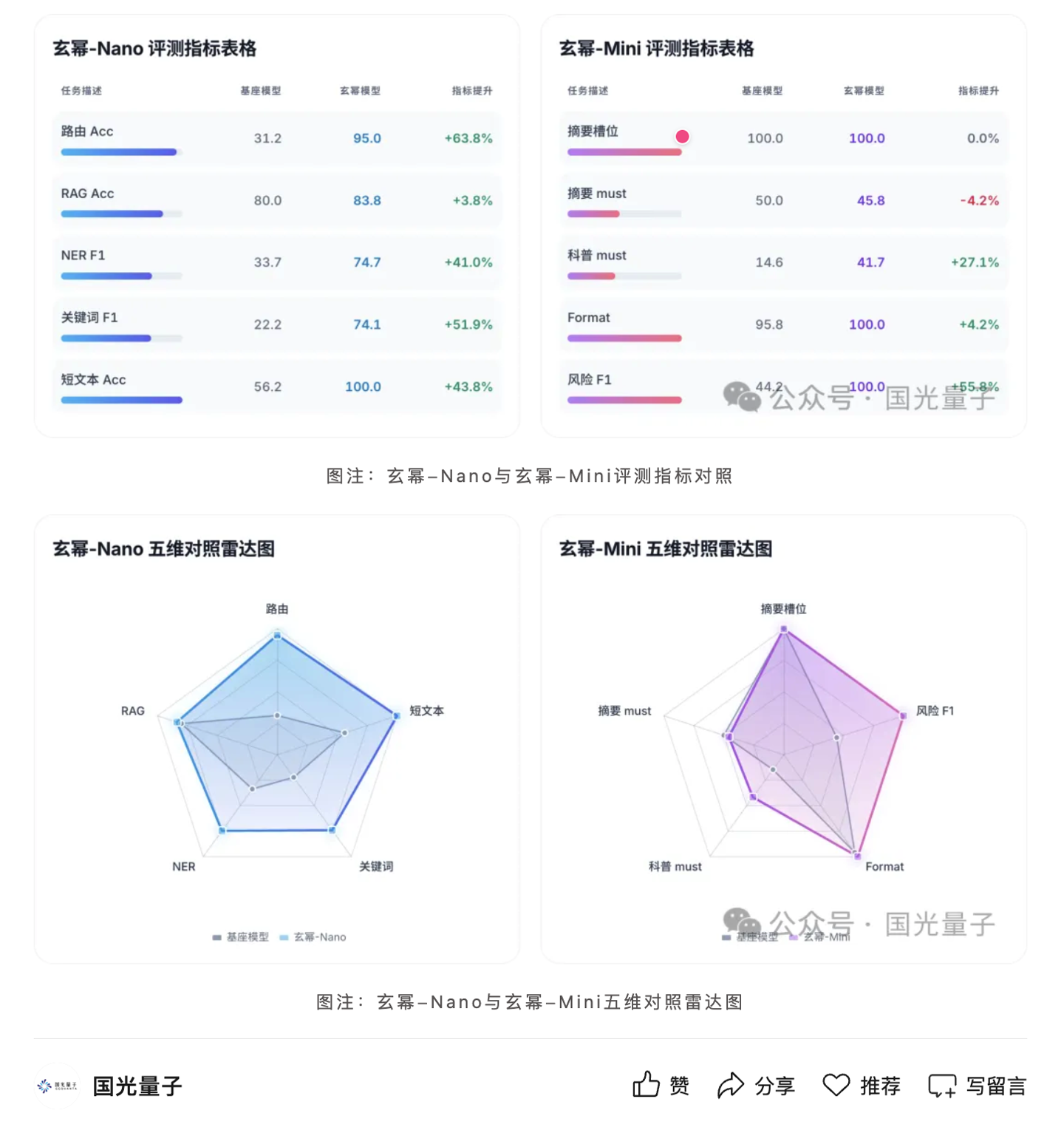
ITHome learned that the Xenomi large model has been successfully applied to Guoguang Liangchao's intelligent quantum computing experimentation platform and the Quamido multi-agent system. It can accurately respond to specific commands in modern AI software and quickly provide decision-making judgments and review results.
In Quamido, Xenomi serves as the domain-model foundation, supporting literature retrieval, experiment planning, hybrid programming, quantum task scheduling, data analysis, and report generation. Multiple agents are each responsible for different stages, while Xenomi helps them understand quantum terminology, experimental constraints, and the conventions of scientific research communication, while also effectively improving the execution efficiency of the overall system.