

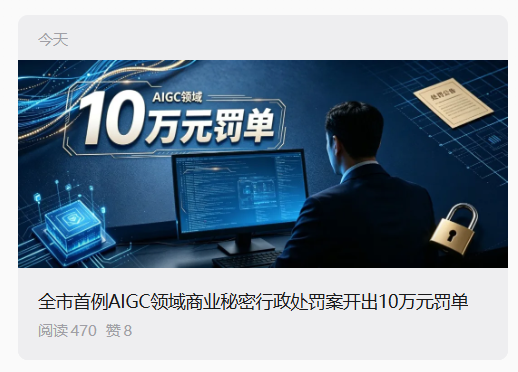
Today, the Beijing Municipal Administration for Market Regulation announced that the city’s first administrative penalty case involving trade secrets in the AIGC sector has resulted in a RMB 100,000 fine.
Recently, the Chaoyang District Administration for Market Regulation in Beijing issued a decision in the city’s first administrative penalty case involving trade secrets in the AIGC sector, imposing a RMB 100,000 fine for taking confidential information to a new job and privately copying and using the former employer’s AI business software.
The rights-holder company in this case specializes in foreign-language translation and dubbing for micro-dramas, as well as AI-driven multilingual film and television translation services. It is a leading domestic company in the overseas expansion of micro-dramas. To support these businesses, the company independently developed an internal AIGC business software application that can significantly shorten translation time and increase production capacity. As a key component of the company’s core competitiveness, this unpublished intangible asset was protected as a trade secret.
In this case, a core employee secretly copied the software and cracked its supporting database during their employment. After leaving the company, the employee founded a new company and continued using the software to take on competing business and profit from it.
Compared with tangible assets, trade secrets in the AIGC sector are highly concealed, technically complex, and vulnerable to the loss of evidence. In response to these characteristics, enforcement officials first used electronic data forensics to promptly preserve data on the computers and servers involved, preventing key evidence from being deleted or altered. They then cross-checked software installation traces, database access logs, project output files, and other evidence to reconstruct, step by step, the individual’s copying and cracking activities during employment and the entire process of using the software at the new company to complete commercial orders. This ultimately established a complete chain of evidence: “copying - cracking - cross-company reuse - continued profit.”
Under Article 26 of the Anti-Unfair Competition Law of the People’s Republic of China, the parties involved were fined RMB 100,000. The authorities also guided the company in improving confidentiality measures such as tiered access controls, audit logging, and offboarding audits, helping it close management gaps.
As Beijing’s first administrative penalty case involving trade secrets in the AIGC sector, this case confirmed for the first time at the administrative enforcement level that AIGC business software can qualify as a trade secret and receive legal protection. It also demonstrated that market regulators can use technical methods such as electronic data forensics to effectively address the difficulties of collecting evidence in this sector, providing a reference enforcement model for similar cases in the future.
The case also clearly defined the boundary between employee mobility and infringement: employees may change employers, but they may not take the former employer’s AI digital assets away as startup capital to profit from them. The resolution of this case marks a substantive step forward for Beijing in protecting trade secrets in emerging digital economy sectors and provides useful experience for trade secret protection in the AIGC industry nationwide.