

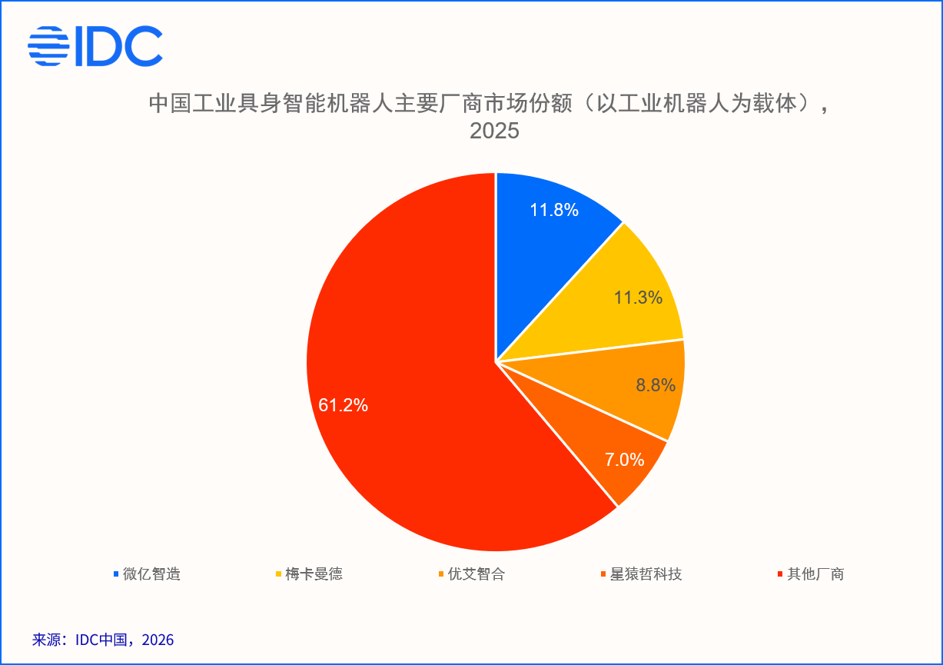
On July 31, data from International Data Corporation (IDC) showed that China’s industrial embodied intelligent robot market was worth approximately RMB 5.74 billion in 2025. Of this, the market for embodied intelligent applications based on industrial robots was approximately RMB 3.62 billion, making it the primary direction for current commercial implementation. As industry competition gradually shifts from robot hardware performance toward comprehensive capabilities in models, data, engineering, and scenario implementation, industrial embodied intelligent robots are becoming an important direction for the development of intelligent manufacturing.
Industrial embodied intelligent robots are intelligent robotic systems designed for industrial production environments. By integrating artificial intelligence models, multimodal perception systems, robot control systems, and robot bodies, they provide a closed loop of perception, learning, decision-making, and execution. They can autonomously perform tasks in real-world industrial scenarios and interact with personnel and production equipment.
IDC data shows that in 2025, China’s industrial embodied intelligent robot market entered a phase of accelerated commercialization, with the overall market size reaching approximately RMB 5.74 billion. The current market mainly uses robots in multiple forms as carriers, upgrading industrial production lines and manufacturing workstations through intelligent technologies. This integrates perception, learning, decision-making, and execution capabilities, driving manufacturing scenarios toward greater flexibility and autonomy.
IDC data shows that in 2025, the market for embodied intelligent applications based on industrial robots was approximately RMB 3.62 billion, accounting for the majority of the current market. These applications mainly include collaborative robots, composite (mobile manipulation) robots, and articulated robots. Relying on a mature industrial foundation, these robots integrate visual perception, force control technology, environmental understanding, and embodied intelligence models to provide integrated delivery of “robot hardware + intelligent software + industry services.” They have been applied in industrial scenarios such as loading and unloading, quality inspection, grinding and repair, flexible assembly, and material handling.
In 2025, new embodied intelligence carriers represented by humanoid robots entered the exploratory phase for industrial applications, with a market size of approximately RMB 2.11 billion. Current applications are mainly concentrated on demonstration production lines, scenario validation, and POC testing. Humanoid robots offer greater morphological versatility and potential for adapting to complex environments, but they are currently undergoing improvements in technical capabilities and exploration of commercialization models. Factors including product cost, reliability, engineering maturity, and actual production efficiency are still being further validated.
Over the next three to five years, China’s industrial embodied intelligent robot market will enter an important phase of expanding from validation in individual scenarios to process-level applications in production. IDC believes the industry will exhibit the following development trends:
From intelligent workstations to intelligent production processes. Robots will move beyond the limitations of individual tasks and integrate deeply with MES, WMS, ERP, PLC, and industrial internet platforms, gradually evolving from devices that perform single tasks into intelligent nodes within production systems.
Industrial knowledge will become an important component of model capabilities. Industrial embodied intelligence models will need to further integrate process rules, equipment mechanisms, and production experience, evolving from “completing tasks” to “understanding production processes.” In the future, competition among models will depend not only on data volume but also on their ability to integrate industrial knowledge.
Multiple robot forms will coexist over the long term. Future industrial scenarios will feature multi-robot collaboration: humanoid robots will be suitable for highly flexible, unstructured tasks; mobile manipulation robots will be suitable for tasks spanning multiple spaces; collaborative robots will be suitable for human-robot collaboration scenarios; and specialized industrial robots will be suitable for high-precision, high-stability tasks. In the future, the focus of competition will not be the form of the robot, but who can truly solve industrial problems.
Data closed loops and engineering capabilities will determine large-scale implementation. As the market enters the phase of batch deployment, the accumulation of real-world industrial data, the efficiency of model iteration, and the ability to deliver at scale will become key competitive factors. Companies that can establish a closed-loop system of data collection → model training → industrial deployment → feedback optimization will gain long-term competitive advantages.
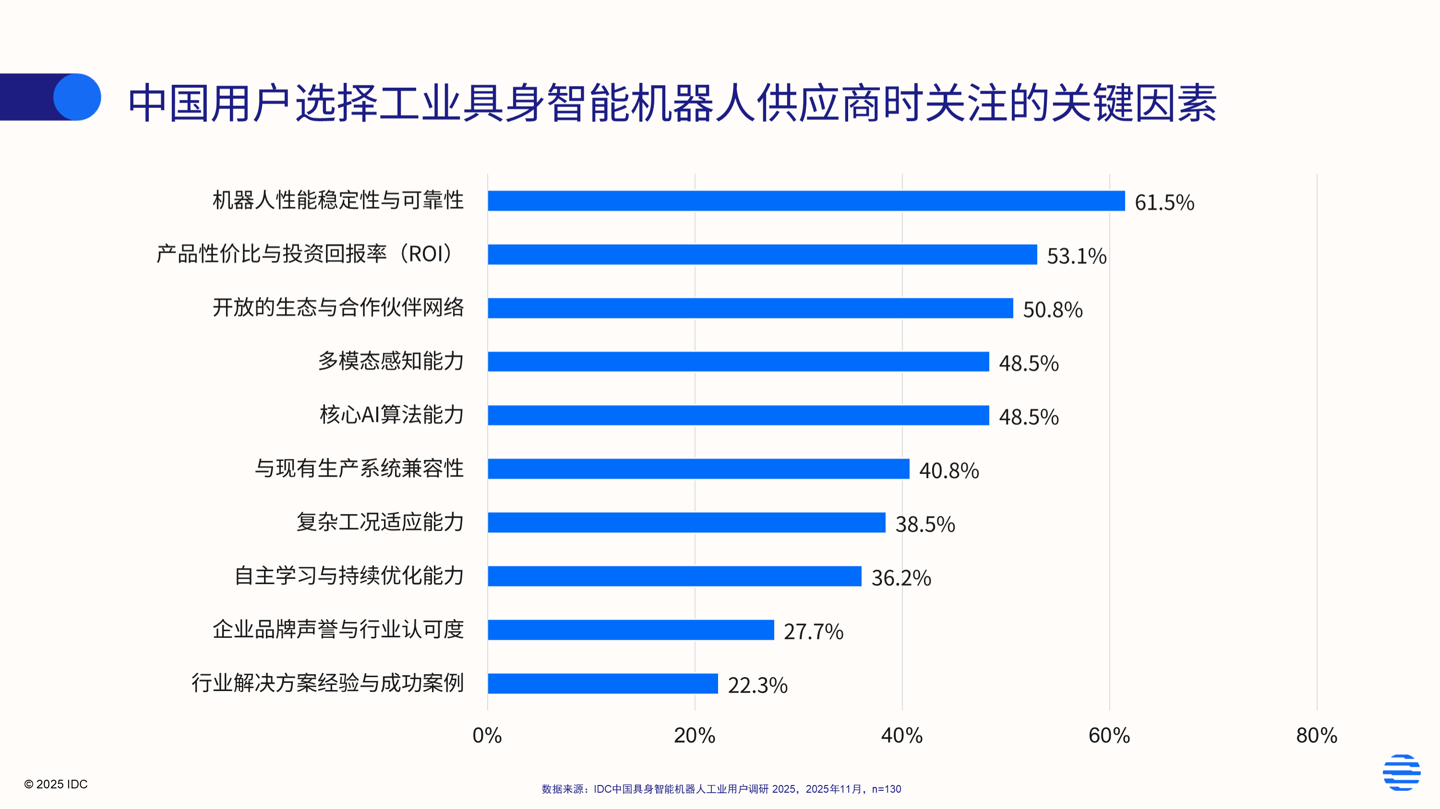
ROI will become the core metric for commercial implementation. IDC user research shows that more than 80% of manufacturing companies hope that industrial embodied intelligent robot projects can achieve a return on investment within two years. In the future, solutions that can be deployed quickly, operate stably, and generate clear economic value will be prioritized by the market.
Reference
Physical AI Accelerates Industrial Implementation: China’s Industrial Embodied Intelligent Robot Market Reaches RMB 5.74 Billion in 2025, Commercialization Accelerates Across the Board