

According to the BBC in the UK today (the 27th), 48-year-old Rees Hibbert from Bedfordshire has become the world’s first patient to undergo brain surgery with real-time AI assistance. Doctors successfully removed his brain tumor.
Surgeons at University College London Hospitals said that without the operation, he might eventually have lost his sight. During the procedure, AI analyzed images from the endoscope in real time, helping doctors determine where important blood vessels and nerves might be hidden in the brain. This allowed them to avoid these critical structures and remove as much of the tumor as possible while maintaining safety.
Hibbert said: “From a patient-safety perspective, I can completely understand the benefits of this technology. There are no road signs inside your head.”
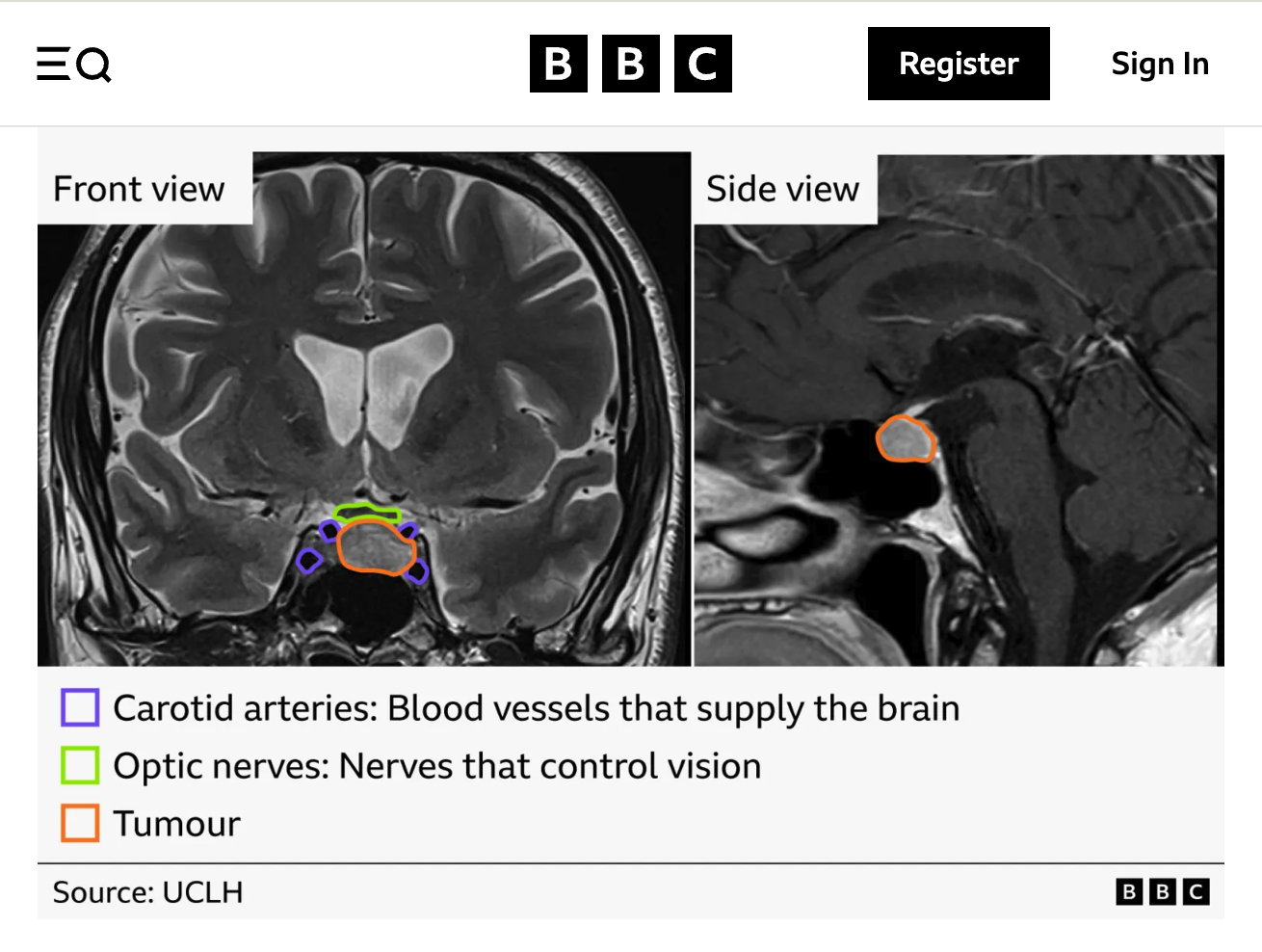
Eighteen months ago, 48-year-old Hibbert was a healthy customer service manager who walked about 3.2 kilometers during his lunch break every day. During one lunchtime walk, he suddenly lost consciousness, collapsed in the street, and began having seizures. Subsequent examinations found an 11 mm benign tumor on his pituitary gland.
The pituitary gland is located at the base of the skull and is about the size of a marble. It secretes several important hormones and plays a vital role in regulating growth, metabolism, blood pressure, and body temperature. Its location also makes surgery more challenging, as the carotid arteries supplying blood to the brain and the optic nerves controlling vision are nearby.
As the tumor gradually compressed his optic nerves, Hibbert’s peripheral vision began to narrow. At first, he did not need surgery immediately, but he later began frequently tripping over objects and developed severe fatigue and dizziness.
Hibbert said candidly: “For 18 years of marriage, I have gotten up every day and made my wife a cup of coffee. I won’t let this tumor stop me.” Compared with the physical discomfort, the emotional and psychological pressure affected him more. “Many people kindly offered to help me, but you never want to become a burden to others.”
Doctors later asked whether he would be willing to become the first patient to use this customized AI tool during surgery. Hibbert did not hesitate. “If patients are unwilling to participate in research, how can doctors learn, and how can medicine advance?”
ITHome understands that the procedure requires an endoscope to be inserted through the nasal cavity to the base of the skull, with a camera at its tip used to observe the surgical area. Although the tumor is nearby, it is obscured by bone structures and tough membrane tissue, preventing doctors from seeing it directly.
The real difficulty is determining the safest entry point, because everyone’s anatomy is different. The risk of complications in this type of surgery is not fixed. In Hibbert’s case, there was a 25% to 50% chance that the tumor could not be completely removed, along with a 0.5% to 2% risk of major blood-vessel damage.
This is where AI provides assistance. A second screen analyzes the surgical images in real time, tracks the positions of the instruments, identifies the areas where blood vessels and nerves are most likely to be located, and marks relatively safe sites for removing the tumor.
The principle is similar to facial recognition on a phone, except that the AI must identify important anatomical structures that are often not visible.
Surgeons in the UK perform only about 10 to 20 of these procedures on average each year and typically rely on preoperative scans to familiarize themselves with a patient’s anatomy. The research team trained and evaluated the AI using hundreds of videos of pituitary tumor removal surgeries, carefully outlining the blood vessels and nerves in each video so that the system could gradually learn to “recognize” the most critical structures.
Professor Hani Marcus, who participated in the surgery, said: “The number of surgical procedures this system has been trained on is greater than what most surgeons have seen or performed in their entire careers. It is like having an extra pair of expert eyes.” The system can also work in real time, unlike other AI tools that are still in the experimental stage.
The research team emphasized that the AI will not take over the surgery. It only provides assistance to doctors, and all actions remain the surgeons’ decisions.
Professor Marcus said the team ultimately hopes to develop a “ChatGPT for surgeons,” effectively adding another expert to the operating room. “Doctors can ask it for advice when they want it, and if they disagree, they are entirely free not to follow it.”
The AI was developed by researchers at University College London and funded by the UK National Institute for Health and Care Research and Google. Before entering the operating room, the team conducted years of testing in the laboratory.
The results of the first real-world surgery satisfied the researchers, and the team is now preparing a larger clinical trial.
Hibbert said: “When I opened my eyes after surgery, I felt as though I had regained a 360-degree field of vision. I hadn’t been able to see this clearly for a full year.” During the eight weeks after surgery, he could feel his vision continuing to improve every few days. “My energy has returned too, and all the discomfort I had before surgery has disappeared. This operation gave me my life back.”
UK Health Innovation Minister James Frith said he was delighted that Rees was able to undergo the “life-changing surgery” through government-funded research. “AI must have appropriate safeguards, and we will always take safety seriously. At the same time, we will ensure that we make full use of the opportunities AI brings.”