

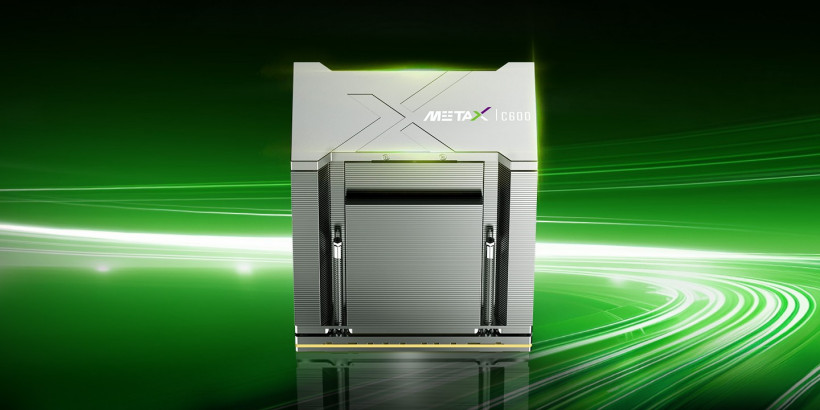
MetaX today announced that its MetaXing C Series GPUs have completed Day 0 adaptation for MiniMax H3, a multimodal generative model from MiniMax. Powered by MetaX's full-stack, self-developed MXMACA software stack, users can rapidly deploy MiniMax H3 and leverage the model's powerful multimodal creation capabilities.
MetaX stated that the MetaXing C Series GPUs are built on its self-developed core GPU IP, delivering high energy efficiency and broad versatility while precisely meeting the requirements of large models for ultra-large-scale parameter processing and long-context inference. Powered by a self-developed high-performance hardware architecture and the MXMACA computing platform, the MetaXing C Series GPUs enable rapid adaptation of the MiniMax H3 model.
The MXMACA software stack is the core foundation that advances MetaX GPUs from being “usable” to being “effective and easy to use.” As the central hub connecting hardware computing power with the upper-layer application ecosystem, the MXMACA software stack covers the entire chain, including underlying drivers, user-space interfaces, the MXCC compiler, deep operator adaptation, and integration with mainstream training and inference frameworks. It is natively compatible with major international ecosystems, supports PyTorch, TensorFlow, vLLM, SGLang, and more than 40 other mainstream AI frameworks, and enables the stable operation of more than 500 AI models, significantly shortening the traditional model adaptation cycle.