

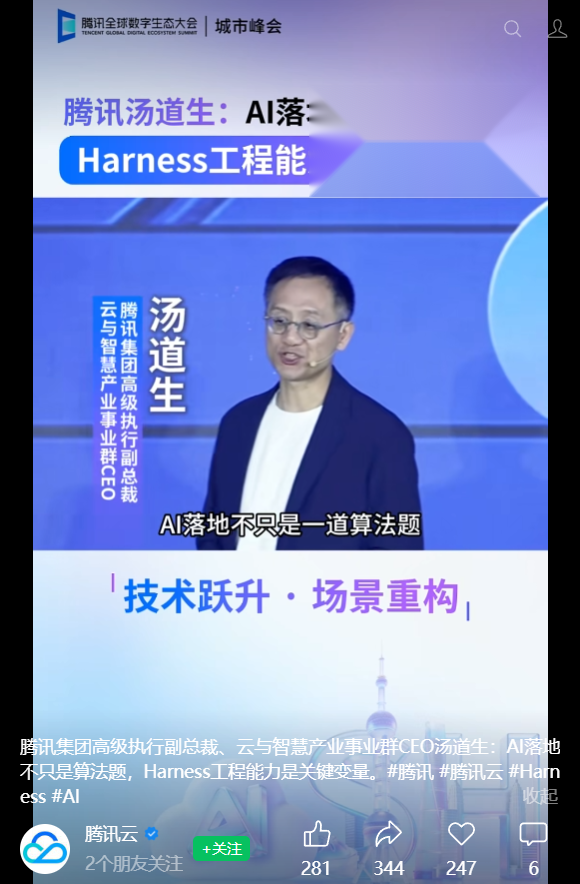
According to Bianews' report today, Tang Dao-sheng, Tencent Group Senior Executive Vice President and CEO of the Cloud and Smart Industries Group, published an article in Tencent's internal annual publication, ZhDian, on the evening of August 25.
Tang said that he completed the article collaboratively with AI. AI has evolved from a simple execution tool into a collaborative partner that assists with thinking.
In the article, Tang directly addressed the outside assessment that “Tencent has been slow in AI.” He acknowledged that the global race to develop large models is moving at a rapid pace, competitors have a strong presence in the ToB market, and insufficient computing power has slowed iterations of the Hunyuan large model and product deployment, inevitably causing internal anxiety.
However, he believes that AI competition is not a sprint but a marathon. The industry is still in its early stages, and the market landscape and business models have yet to take shape. Endurance matters more than an early start. The ability to invest over the long term and capture the needs of real-world scenarios is the key to navigating industry cycles.
Regarding AI deployment, Tang said the industry should not focus solely on large models. Algorithms determine the upper limit, engineering capabilities determine the speed of deployment, and scenarios are Tencent's core advantage. He emphasized that two things remain unchanged amid the transformation: long-termism and a people-first approach.
At Tencent's shareholder meeting in May this year, Ma Huateng, chairman and CEO of Tencent, said that Tencent's foundational capabilities in AI were not particularly strong in its early days. In recent years, the company has continued to address its shortcomings through talent development, team management, and internal training, and is now gradually getting onto a development track.
Ma candidly acknowledged that Tencent may not have been the fastest in the industry to seize opportunities, but it has persisted in following the right path and steadily building on its unique strengths: “We can't simply jump over and grab someone else's territory just because we see them doing it. We did that in the past, but it basically ended in failure.”
Regarding whether Tencent is falling behind in AI, Ma said, “A year ago, we thought we had boarded the ship, but later discovered that it was leaking. Now it feels like we've gotten on board, but we still can't sit down. We still hope the ship can go a little faster.”
At the 2026 Tencent Cloud AI Industry Applications Conference in June this year, Tang responded to criticism that “Tencent has fallen behind.” He acknowledged that different business lines move at different speeds in a complex organization, with some moving quickly and others slowly, along with failures and experimentation. He said he remains open to external criticism and reminders and accepts the suggestions.