

The technology media outlet GPTZero published a blog post on July 28, reporting that the four Middle East-related research reports published by PwC between 2024 and 2026 contain a large amount of fabricated information and false statements.
PricewaterhouseCoopers (Price Waterhouse Coopers, abbreviated as PWC), whose full name is PricewaterhouseCoopers, was established on July 1, 1998, and is headquartered in London, United Kingdom. Its main business areas include auditing, taxation, risk management, and corporate mergers and acquisitions. PwC, together with Deloitte, KPMG, and Ernst & Young, is known as one of the “Big Four accounting firms.”
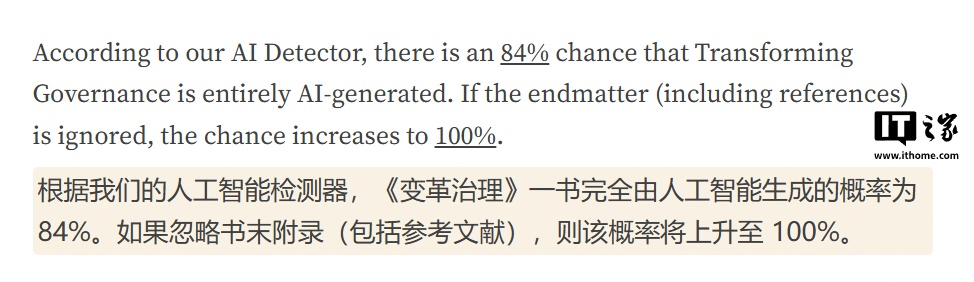
The media outlet conducted an in-depth investigation into the research reports published by PwC and pointed out that they contain a large amount of false content. The most serious case is a report titled “Transformation Governance,” which was determined to have an 84% probability of being entirely generated by AI. If the appendix at the end of the report, including the references, is excluded, the probability rises to 100%. Relevant screenshots are shown below:
The report primarily promotes a product called “Citizen Pulse,” claiming that governments in countries including Denmark, Saudi Arabia, the United States, and Australia are using the product. However, after conducting an in-depth investigation, the media outlet found no actual information about the product.
Reports with the highest artificial intelligence scores also tend to contain the largest number of false sources. GPTZero calls this phenomenon “Vibe Citing,” meaning that citations are not rigorous and often lack correct title, URL, or author information, and in fact cannot support the arguments to which they are attached.