
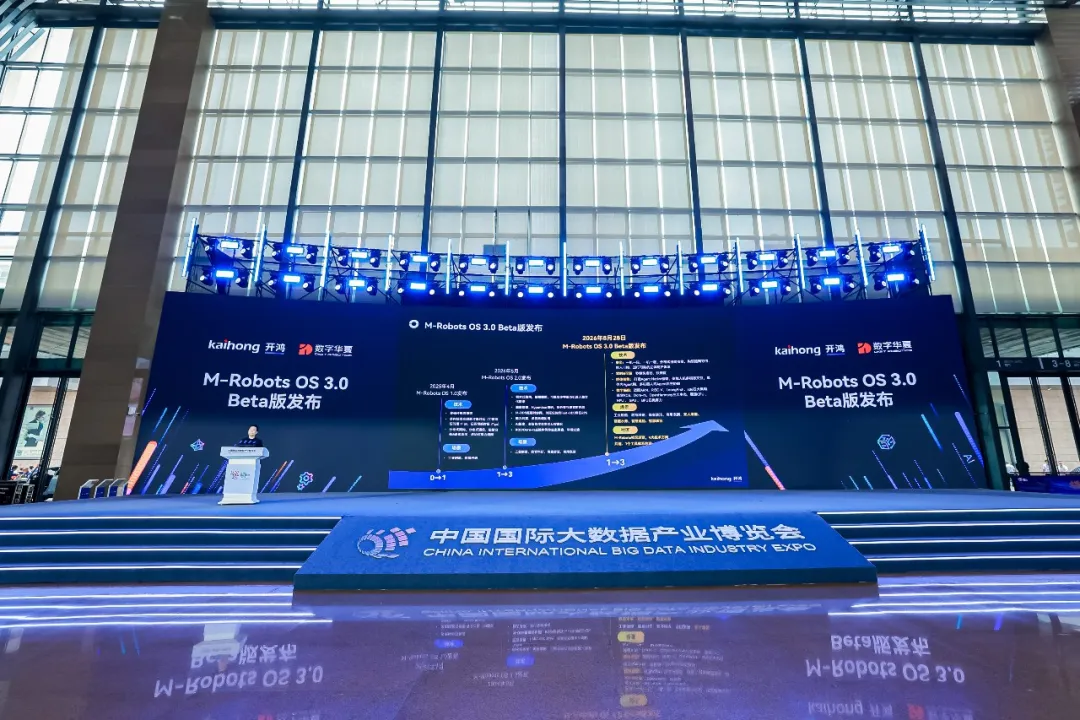
The 2026 China International Big Data Industry Expo, hosted by the National Data Administration, opened yesterday in Guiyang. Dr. Wang Hao, Senior Vice President and President of the R&D System at Kaihong, officially released the M-Robots OS 3.0 Beta at the event.
Note: M-Robots OS is the first distributed heterogeneous multi-robot collaborative operating system released in China that is based on open-source OpenHarmony. It uses OpenHarmony as its foundation.
According to the introduction, the newly released 3.0 Beta shifts its focus from "single-machine capability" to "swarm intelligence," establishing a secure, real-time, and trusted foundation for a distributed robot operating system. It has undergone systematic upgrades in four areas: security, real-time performance, swarm intelligence, and the digital foundation.
In terms of security, the system has built a comprehensive protection architecture featuring trusted networking, controlled access, and protected operations. Based on the VAA unified identification system, it assigns each device a unique digital identity, enabling "one device, one code, one device, one key." KGSI secure boot establishes a chain of trust to ensure a clean and trusted runtime environment. When multiple devices form a super device, the device with stronger security capabilities handles unified security authentication, delivering both efficiency and reliability. The system also enables security-status sharing: when a single device is attacked, it can quickly share the risk and sever the connection to prevent the risk from spreading, achieving "swarm security through east-west coordination."
In terms of real-time performance and reliability, the system uses a self-developed single-chip, multi-kernel hybrid deployment architecture to achieve microsecond-level hard real-time response, with both interrupt response latency and task-switching latency of ≤1μs. It also supports startup within seconds and rapid recovery: critical services resume within 2 seconds, system failures are recovered from within 4 seconds, and the impact of a single-point failure does not spread. This meets the stringent reliability requirements of scenarios such as intelligent manufacturing and inspection.
In terms of swarm intelligence, the 3.0 Beta introduces the Agent Native framework, enabling multimodal human-machine interaction, autonomous collaboration among multiple Agents within a single robot, and autonomous Agent collaboration between robots. M-Claw, built on this framework, enables end-to-end distributed autonomous clusters featuring multi-robot self-organizing networks, distributed capability sharing, and dynamic task allocation. It truly moves robots from "single-machine execution" to "swarm collaboration."
In terms of the digital foundation, the system supports the four major mainstream architectures: ARM, RISC-V, LoongArch, and x86. It is compatible with the three major ecosystems of ROS, Dora-rs, and OpenHarmony, and covers four types of computing power: CPU, NPU, GPU, and BPU. This ensures that existing industry application assets and developers' accumulated technical expertise can be migrated smoothly, avoiding the need to "start over from scratch."
At the launch event, Wang Hao demonstrated the practical applications of M-Robots OS 3.0 Beta through three real-world scenarios:
In unmanned retail, preparation robots and delivery robots use M-DDS to discover one another and form self-organizing networks based on M-Robots OS. Order information, device status, and task progress are synchronized in real time, completing the "unmanned relay of a cup of coffee" from ordering to preparation to delivery through cross-device collaboration across the entire process.
In campus inspection, M-Robots OS is adapted to Hai'en inspection robots and works with drones. Using M-DDS, they form a super device to create an integrated air-ground campus security system. When an anomaly such as a fire or illegal intrusion is detected, the system automatically coordinates nearby devices to verify and analyze data from multiple sources, then dispatches the nearest ground robot to handle it, creating an end-to-end terminal-side loop of "detection-confirmation-response."
In water-quality testing, water-quality testing robots dynamically coordinate with laboratory environmental monitoring equipment and personnel work-status monitoring equipment to create an integrated "people-machine-environment" laboratory management system. When a robot performs a water-sample testing task, it can automatically adjust lighting, ventilation, temperature, and humidity, enabling unified intelligent control of testing operations and laboratory environmental management.