
According to a report by CCTV News today, global multi-model aggregation platform OpenRouter recently released its latest weekly ranking of AI foundation model usage. All of the top five products were developed by Chinese companies. Xiaomi's MiMo-V2.5 topped the ranking, reaching 10.5 trillion tokens in weekly usage, an increase of 12% from the previous week.
According to Xin Yanshu, a product manager on Xiaomi's MiMo foundation model team, weekly usage rose from 1.5 trillion tokens to 10.5 trillion tokens, growing more than sixfold in two months. It has just taken first place in both the weekly and monthly rankings. Xin said that users downloading the model are mainly independent developers, startups with teams of three to five people, and numerous small and medium-sized companies focused on AI programming and agent tool development.
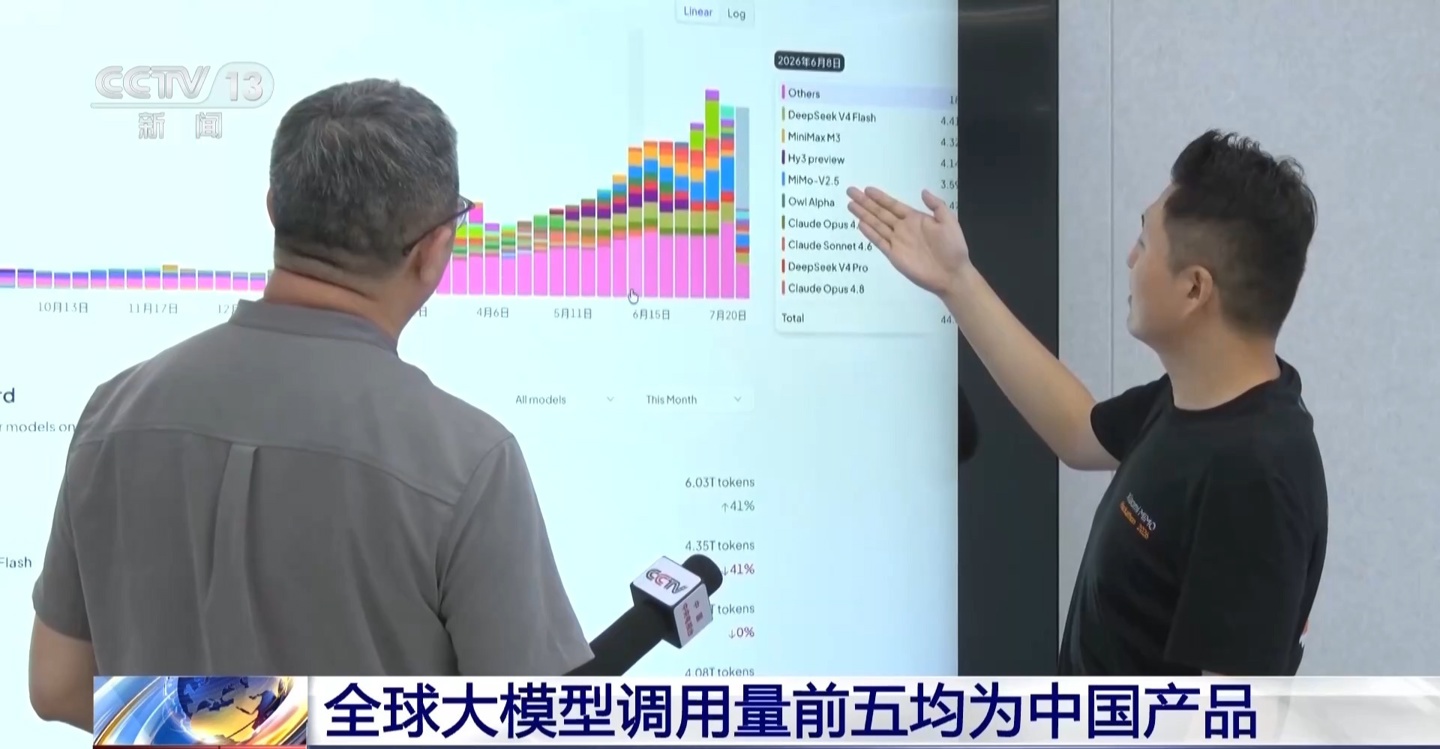
In addition, the models ranked second and fifth both come from DeepSeek. The two models complement each other, covering different development needs, while the flagship Pro version matches leading overseas closed-source models in coding and complex agent tasks. Tencent's Hunyuan Hy3, ranked third, was not officially open-sourced until July 6. Its weekly increase exceeded 999% compared with the previous week, making it the fastest-growing model on the list.
This means that domestic open-source models are breaking through the ecosystem barriers erected by overseas providers and taking the lead on fully market-driven third-party channels. However, the ranking also has limitations: enterprise private deployments and traffic from closed APIs in the United States are not included in the statistics.
In terms of global open-source model downloads, Chinese foundation models also remain ahead worldwide. Hugging Face, the world's largest AI open-source community, shows that the cumulative download volume of China's open-source models ranks first globally. The Qwen series leads the ranking by a margin of more than 1 billion downloads.
Li Wei, deputy director of the Cloud Computing and Digitalization Research Institute at the China Academy of Information and Communications Technology, said that domestic models have energized the innovation ecosystem through open-source strategies. With advantages including superior performance, controllable costs, and ease of localized deployment, they have significantly lowered the barrier to applying artificial intelligence technology and won widespread favor among developers worldwide.
Responding to questions about why companies would choose open source after investing enormous resources in training foundation models, experts said that China's companies are continuing to open-source their models in essence to exchange model investment for long-term ecosystem influence. Zhong Xinlong, an associate research fellow at the Future Industries Research Center of the China Academy of Information Industry Development, noted that open source does not equal free, nor does it mean giving up commercial returns. Companies can also generate revenue through cloud-based inference, model fine-tuning, agent platforms, industry solutions, technical support, and other methods.
Data from U.S. investment institutions shows that as many as 80% of U.S. AI startups use Chinese open-source models when making funding pitches. The data shows that more than 200 derivative models based on Chinese foundation models now emerge on average every day.