
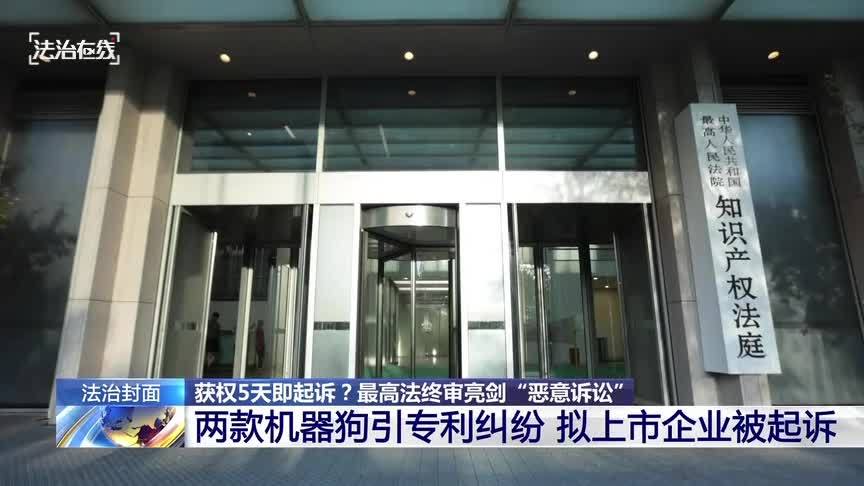
In 2025, Loumoumei accused Unitree Technology of infringing its invention patent titled “An Electronic Dog” by manufacturing and selling robotic dogs, attracting public attention. The case reached its final judgment in February this year, with the court rejecting all of Loumoumei’s claims.
Today, CCTV’s Legal Daily program disclosed specific details of the case. After ascertaining the facts, the court not only found that no infringement had occurred, but also clearly addressed in its judgment the litigation conduct that violated the principle of good faith.
According to the report, a company that had never manufactured the products in question launched “lightning litigation” against a prospective STAR Market-listed technology enterprise just 5 days after obtaining a patent.
In court, the two sides debated an invention patent titled “An Electronic Dog.” Loumoumei claimed that the metal shell, foot-end sensors, and LiDAR on Yumou Technology’s A2 robotic dog corresponded respectively to core technical features in its patent, including “color-changing bionic fur,” a “liquid-level sensor,” and a “gas sensor.”
However, as the trial proceeded, the objective basis for this infringement claim gradually revealed significant flaws.
After examination, the court determined that Yumou Technology’s product did not contain multiple technical features of the patent at issue, including the “color-changing bionic fur.” Loumoumei’s infringement claim clearly could not stand.
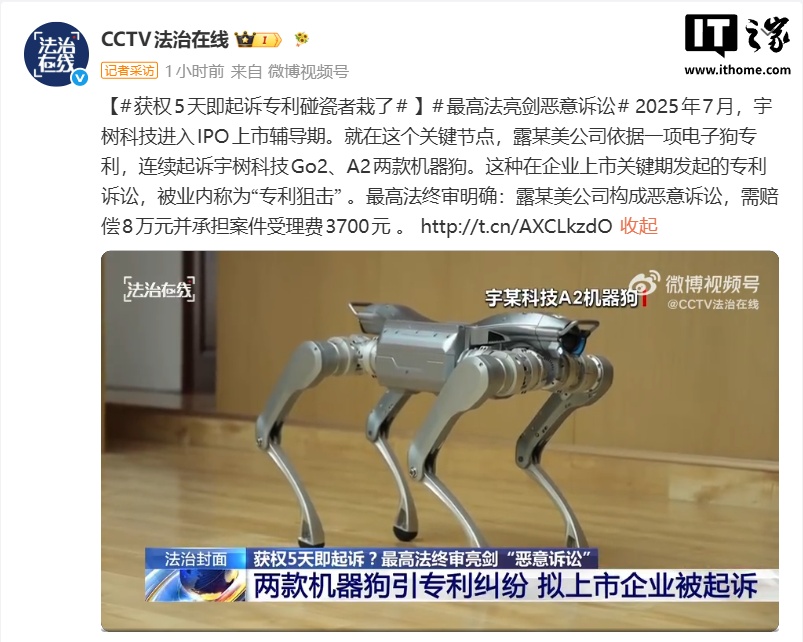
Beyond the technical comparison, a series of unusual strategies adopted by Loumoumei during the litigation also drew the court’s attention. In fact, this was not the first confrontation between the parties. Previously, they had gone to court over whether another robotic dog made by Yumou Technology, the Go2, infringed the patent.
In the first lawsuit concerning the Go2 robotic dog, Loumoumei’s compensation claim displayed obvious contradictions. At first instance, it sought only 500 yuan in damages, while also requesting that the amount be determined based on an audit of Yumou Technology’s profits and seeking punitive damages of 3–5 times the gains from the alleged infringement. This caused the potential claim to soar to more than 70 million yuan.
The court held that when a claim is clearly lacking factual support, the higher the amount claimed, the higher the litigation fee the plaintiff must pay in advance. Loumoumei deliberately set its claimed amount at a low level while retaining an audit claim for substantial damages. This strategy objectively lowered the barrier to litigation, but its purpose was not simply to stop infringement and protect its lawful rights and interests.
In addition, the court identified a key date in the case: Loumoumei acquired the patent at issue from an unrelated party on June 25, 2025, and sued Yumou Technology just 5 days later, on July 1. As a company whose principal business was limited to daily-use commodities and that had never actually manufactured or sold products covered by the relevant patent, its pattern of “suing immediately after obtaining the patent” reasonably caused the court to question the legitimacy of its rights enforcement.
Based on the evidence in the case and the results of the technical comparison, the Hangzhou Intermediate People’s Court found that the infringement claim could not stand and legally rejected all of its claims on September 26, 2025.
Loumoumei refused to accept the first-instance judgment and appealed to the Supreme People’s Court.
During the second-instance proceedings, Loumoumei’s litigation conduct changed repeatedly. Although the first-instance court had already found that Yumou Company did not infringe, Loumoumei at one point asked the court to first order Yumou Company to pay 80 million yuan in damages. Yet just one day after the second-instance inquiry concluded, it reset its compensation claim in writing to 500 yuan.
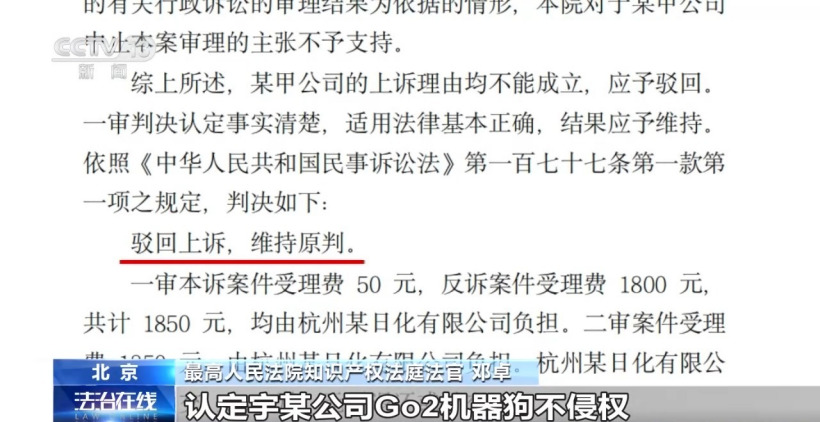
On February 3, 2026, the Supreme People’s Court issued its final judgment, finding that Yumou Company’s Go2 robotic dog did not infringe and upholding the first-instance judgment.
While the first-instance proceedings concerning the Go2 robotic dog were still underway and before a judgment had been issued, Loumoumei filed another lawsuit, this time targeting Yumou Technology’s other robotic dog, the “A2.”
In early September 2025, Loumoumei sued Yumou Company over its A2 robotic dog. It asked the court to order Yumou Company to pay 1,500 yuan in economic damages, while also stating that this was only a provisional amount and that the final compensation should be determined based on an audit of the profits from the alleged infringement.
In the second lawsuit concerning the A2 robotic dog, Yumou Technology filed a counterclaim, asking the court to find that Loumoumei’s conduct constituted “malicious litigation” and ordering it to pay 80,000 yuan in reasonable expenses, including attorneys’ fees incurred in responding to the lawsuit.
After trial, the court found that Yumou Technology’s A2 robotic dog likewise did not infringe. Did Loumoumei’s series of lawsuits constitute “malicious litigation”? The court conducted a comprehensive assessment from both subjective and objective perspectives based on the facts of the entire case. It held that although Loumoumei’s series of infringement lawsuits had a legal rights basis, they were clearly lacking in factual grounds.
In addition, the court pointed out that Loumoumei chose to file the lawsuit during Yumou Technology’s IPO listing-counseling period and applied for investigation and evidence collection as well as evidence preservation, objectively exerting an adverse impact on Yumou Technology’s listing process. This showed that it was not acting out of a genuine purpose of enforcing its rights, but had an improper purpose beyond litigation-based rights enforcement.
Based on these factual findings, the court supported Yumou Technology’s claim for 80,000 yuan in compensation.
Looking back at the entire case, Loumoumei’s conduct displayed a highly standardized pattern:
On the factual level, it continued to pursue the litigation despite knowing that the accused product lacked the core technical features of the patent at issue;
On the strategic level, it used a “symbolic claim of 500 yuan” together with a “demand for an audit of massive profits” to exert litigation pressure on the other party at extremely low litigation cost;
In its choice of timing, it precisely targeted a critical stage of the company’s IPO, attempting to turn the litigation process into leverage for interfering with the company’s normal operations.
The Supreme People’s Court ultimately reached the following clear conclusions based on an overall review of this series of litigation conduct: Yumou Technology did not infringe; Loumoumei’s conduct violated the principle of good faith and constituted malicious litigation.
Ultimately, the Supreme People’s Court rejected all of Loumoumei’s claims and ordered it to pay 80,000 yuan for the reasonable expenses Yumou Technology incurred in enforcing its rights.
The Supreme People’s Court explicitly stated in its judgment that Loumoumei’s conduct “used the name of rights protection to carry out infringement in substance.” This finding is not only a judicial response to the specific litigation conduct, but also sends a clear signal to society: Judicial authorities will regulate in accordance with the law conduct aimed at disrupting companies’ normal operations and affecting the capital market through patent hoarding and malicious litigation, thereby effectively protecting the lawful rights and interests of innovators.