

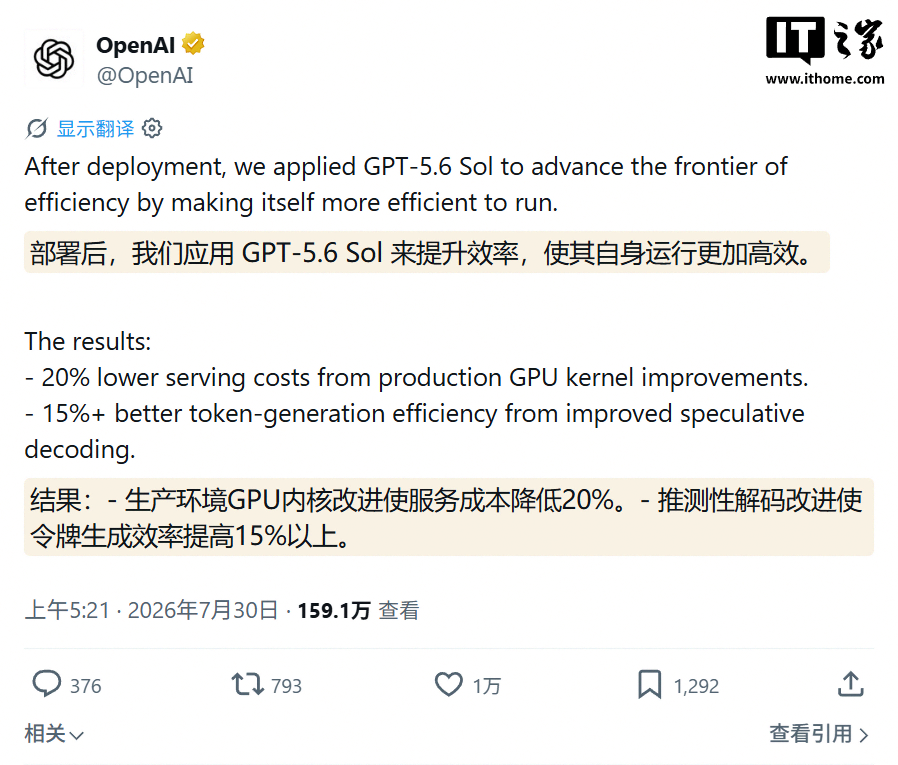
OpenAI published a blog post yesterday (July 29), announcing that it used the GPT-5.6 Sol model to optimize the AI reasoning pipeline of the GPT-5.6 series itself, reducing end-to-end service costs by up to 20%.
OpenAI launched its most powerful AI model, the GPT-5.6 series, on July 9. During subsequent architectural optimization, the official team used the GPT-5.6 Sol model to improve its own operational efficiency, reduce computing costs, and increase GPU utilization.
OpenAI said that the system assigns requests based on region, available capacity, and accelerator type. Within clusters, tasks are also distributed according to factors such as load, context length, and cache availability. GPT‑5.6 Sol uses Codex to analyze production traffic, identify sources of load imbalance, test routing strategies, and adjust heuristic rules.
During the model’s forward pass, GPT‑5.6 Sol identifies work that can be precomputed, avoided, or parallelized, and uses Codex to autonomously rewrite and optimize GPU kernels in the production environment. The relevant screenshots are shown below:
The team trained the GPT-5.6 Sol model on the two programming languages Triton and Gluon, enabling it to optimize inference engine kernels and reduce end-to-end service costs attributable to GPU kernels in the production environment by up to 20%.
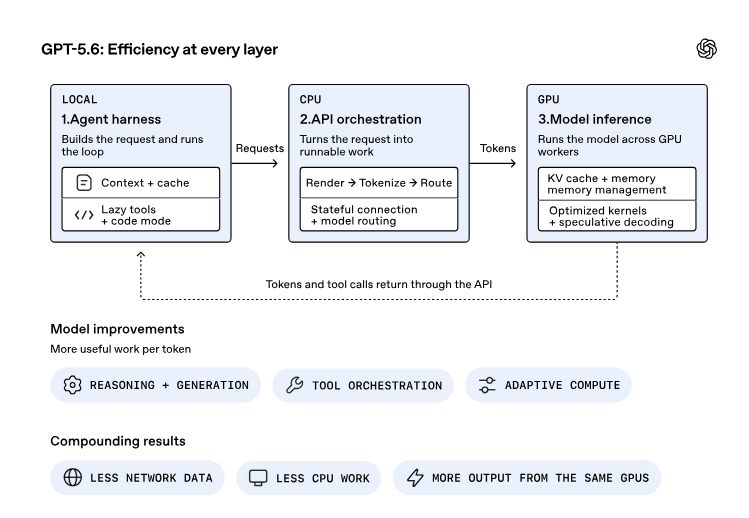
OpenAI also used the open-source tool FpSan (a floating-point cleaner) to verify the correctness of kernels written by GPT‑5.6 Sol.
OpenAI also had GPT-5.6 Sol optimize speculative decoding. This inference acceleration technique uses a smaller draft model to predict the next token, which the main model then verifies or corrects. In a public post dated July 29, 2026, OpenAI said that the improvement increased token generation efficiency by more than 15%.