

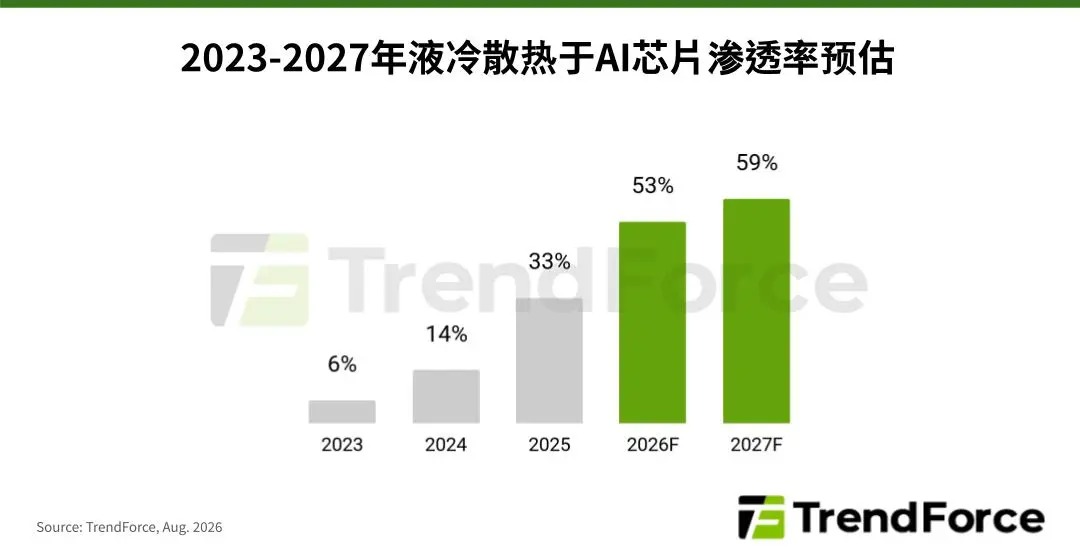
TrendForce recently published a new industry insight report stating that AI chips from NVIDIA, AMD, Google, and other companies continue to evolve, with the TDP of individual chips now generally exceeding 1kW and the power consumption of rack-scale AI servers climbing to hundreds of kW. Liquid cooling is gradually becoming a standard feature of high-end AI infrastructure.
According to the report, chip solutions from NVIDIA, AMD, and other companies have fully adopted liquid-cooling technology. As new AI chips continue to emerge and CSPs (cloud service providers) accelerate upgrades to their AI data center architectures, liquid cooling penetration among AI chips is expected to rise from approximately 33% in 2025 to 53% in 2026.
Google was the first among major CSPs to adopt liquid-cooling technology, which now covers more than 80% of its AI servers. Drawing on years of in-house development experience, Google has established a highly customized liquid-cooling architecture.
From a supply-chain perspective, liquid-cooling systems incorporate key components such as cold plates, manifolds, and coolant distribution units (CDUs). Compared with air-cooling systems, they significantly improve heat dissipation while also enhancing power usage effectiveness (PUE).
As NVIDIA’s Vera Rubin platform fully adopts a fanless, all-liquid-cooled architecture, liquid-cooling coverage is expanding beyond GPUs and CPUs to include CX9 network interface cards, busbars and power boards, optical transceiver modules, and other key components, increasing the thermal-management value of each rack.
Major cold-plate suppliers currently include Cooler Master, AVC, BOYD, and Auras. AVC is expected to begin shipping Vera Rubin cold-plate modules in the third quarter and has entered the AI ASIC platform supply chains of AWS, Google, Meta, OpenAI, and other companies.
As for the heat spreader packaged together with the chip, NVIDIA originally planned to use a two-piece design for the Rubin platform to improve cooling efficiency. However, due to issues including substrate warpage, it is temporarily transitioning with a single-piece solution. Heat spreaders for the Rubin platform are currently supplied exclusively by Jentech.