


According to the Financial Times, Anthropic’s U.S. customers are using cheaper alternatives instead of its most powerful AI tool, raising questions about its high-spending business model ahead of what is expected to be the largest IPO in its history.
Spending data collected by payments group Ramp from 70,000 companies shows that Fable 5, Anthropic’s largest and most expensive model, accounted for only about 11% of total spending more than two months after its launch, and has since leveled off.
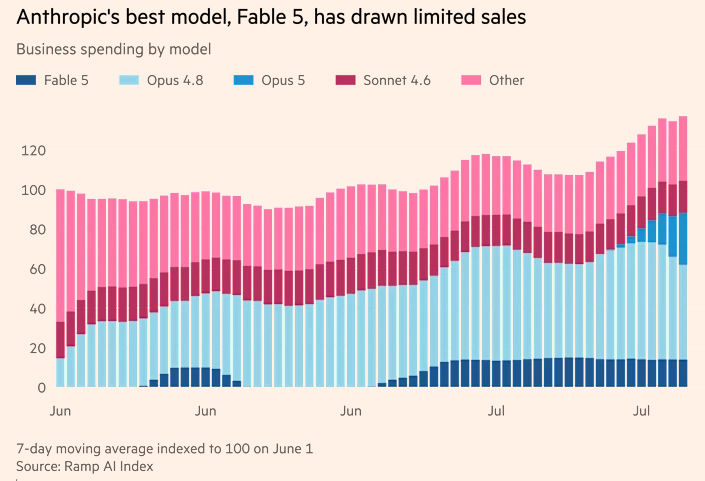
This breaks the pattern of enterprise users defaulting to the most powerful model. Anthropic analysts and investors say the shift is mainly driven by Fable’s high price and the fact that older models can handle most business needs.
If this shift continues, it could fundamentally change the business model of frontier labs. Until now, these labs have directed much of their billions of dollars in development spending toward training larger and more sophisticated models.
“Most people don’t need to operate at the frontier,” said Miles Clements, a partner at Accel, which has invested nearly $1 billion in Anthropic (note: approximately RMB 6.729 billion at current exchange rates). He added that the period when customers tended to choose only frontier models “is not a lasting era.”
Clements said breakthroughs in intelligence remain crucial to fulfilling companies’ grandest promises, such as curing diseases, and to attracting the best researchers, but they will increasingly serve as showcases.
Fable 5’s launch in early June was disrupted by the Trump administration, which forced Anthropic to withdraw the model over national security concerns.
Concerns about further restrictions on access to Fable have eased since the U.S. government approved its relaunch on July 1. According to analysts and investors, political uncertainty has become a secondary factor in customers’ model choices compared with price and performance.
Demand for Fable has declined, and its adoption has been slower than that of previous frontier products, adding to Anthropic’s uncertainty ahead of its IPO. Investors expect the IPO to value the group at $2 trillion (approximately RMB 13.46 trillion at current exchange rates) or more, potentially as early as next month.
Anthropic’s revenue in July fell short of investors’ most optimistic expectations. Investors had expected its annualized sales to exceed $80 billion (approximately RMB 538.329 billion at current exchange rates). Anthropic told shareholders last week that its annualized revenue reached $65 billion (approximately RMB 437.392 billion at current exchange rates) last month, up from $47 billion (approximately RMB 316.268 billion at current exchange rates) in May.
Even so, the startup led by CEO Dario Amodei continues to grow at a remarkable pace, with revenue rising nearly sevenfold since the beginning of the year.
According to people familiar with the matter, Anthropic recorded its first adjusted operating profit in the second quarter of this year and told investors it was likely to be profitable again in the third quarter. The company also told investors that it has 6,000 customers who spend $100,000 (approximately RMB 673,000 at current exchange rates) or more per year.
Enterprises are trying to contain AI spending by using models more efficiently. The emergence of inexpensive open-weight models from China and elsewhere is giving customers more alternatives to leading U.S. labs.
There are also signs that Sam Altman’s OpenAI is catching up after declining for much of 2026. According to people familiar with the matter, the ChatGPT maker’s annualized revenue so far this quarter has jumped 35% and now exceeds $40 billion (approximately RMB 269.165 billion at current exchange rates). GPT 5.6, launched in July, has boosted the company’s performance after a weak start to the year.
GPT 5.6 is priced well below Fable 5. According to Ramp, Anthropic’s own Opus 5, a smaller but powerful and cheaper model, has already surpassed Fable in business spending since its launch at the end of July.
Anthropic’s revenue growth was hit in June, primarily because of the U.S. government’s decision to restrict Fable’s rollout, but it has since rebounded.
Ara Kharazian, Ramp’s chief economist, said data-retention rules imposed by the Trump administration also hindered Fable’s adoption.
Kharazian said forecasting the company’s trajectory over the next few months is nearly impossible. “If you extrapolated from the previous trend, you would expect Anthropic to dominate the market. But because [OpenAI’s latest model] is so good and Fable is underperforming, the result is exactly the opposite,” he added.