

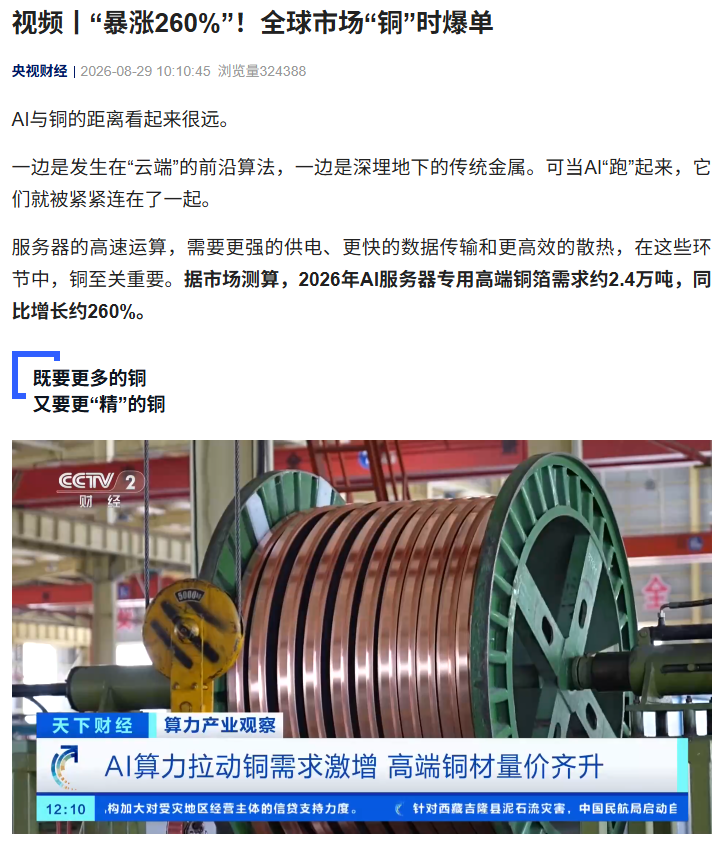
According to a report by CCTV News today, AI and copper may seem worlds apart. One involves cutting-edge algorithms operating in the “cloud,” while the other is a traditional metal buried deep underground. But when AI “runs,” the two become tightly connected. High-speed server computing requires stronger power delivery, faster data transmission, and more efficient cooling. Copper is crucial in all these areas. Market estimates indicate that demand for high-end copper foil dedicated to AI servers will reach approximately 24,000 tons in 2026, up about 260% year over year.
A conventional server typically requires only a few kilograms of copper, while a high-performance server used for artificial intelligence training can contain 15 to 30 kilograms, 3 to 6 times as much as an ordinary server. As liquid cooling becomes more widely adopted, copper, which offers good thermal conductivity, is increasingly used in cooling components such as cold plates.
In Yingtan, Jiangxi, a copper-material processing company is operating its production line around the clock, with orders booked through year-end. Its products are mainly used in cold plates for AI computing chips. Monthly output exceeds 2,000 tons, and orders have increased 30% year over year.
In addition to cooling, AI servers must handle large volumes of high-speed data transmission, further raising performance requirements for copper materials. In Chizhou, Anhui, one company produces ultra-low-profile copper foil mainly for high-speed PCBs in AI servers. Its surface roughness can be controlled to within 2 micrometers, and its signal transmission rate is 70% higher than that of traditional copper foil.
Since the fourth quarter of last year, some high-end copper foil for computing applications has remained in short supply. Companies report that processing fees for some advanced copper foils have risen 30% to 50% since December last year. This year, prices for ultra-low-profile copper foil compatible with AI servers and high-speed computing equipment have increased by approximately 10% to 30%.
Market estimates indicate that demand for high-end copper foil dedicated to AI servers will reach approximately 24,000 tons in 2026, up about 260% year over year. This means that the growth of computing power is driving not only an increase in copper consumption, but also a concentration of demand in high-thermal-conductivity, high-frequency, high-speed, and high-precision copper materials.
Ultra-low-profile copper foil (HVLP / VLP copper foil) has become a key material for high-speed PCBs in AI servers because of the “skin effect” in high-frequency signal transmission: signal current concentrates in an extremely thin layer on the conductor’s surface, and the rougher the copper foil surface, the greater the signal transmission loss. HVLP (ultra-low-profile) copper foil uses a special electroplating process to control surface roughness Rz to below 1.5μm to 3μm. Compared with ordinary copper foil, it can significantly reduce signal attenuation and is a standard material for high-speed copper-clad laminates at M7/M8 grades.
Looking at longer-term demand trends, market estimates suggest that global demand for high-end copper foil dedicated to AI servers could grow to approximately 50,000 tons in 2027 and exceed 110,000 tons in 2030. In addition, Morgan Stanley expects global data-center copper demand to reach 1.3 million tons by 2028, doubling from 2026. Incremental demand will come not only from inside AI servers, but also from liquid-cooling systems, high-speed connectors, and power-supply infrastructure.
Copper prices have generally strengthened since the beginning of this year. Three-month copper futures on the London Metal Exchange (LME) have risen by more than 14% cumulatively, reaching $14,000 per ton in mid-August. Domestically, the main Shanghai copper contract rose from approximately 86,000 yuan per ton at the beginning of the year to nearly 109,000 yuan at one point.