

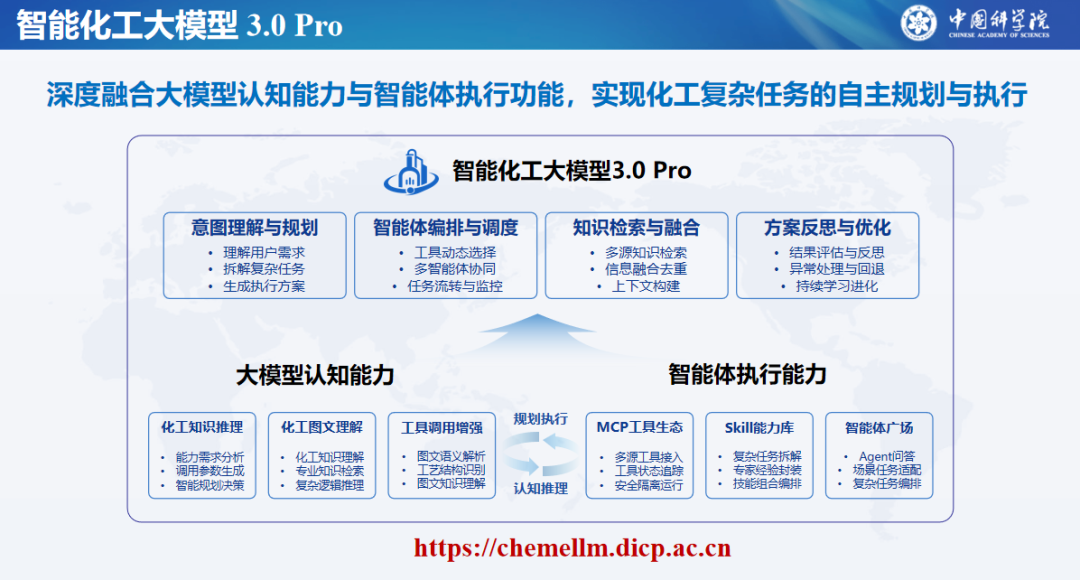
The Intelligent Chemical Engineering Foundation Model 3.0 Pro (hereinafter referred to as “3.0 Pro”), jointly developed by the Dalian Institute of Chemical Physics of the Chinese Academy of Sciences (hereinafter referred to as the “Dalian Institute of Chemical Physics”), iFlytek Co., Ltd. (hereinafter referred to as “iFlytek”), Alibaba Cloud Computing Co., Ltd. (hereinafter referred to as “Alibaba Cloud”), and others, was officially released on August 31.
As the latest iteration of China’s first foundation model for the chemical engineering industry, 3.0 Pro marks a major transition from a “professional knowledge question-answering model” to an “intelligent chemical engineering task execution system,” advancing intelligent chemical engineering foundation models from “understanding and answering” to “planning, executing, and verifying.” It further upgrades from a “professional assistant” that supports knowledge acquisition to an “intelligent engineering partner” capable of collaborating with professionals on complex tasks, providing a new technological foundation for intelligent chemical engineering research and development, engineering design, and production operations.
The chemical engineering industry is characterized by complex objects, wide variations in scale, diverse data types, and strong engineering constraints, making it difficult for general-purpose foundation models to meet specialized needs. Since releasing the Intelligent Chemical Engineering Foundation Model 1.0 in March 2024, the Dalian Institute of Chemical Physics has continued to advance model iteration and capability upgrades.
3.0 Pro moves beyond the traditional application model of foundation models, which focuses primarily on knowledge question answering and content generation, and establishes a four-layer technical architecture of “foundation model — intelligent agent — professional skills and tools — application scenarios.” These layers include:
The foundation model serves as the cognitive core, responsible for understanding professional knowledge, parsing multimodal information, generating solutions, and planning tasks;
The intelligent agent serves as the execution主体, carrying out process decomposition, tool invocation, result verification, and dynamic adjustment around task objectives to create closed-loop capabilities spanning cognition, reasoning, planning, execution, and verification.
3.0 Pro integrates more than 400 chemical engineering intelligent agents and tools. It has undergone continuous pretraining on chemical engineering professional corpora at the tens-of-billions-of-token level and supervised fine-tuning using high-quality question-and-answer data at the billions-of-tokens level, providing professional support for complex chemical engineering tasks.
According to a multidimensional evaluation system for the chemical engineering field, 3.0 Pro achieved text question-answering and multimodal question-answering accuracy rates of 81.96% and 80.75%, respectively. Its overall scores increased by 20.2% and 31.4%, respectively, compared with version 3.0.
The Intelligent Chemical Engineering Foundation Model is an important part of the new intelligent chemical engineering R&D paradigm built by the Dalian Institute of Chemical Physics to take laboratory research “from one step to the factory.” To date, more than 300 chemical engineering enterprises, universities, and research institutes have registered to use the model, with cumulative API calls exceeding 14 million.
At the data infrastructure level, the Dalian Institute of Chemical Physics has also built China’s first petrochemical and chemical engineering big data center covering the entire chain of “R&D — design — production — market.” It has been selected as a leading and pilot organization for the National Data Administration’s high-quality dataset development initiative in the petrochemical and chemical engineering industry. On Changxing Island in Dalian, it has built China’s first 1,000-ton intelligent pilot-scale platform, developing the capability to generate on demand real-world catalytic reaction and process data under operating conditions that are difficult to cover in laboratories and difficult to obtain from industrial facilities.
Meanwhile, the Dalian Institute of Chemical Physics, iFlytek, Alibaba Cloud, Huawei Technologies Co., Ltd., Ningbo Data Group (筹), SUPCON Technology Co., Ltd., AVEVA, and other organizations have established a Joint Innovation Laboratory for Intelligent Chemical Engineering. The laboratory will conduct joint research on key technologies, jointly build platforms, validate scenarios, and commercialize results in areas including intelligent chemical engineering foundation models and agent R&D, industry data and computing platform development, industrial software integration, and typical application scenarios.
Going forward, the Dalian Institute of Chemical Physics will continue to optimize and iteratively develop Intelligent Chemical Engineering Foundation Model 4.0, featuring deep reasoning and collaborative planning across multiple tools. Using mature processes such as methanol-to-olefins as validation scenarios, it will gradually connect key stages including laboratory R&D, engineering design, and factory operations, establishing a new chemical engineering R&D paradigm that takes laboratory research “from one step to the factory.”