
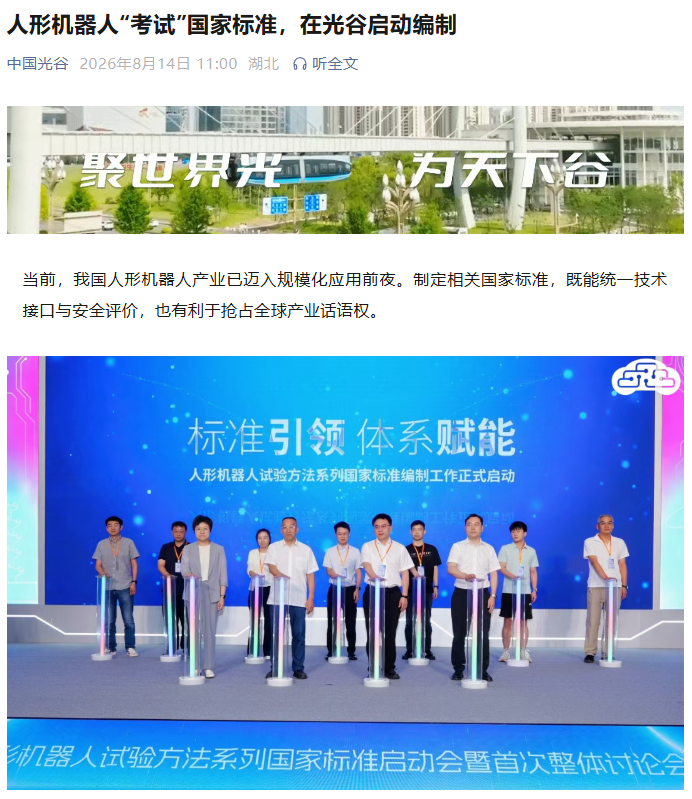
According to “China Optics Valley,” on August 13, the launch meeting for the Series of National Standards for Humanoid Robot Testing Methods was held in Wuhan Optics Valley. At the meeting, the development of seven standards, including General Principles, Environmental Perception, Decision-Making and Planning, and Motion Control, was launched simultaneously.
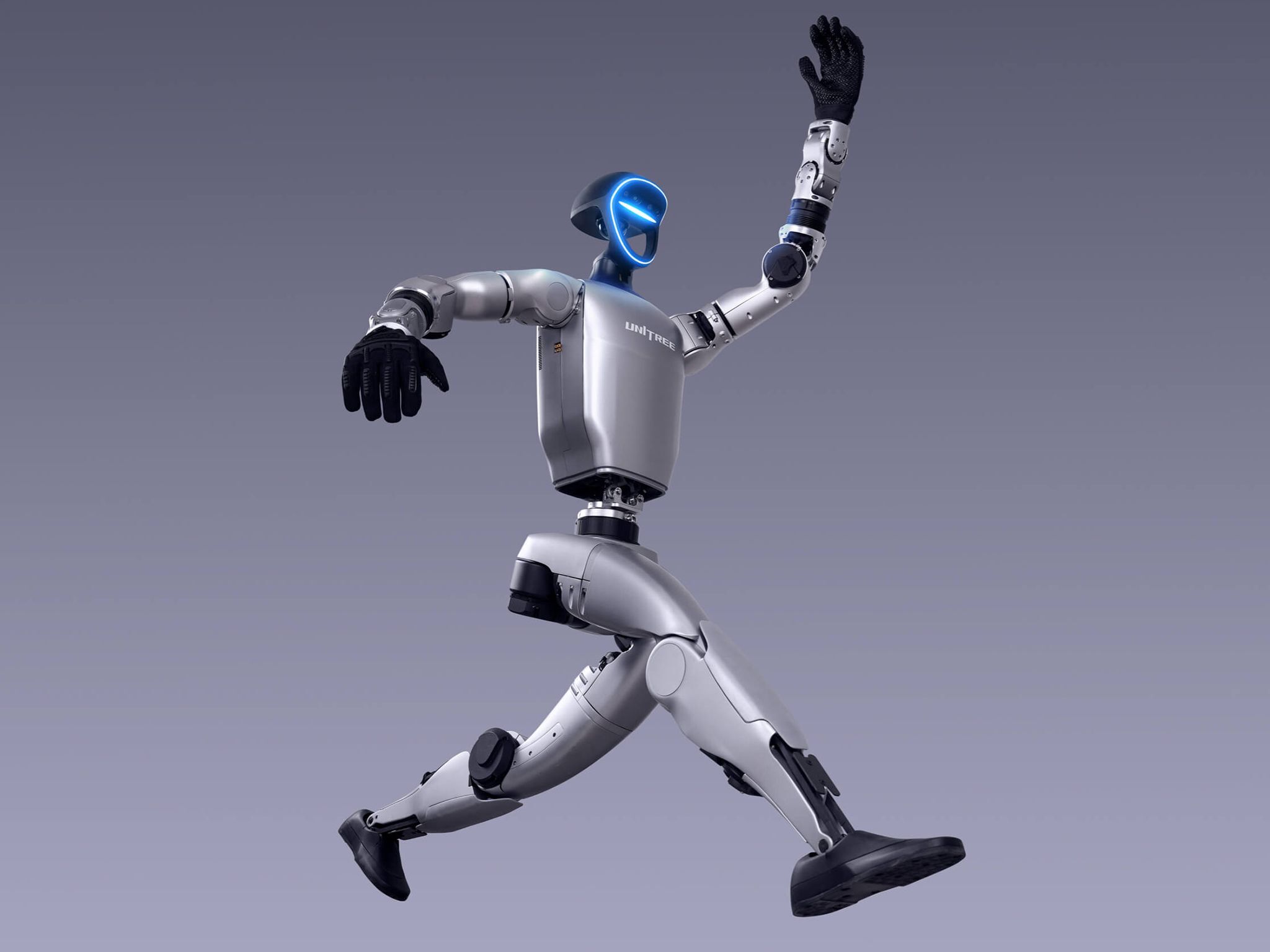
More than 200 industry representatives from leading domestic companies, including Unitree Robotics, Xiaomi Robotics, MagicLab, ZTE, DEEP Robotics, Horizon Robotics, Embodied Intelligence, and Galaxy General, as well as universities including Wuhan University, Huazhong University of Science and Technology, Nanjing University of Aeronautics and Astronautics, Northwestern Polytechnical University, China Jiliang University, and Bamberg University, attended the meeting.
At the event, the Humanoid Robot and Embodied Intelligence Standards Working Group of the Hubei Electronic Information Standardization Technical Committee was officially established. Its first group of members includes 29 organizations, such as the Hubei Humanoid Robot Innovation Center, the Hubei Institute of Metrology and Measurement Technology, Wuhan University, and Huazhong University of Science and Technology.
Liu Xin, secretary-general of the Humanoid Robot Subcommittee of the National Robot Standardization Technical Committee, said that testing methods specify how humanoid robots should be tested and how to determine whether they truly meet the requirements—equivalent to a nationally recognized “exam syllabus.” “At present, every robotics company has different technical standards and testing methods, making large-scale replication difficult. Only when standards are established can the industry truly move forward.”
According to information from the Ministry of Industry and Information Technology, quadruped robots developed in China accounted for nearly 70% of global sales in the first half of this year. More than 400 humanoid robot products have been developed, accounting for over half of the global total. Official estimates indicate that the core industry of artificial intelligence in China exceeded 1.2 trillion yuan in 2025. As large models, intelligent agents, and artificial intelligence chips continue to iterate rapidly, annual humanoid robot production is expected to exceed 100,000 units this year.