

- Monthly visits
- 0
- Pricing
- Free & Paid
- Listed
- 2025-08-30
- Updated
- 2026-08-25
01Product Positioning
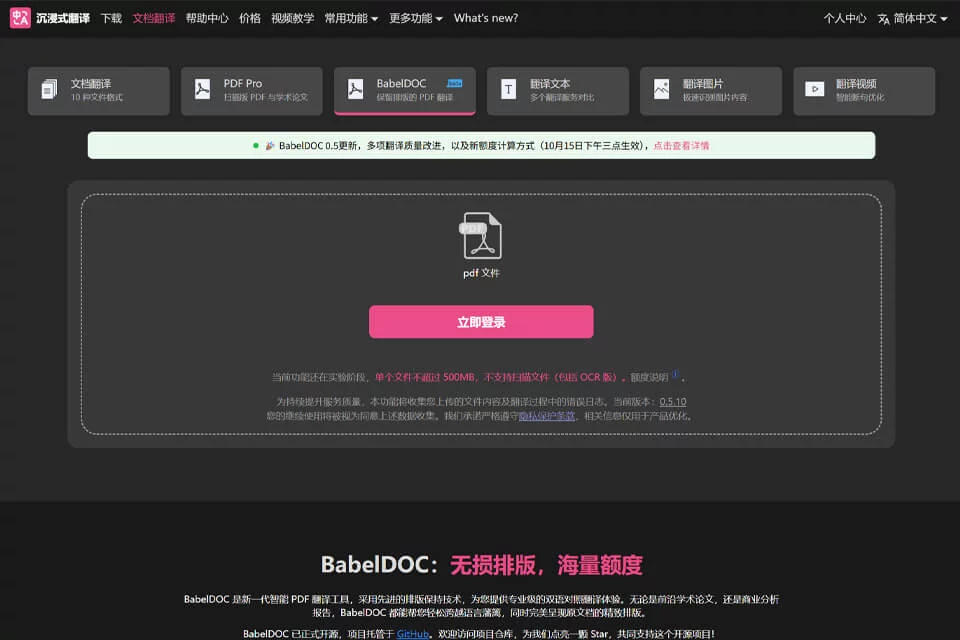
BabelDOC is an open-source tool focused on document translation, with an emphasis on supporting the reading of foreign-language PDFs. It analyzes documents in a structure-aware manner and outputs versions that compare the original and translated text, reducing the impact of post-translation layout changes on reading.
The tool is suitable for researchers, students, and technical professionals who regularly consult foreign-language materials. It is best used as an aid for understanding, searching, and initially organizing literature rather than as a replacement for professional human proofreading.
02Key Features
BabelDOC supports bilingual translation output, with side-by-side or paragraph-by-paragraph reading formats. For mathematical formulas, figures, tables, and references in documents, it attempts to preserve the original structure and positioning.
Users can switch between multiple translation engines, batch-process multiple PDFs, or translate only specified page ranges. The tool also offers online access, command-line operation, Python API integration, and self-hosting.
03Use Cases
Researchers can use it to organize and read foreign-language academic papers, students can use bilingual versions to understand textbooks and specialized materials, and technical professionals can consult technical documentation and product manuals.
When users need to process multiple documents at once or focus only on specific sections of a document, batch processing and page-range settings reduce repetitive work. For materials where the original layout matters, bilingual output also makes it easier to locate the corresponding source content.
04Usage Considerations
Translation accuracy and layout quality are affected by the structure and content type of the source document, as well as the selected translation engine. Even when formulas, tables, and figures are preserved, their positions, text, and correspondences should be checked before formal citation or publication.
Materials with dense terminology, complex meaning, or specialized judgment should not be reused directly without review. Before starting a batch translation, test a small number of pages to evaluate the output, then select the engine and processing range.
© Disclaimer: domains and linked content may change over time. AIEZZ does not control third-party websites. Review external content and risks independently.
User reviews0