
- Monthly visits
- 0
- Pricing
- Not set
- Listed
- —
- Updated
- 2026-11-05
01What Is OmniEdu?
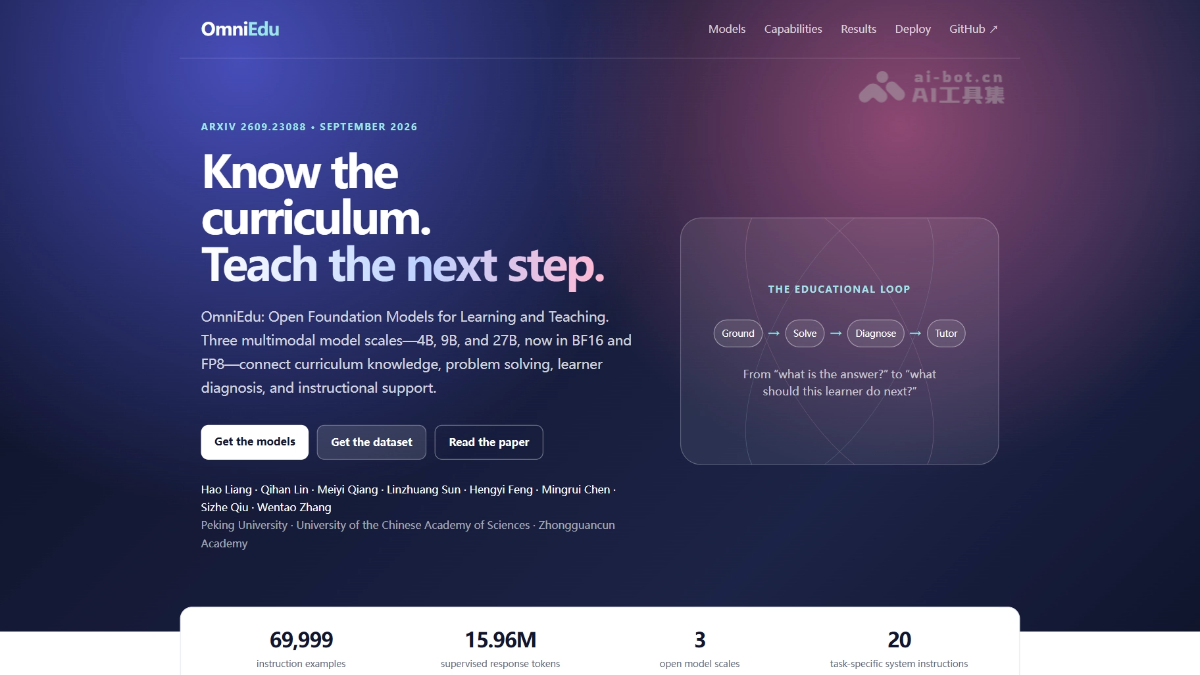
OmniEdu is a series of open-source educational multimodal models developed by Peking University's DCAI team in collaboration with UCAS and Zhongguancun Academy, available in 27B, 9B, and 4B sizes. OmniEdu emphasizes teaching capabilities: it can solve subject questions, identify the curriculum position of knowledge points, diagnose the causes of students' mistakes, and select appropriate teaching actions. The team selected approximately 69,000 samples from 1.34 million candidate data items for training, enabling the models to achieve SOTA performance on multidisciplinary, diagnostic, and tutoring tasks. The 4B small model can be deployed on ordinary servers, lowering the barrier to adoption for schools.
02OmniEdu's Main Features
Subject problem solving: Covers mathematics, science, reading comprehension, and writing, providing correct answers while keeping explanations consistent with the question conditions and reasoning process.
Curriculum understanding: Identifies the knowledge point, grade level, difficulty, and prerequisite relationships associated with a question, determining what needs to be supplemented before learning can continue.
Diagnostic reasoning: Uses students' solution processes and incorrect answers to locate the step where an error occurred, analyze misunderstandings, and identify missing knowledge, rather than relying solely on the question to guess.
Teaching actions: Selects an appropriate response based on the task, including hints, guided questions, review of prerequisite concepts, identification of errors, or a complete explanation.
03How OmniEdu Works
Follow the WeChat account and reply “开源” to join the AI open-source project group.
Task-goal-driven data design: Training data was cleaned, semantically reviewed, quality-assessed, and diversity-filtered from approximately 1.34 million candidate samples, retaining about 69,000 samples. Each educational sample is categorized by four capability types and assigned one of 20 task instructions. “What the sample teaches” and “how the model should respond” are annotated separately, enabling the model to switch behaviors by task.
Semantic review and rewriting: Language models review samples according to task-specific standards, checking solution correctness, curriculum relationships, diagnostic evidence, and scaffolding quality. Unqualified samples are rewritten under supervision and reviewed again. Multimodal samples are also checked for consistency between images and text, while source license information is retained and non-compliant sources are excluded.
Deduplication and structural standardization: Message formats are standardized; duplicate, incomplete, and structurally corrupted samples are removed; answers for verifiable tasks are checked; and training data is deduplicated against evaluation sets to prevent distorted results.
Balancing the training mix by token budget: Long tutoring dialogues contain more supervised tokens than short answers, so sampling by sample count would overrepresent long dialogues. Token budgets are allocated by task category, while stricter thresholds are applied to key dimensions during diversity selection to control the actual amount of supervision received by each teaching task.
04How to Use OmniEdu
Method 1: Run locally (Transformers) Install dependencies: run pip install -U torch torchvision transformers accelerate safetensors pillow (FP8 weights additionally require compressed-tensors).
Load the model: use AutoProcessor and Qwen3_5ForConditionalGeneration.from_pretrained to load the corresponding model ID, such as lhpku20010120/Omni-Edu-4B. Replace the ID for the 9B or 27B model.
Construct the input: organize the student's question, answer, or image into messages using the chat template. For image-based questions, add a {"type": "image"} item.
Generate a response: call generate (be sure to set enable_thinking=False), then use batch_decode to decode the output.
Method 2: Deploy as a service (vLLM, recommended) Start the service: run vllm serve lhpku20010120/Omni-Edu-4B --max-model-len 32768 --reasoning-parser qwen3 --default-chat-template-kwargs '{"enable_thinking": false}' (use Omni-Edu-4B-FP8 for the FP8 version, and set --tensor-parallel-size for multiple GPUs).
Send requests: access http://localhost:8000/v1/chat/completions with curl and ask questions using the OpenAI-compatible format.
Method 3: Use the official toolkit Install the SDK: run pip install omniedu (install omniedu[eval] for evaluation).
Chat: call OmniEdu.from_pretrained("4B", base_url=service address), then ask questions with model.chat(text=...).
Evaluate and compare: run omniedu eval --list to view 12 educational evaluation benchmarks and generate a report.
05OmniEdu's Core Advantages
Task-instruction-driven behavior switching: 20 system instructions enable the same model to distinguish among step-by-step problem solving, error diagnosis, Socratic questioning, and tutoring dialogues according to the task.
Carefully designed, high-quality training data: Approximately 70,000 samples were selected from 1.34 million candidates after semantic review, deduplication, and token-budget balancing, with “what to teach” and “how to teach” clearly defined.
SOTA-level performance: The 27B model won 51 of 60 comparisons against five frontier models, including GPT-5.4 and Claude-Opus-5, and ranked first on multiple educational metrics.
Significant gains from scaffolded teaching: The highest scaffolding win rate on MathTutorBench increased from 14% to 78.74%, demonstrating that teaching behavior can be effectively trained.
Multiple sizes for different scenarios: The 4B, 9B, and 27B models cover a range of use cases, while FP8 versions reduce download size by 37%–44%. The small models can be deployed on ordinary school servers.
06OmniEdu Project Links
Official website: https://haolpku.github.io/Omni-Edu/
GitHub repository: https://github.com/haolpku/Omni-Edu
Hugging Face model repository: https://huggingface.co/datasets/lhpku20010120/Omni-Edu
arXiv technical paper: https://arxiv.org/pdf/2609.23088
07OmniEdu Use Cases
Personalized learning support: When students solve problems, the model first identifies where they are stuck, then uses hints and follow-up questions to guide independent thinking, making it suitable for self-study scenarios.
Incorrect-answer diagnosis: Teachers input students' solution processes into the model, which automatically analyzes the causes of errors and corresponding knowledge gaps and generates targeted remediation suggestions, reducing the grading workload.
Curriculum-aligned content generation: Teachers generate practice questions, differentiated assignments, or explanatory materials based on specified curriculum standards and grade levels, with knowledge-point associations and prerequisite relationships labeled automatically.
Classroom interaction assistant (Socratic teaching): The model acts as a teaching assistant, using guided questions to advance students' reasoning and adjusting teaching strategies based on evidence to support differentiated instruction.
© Disclaimer: domains and linked content may change over time. AIEZZ does not control third-party websites. Review external content and risks independently.
User reviews0