
- Monthly visits
- 0
- Pricing
- Free & Paid
- Listed
- 2026-08-06
- Updated
- 2026-08-06
01What Is Omega?
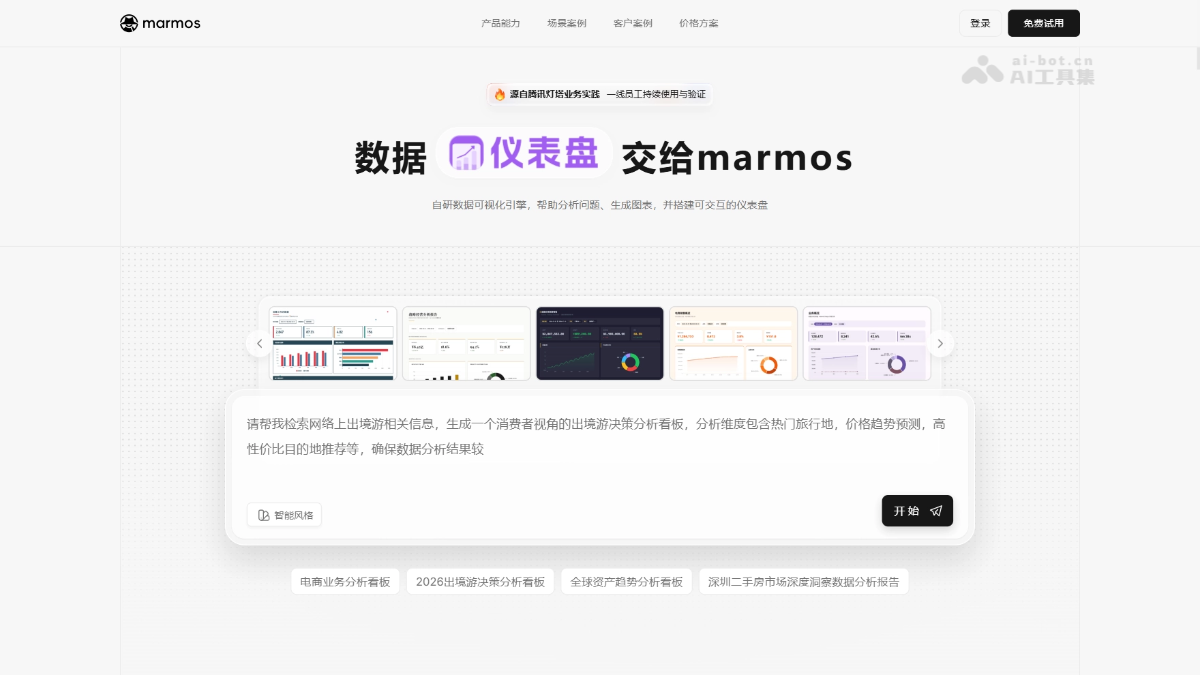
Omega is an AI-native data analysis platform launched by Tencent. Its internal beta version is called “Marmos (marmos).” Powered by an Agent, the tool enables a complete analysis workflow, allowing users to generate interactive, iterative, and regularly refreshed data dashboards with natural language, truly embedding AI into business workflows.
02Key Features of Omega
One-click AI dashboard generation: After users upload data or connect to a database, they can describe their analysis needs in one sentence. The Agent automatically plans metrics, generates SQL, selects charts, and organizes the page, producing a complete dashboard in seconds.
Natural-language iterative editing: Supports precise modifications to existing dashboards, such as “Change the second chart to a line chart” or “Add a region filter.”
Intelligent filter linkage: Through the QueryRegistry data contract, the system automatically calculates the set of affected charts after a filter changes and refreshes them accordingly.
Semantic model integration: Supports integrating existing enterprise semantic models. The Agent uses logical fields to generate SemanticQL, which the query service automatically converts into physical SQL.
Monitoring alerts and scheduled delivery: Alert rules combining multiple cards can be configured on any chart card. The latest data can be delivered as screenshots on a weekly or monthly schedule, with anomalies automatically sent to WeCom or email.
Multi-style visualization engine: Includes 23 visual styles and 18 visualization engines, covering scenarios such as cyberpunk big-screen dashboards, mobile daily reports, and minimalist financial reports.
Version management and collaboration: Every edit is automatically recorded, with support for diff comparison and rollback. Dashboards can be shared, copied, and published, while permissions are reauthorized in the target space.
03How to Use Omega
Register on the official website: Visit the Omega official website at https://marmos.qq.com/ to complete registration and log in.
Connect a data source: Connect a database in the console or upload a local Excel / CSV file.
Start an analysis conversation: Enter an analysis request in the chat box, such as “Show me the sales figures for each region last month.” The AI automatically reads the schema and plans the metrics.
Confirm dashboard generation: After the Agent generates the dashboard, you can switch between visual styles, click charts to view details, or adjust filters.
Optimize through natural-language iteration: Speak directly to unsatisfactory charts, such as “Change it to a bar chart” or “Make the color scheme lighter.” The AI precisely locates and applies the modification.
Set up monitoring and delivery: Configure alert rules for key chart cards in the dashboard and set up weekly or monthly scheduled delivery to WeCom or email.
Share and collaborate: Click the share button to send the dashboard to your team. Members can view, edit, or continue analyzing based on the current results within the scope of their permissions.
04Core Advantages of Omega
Complete closed-loop analysis workflow: From data understanding, metric planning, and chart generation to monitoring alerts and scheduled delivery, it covers the full BI lifecycle rather than providing one-off answers.
Seamless human-AI collaboration: Natural language is suitable for expressing intent, while the GUI is suitable for precise adjustments. Plan Mode lists a modification plan before execution, preventing vague instructions from disrupting the entire page.
Trusted and continuously usable data: QueryRegistry + DTBridge ensure stable and reliable filter linkage, data refreshes, and field bindings, so dashboards continue to work properly the next day and the following week.
Cost-controlled, high-value solution: Harness rule layers intercept deterministic errors, enabling cost-effective models to reliably complete complex dashboards and reducing invocation costs by 30 times.
Enterprise-grade security and permissions: A zero-leakage architecture, AST read-only validation, two-way auditing, and private deployment options meet data security requirements for production environments.
05Omega Use Cases
E-commerce business analysis: Automatically integrates data from multiple systems, including orders, inventory, fulfillment, and marketing, generates weekly reports, monitors anomalies, and automatically sends them to the group at 8 a.m. every Monday.
Content operations monitoring: Aggregates multi-platform UV distribution and IP playback rankings, tracks content fluctuations in real time, and turns support decisions from “going by feel” into “looking at the rankings.”
Financial business reporting: When a financial BP is asked an unexpected question by the CEO during a meeting, they can generate a P&L waterfall chart on the spot, breaking revenue down into 7 factors so the data follows the questions.
Product governance and deduplication: Uses content fingerprints for 5-layer deduplication, automatically identifies identical products across stores and duplicate sources within a store, and prioritizes them by contribution. Governance shifts from “making decisions by guesswork” to “looking at the data.”
Marketing attribution: After a major promotion, breaks down spending peaks across channels, creatives, and audiences, automatically flags ineffective channels in red, and directly reuses the winning combination for the next promotion.
© Disclaimer: domains and linked content may change over time. AIEZZ does not control third-party websites. Review external content and risks independently.
User reviews0