- Monthly visits
- 0
- Pricing
- Not set
- Listed
- —
- Updated
- 2026-10-29
01What is MiniCPM-OCR?
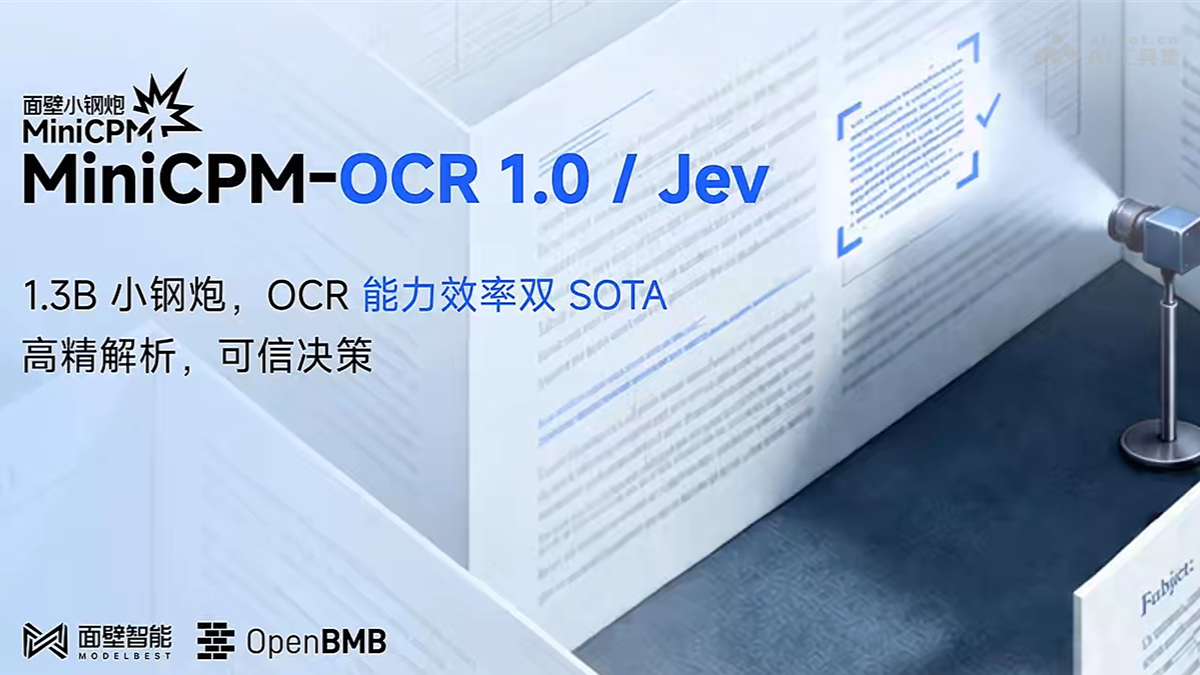
MiniCPM-OCR is an OCR model series released and open-sourced by ModelBest. MiniCPM-OCR 1.0 (1.3B) is designed specifically for document parsing, achieving SOTA results on both Real5-OmniDocBench and OCRBench v2. DSpark decoding acceleration delivers throughput of 1.217 pages per second, making it fast and accurate; MiniCPM-OCR Jev (2B) is the industry's first model for evaluating parsed results. It outputs quality scores, automatically filters results that do not require manual review, and reduces labor costs. MiniCPM-OCR is suitable for privacy-sensitive scenarios in finance, taxation, legal services, healthcare, and other fields, and supports local on-device operation and fine-tuning.
02Key Features of MiniCPM-OCR
Document parsing and structuring: Restores the layout structure of documents such as bills, contracts, reports, and medical records, outputting Markdown or field-based data.
Complex layout recognition: Supports seven common scenarios, including multi-column newspapers, wide financial tables, handwritten notes, complex matrix formulas, and documents obscured by seals.
Automatic image correction: Automatically detects and corrects rotated or upside-down documents without requiring manual adjustment.
Cross-page content merging: Merges information across pages of long documents for integration with business systems.
Parsing quality evaluation (Jev): Outputs a 0–1 quality score for the parsing results of any OCR system to determine their reliability.
Manual review routing: Automatically filters results by score threshold, sending high-scoring results directly to storage and routing low-scoring results to manual review, greatly reducing verification workload.
Multi-model selection: Jev scores each region after parsing with multiple models and selects the best combination, improving the overall score by up to 0.25.
Key information extraction (KIE): Extracts key fields from scenarios such as seal-obscured documents and receipts.
03How MiniCPM-OCR Works
Follow WeChat and reply “Open Source” to join the AI open-source project community.
Powerful foundation: Trained on the MiniCPM-V 4.6 multimodal model, reusing the large-scale, high-quality document pretraining data accumulated by the MiniCPM-V/o series. This gives the model strong image and document understanding capabilities before specialized OCR training, allowing training to focus on recognition accuracy and structured output.
Efficient architecture: Uses the LLaVA-UHDv4 efficient visual tiling approach to prevent computational cost from growing with high-resolution images, and integrates automatic Upright and adaptive Upsize designs.
Data synthesis and reinforcement learning: Collects seed data from numerous real-world scenarios and expands it at scale through Agentic synthesis, balancing real-world characteristics and diversity. It then performs large-scale reinforcement learning on complex real-world scenarios to improve parsing quality for long-tail samples.
DSpark decoding acceleration: A lightweight draft module proposes multiple candidate tokens at once, while the main model verifies them in parallel, replacing token-by-token generation. This improves end-to-end efficiency by 55% without sacrificing quality.
Jev fast-thinking evaluation approach: Uses a System-1 design with a single forward prefill computation and no autoregressive decoding, enabling extremely low latency for frequent quality-control checks. It is trained on block-level correctness labels from real human annotations, allowing its scores to be used directly as business thresholds.
04How to Use MiniCPM-OCR
Local inference deployment: Use the Hugging Face CLI to download model weights (openbmb/MiniCPM-OCR-1.0 or openbmb/MiniCPM-OCR-Jev).
Install an inference framework (initially compatible with vLLM, SGLang, llama.cpp, and Ollama; choose one as needed. The general startup command for OpenBMB models is vllm serve openbmb/<model-name> --port 8000).
Select a quantized version based on your hardware. Multiple chips and quantization formats are supported; GGUF/INT4 versions are available for on-device or low-compute environments.
Input document images, and the model automatically performs correction, layout analysis, and structured parsing, outputting Markdown or field-based results.
05Core Advantages of MiniCPM-OCR
Dual-SOTA accuracy: 93.68 on Real5-OmniDocBench and 54.7 on OCRBench v2, leading the next-best model by 7.7 points. In a comparison of 14 mainstream models across six benchmarks, it ranked first on four.
Leading efficiency: DSpark decoding acceleration improves end-to-end efficiency by 55% and delivers throughput of 1.217 pages per second, making it the only model in the efficiency–quality chart that is both “fastest and most accurate.”
Extremely lightweight: With only 1.3B parameters, it outperforms larger models and supports on-device and limited-compute environments. It can run locally to meet privacy requirements.
Reliable and evaluable results: Jev is the industry's first OCR quality-control model. Its AUROC of 93.6 surpasses 35B-class evaluation models, making it possible to predict for the first time which pages require manual review.
Plug-and-play quality control: Jev is not tied to a specific OCR system. It maintains an AUROC of 91.9~93.4 across systems including GLM-OCR and PaddleOCR-VL.
06MiniCPM-OCR Project Links
GitHub repository: https://github.com/OpenBMB/MiniCPM-OCR
Hugging Face model repository: https://huggingface.co/openbmb/MiniCPM-OCR-1.0
https://huggingface.co/openbmb/MiniCPM-OCR-Jev
07MiniCPM-OCR Use Cases
Financial document processing: Automatically recognizes and structures bank statements, checks, and payment slips for data entry. After Jev quality control, high-scoring documents go directly into storage, reducing manual counter data entry.
Legal contract review: Law firms and legal departments can parse contract text in batches. Local deployment keeps documents within the organization, while Jev enables up to 85% of pages to bypass manual review, greatly reducing verification time.
Medical record digitization: Hospitals can convert paper medical records and test reports into structured electronic data. Private deployment meets patient privacy and compliance requirements.
Government archive management: Recognizes official documents, identification documents, and stamped files, and extracts key information (KIE), automatically retrieving key fields obscured by seals.
© Disclaimer: domains and linked content may change over time. AIEZZ does not control third-party websites. Review external content and risks independently.
User reviews0