
- Monthly visits
- 0
- Pricing
- Free
- Listed
- 2025-09-01
- Updated
- 2026-05-16
01Positioning
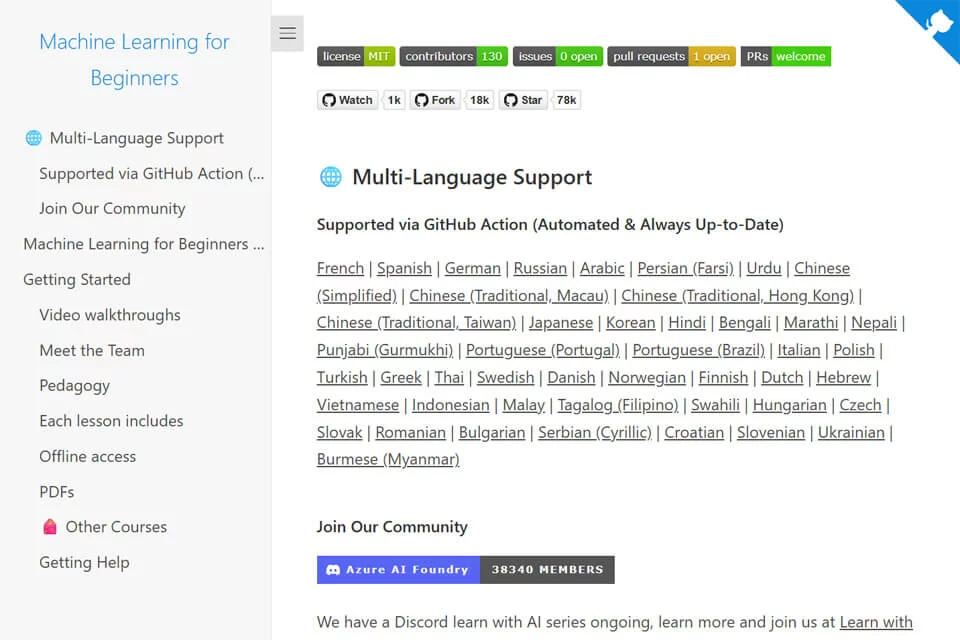
ML For Beginners is a machine learning course for beginners. Centered on classical machine learning, it helps learners build foundational knowledge and practical skills through a sequence of lessons and hands-on projects.
The course provides a 12-week, 26-lesson learning path for individuals who want to understand machine learning from the ground up. It emphasizes common topics such as regression, classification, and clustering, rather than deep learning models.
02Key Features
The course covers topics including the history of machine learning, regression, classification, clustering, and natural language processing. Each lesson centers on a practical project, such as performing regression analysis with pumpkin price data or learning classification with food data.
Learning resources include pre-lesson quizzes, instructional content, Jupyter Notebook code examples, post-lesson assignments, and accompanying videos. The hands-on work primarily uses Python and involves data science tools such as Scikit-learn, Pandas, and Matplotlib.
03Use Cases
It is suitable for beginners with no machine learning experience who want a systematic introduction. It can also supplement classroom learning for students or help career changers build a foundation in data science and artificial intelligence.
Developers with programming experience can use it to learn about machine learning workflows and commonly used tools. Learners can follow the lessons in order, read the explanations, complete the quizzes, and reinforce each topic with the code examples and assignments.
04Usage Considerations
The course is free and open source. Learners can access the materials through GitHub and complete the exercises step by step according to the course schedule. Because it focuses on classical machine learning, users who plan to study deep learning, model deployment, or other advanced topics will still need additional materials.
The course includes code examples and assignments, and its effectiveness depends on being able to run the code, understand the data processing steps, and complete the exercises. Before starting, prepare a learning environment suitable for Python and Jupyter Notebook.
© Disclaimer: domains and linked content may change over time. AIEZZ does not control third-party websites. Review external content and risks independently.
User reviews0