

- Monthly visits
- 0
- Pricing
- Free & Paid
- Listed
- 2026-06-02
- Updated
- 2026-08-25
01About Extend
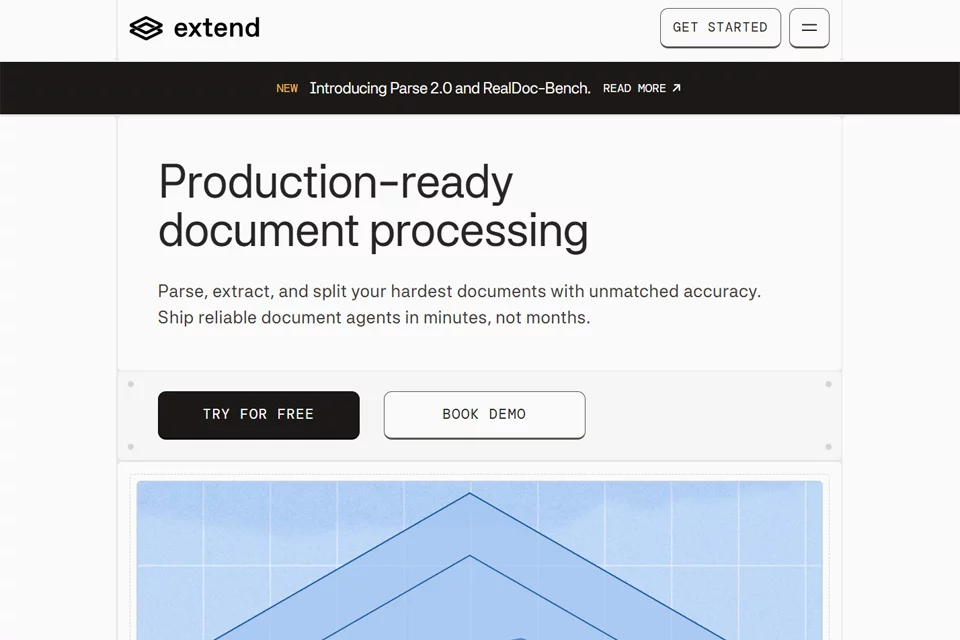
Extend is a developer platform for processing unstructured documents. Users can upload and process files through the API, CLI, or Studio to perform layout parsing, structured field extraction, multi-document splitting, classification, and form editing. They can also configure workflows, run evaluations, and inspect output quality. The platform supports multiple file types and languages, and provides Python, TypeScript, Java, and Go SDKs.
02Who Uses Extend
AI application development teams
Turn complex files such as PDFs into context that agents can use, and integrate it with existing AI applications or data pipelines.
Data and machine learning engineers
Build document parsing, field extraction, classification, and splitting workflows with APIs, SDKs, and the CLI, and test them during development.
Enterprise domain experts and product teams
Adjust extraction schemas in Studio, run evaluations, and identify regressions while contributing to the iteration of document processing solutions.
Companies in regulated industries
Process sensitive documents in healthcare, finance, real estate, supply chain, and other sectors, selecting compliance and deployment capabilities based on their enterprise requirements.
03Key Extend Features
Document parsing
Parse unstructured documents into context for agents and pipelines, identifying layout elements such as tables, checkboxes, images, handwriting, and signatures.
Structured information extraction
Extract structured data from documents according to user-defined schemas, making it suitable for converting contracts, forms, and other files into fields that applications can process.
Multi-document splitting
Identify bundled documents containing multiple files and split them into independent subdocuments for separate parsing, extraction, or routing.
Document classification
Classify documents according to predefined categories, serving as an identification and routing step in document processing workflows.
Form editing
Detect form fields in documents and populate them programmatically for file processing tasks that require field recognition and content entry.
Workflow orchestration
Combine parsing, splitting, extraction, validation, and routing steps to create multi-step document workflows with version management and persistence.
Studio and evaluations
Iterate on schemas in a visual interface, run evaluation sets, and inspect regressions to help teams validate document processing results before release.
Composer and review
After examples are uploaded, Composer identifies issues and optimizes schemas; review agents can perform multiple rounds of output checks and flag potential errors.
04What Sets Extend Apart
Parsing for complex layouts
Layout models cover tables, checkboxes, images, handwriting, and signatures, combining computer vision and vision-language models to process page elements.
Unified document processing APIs
Parse, Extract, Split, Classify, and Edit capabilities are provided through one platform, covering the major stages from content parsing through downstream processing.
Development-to-production toolchain
In addition to APIs and SDKs, Extend provides Studio, evaluations, Composer, review agents, and workflow version management to support continuous iteration of processing solutions.
Multiple performance modes
Switch between processing modes optimized for low latency, cost efficiency, or high accuracy to support different scenarios, including real-time and batch tasks.
Enterprise deployment and data controls
Enterprise plans support self-hosted deployment, SSO and SAML, RBAC, custom models, and data retention settings, along with zero data retention.
05Sources
- Official homepage: Extend: Document Processing Infrastructure for AI Agents
- Official about page: About Extend | The Team Building Document Processing Infrastructure
- Official pricing page: Extend Pricing | Document Processing Plans from Free to Enterprise
- Official documentation: SDKs | Extend Documentation
© Disclaimer: domains and linked content may change over time. AIEZZ does not control third-party websites. Review external content and risks independently.
User reviews0