
- Monthly visits
- 0
- Pricing
- Free & Paid
- Listed
- 2026-04-14
- Updated
- 2026-04-15
01Product Positioning
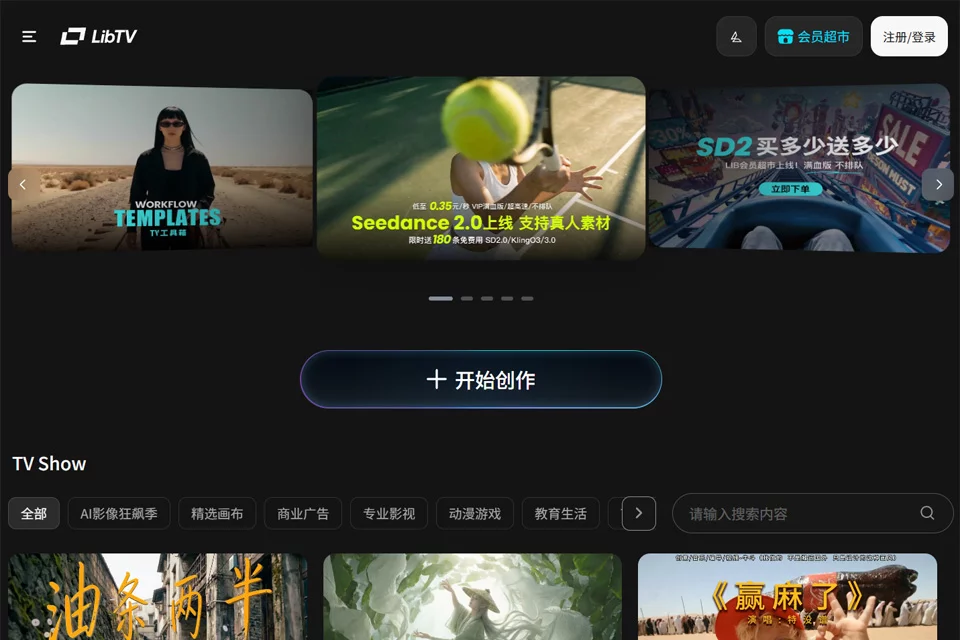
LibTV is positioned as an AI short-drama and video creation platform for creators and AI agents. Its dual-entry design brings human creation and agent workflows into the same infinite-canvas workspace, supporting video production workflows organized around scripts, storyboards, and source materials.
The platform is suitable for users who need to combine multiple generation steps, and can also be used to explore collaboration between manual operations and automated workflows.
02Key Features
The platform provides five types of basic nodes, including text, image, and video nodes, allowing users to build creation workflows by connecting nodes. Current information indicates that LibTV supports uploading reference videos and performing multi-panel storyboard analysis to organize visual information such as shot sizes and camera movements.
In addition, the platform provides cinematic lighting control, three-view character generation, a subject library, and character consistency management. It also aggregates multimodal models and supports switching between different models. For agent use cases, the platform also provides an open interface and an OpenClaw-exclusive Skill package.
03Use Cases
Film and television creators can use it to organize short-drama production workflows from script to final video, while managing storyboards, lighting, and character settings. Creator teams can use it for short-video topic development, visual planning, and asset generation.
For automation developers, the node-based canvas and agent interface are suitable for building batch or automated video workflows. Commercial marketing teams can use the platform for early ideation and production of visual content such as product promotional videos and event videos.
04Usage Considerations
LibTV offers both free and paid access. Specific available features, model coverage, and billing conditions are subject to the platform's current page. When using multi-model and multi-node workflows, users should first clarify the source materials, node relationships, and output objectives.
Storyboard analysis, character management, and video generation results should still be checked against the actual footage, with particular attention to plot continuity, character performance, camera movement, and asset compliance. For complex projects, it is recommended to validate a small-scale workflow first before expanding to full production.
© Disclaimer: domains and linked content may change over time. AIEZZ does not control third-party websites. Review external content and risks independently.
User reviews0