
- Monthly visits
- 0
- Pricing
- Not set
- Listed
- —
- Updated
- 2026-10-29
01What Is New Term Radar
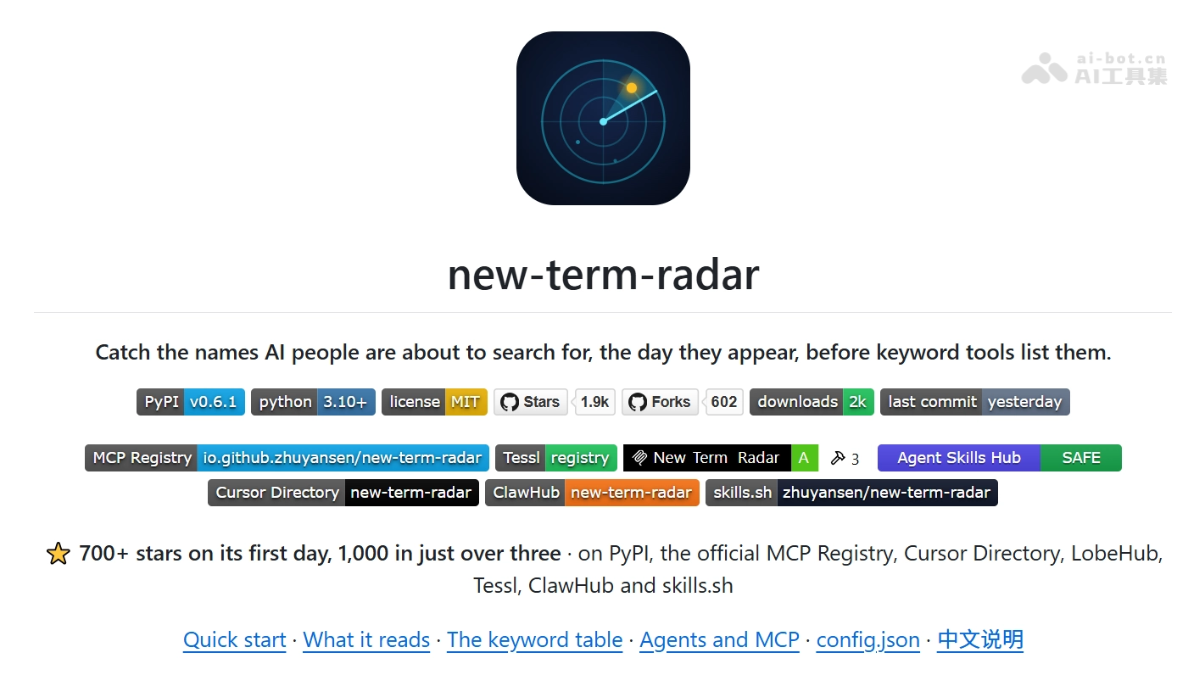
New Term Radar (new-term-radar) is an open-source AI tool for monitoring emerging terms, helping users discover new terms before they are indexed by keyword tools. New Term Radar automatically scans public signals such as X accounts, the Hugging Face trending list, GitHub breakout repositories, and AI directory sitemaps every day. After filtering out noise with models, it produces a daily report showing which new names have appeared and which ones are worth writing about. For each new term, New Term Radar extracts the underlying generic search terms, estimates search volume, analyzes the competitive landscape on the first page, and directly recommends whether to prioritize, watch, or skip it.
02Key Features of New Term Radar
Follow the WeChat account and reply “开源” to join the AI open-source project group
Multi-source signal monitoring: Scans six types of public signals every day, including X accounts, the Hugging Face trending list, GitHub breakout repositories, and directory sitemaps, to capture the earliest traces of emerging terms.
AI noise filtering: Uses a small model to score candidate terms, distinguish proper nouns from common words, and automatically filter out invalid signals.
Keyword extraction: Derives the underlying generic search terms for each new name and estimates daily search volume.
Competitive landscape analysis: Examines first-page competition and keyword difficulty, then recommends whether to “prioritize, watch, or skip.”
Multiple integration options: Supports command-line daily reports, Agent Skill, and an MCP server, with direct integration for tools such as Claude Code and Cursor.
Automatic results review: Checks each lead against search trends after 14 days and measures the hit rate and lead time of each signal source.
03How to Use New Term Radar
Clone the project: git clone https://github.com/zhuyansen/new-term-radar and enter the project directory.
Copy and edit the configuration: cp config.example.json config.json, then enter the X accounts, sitemaps, and topics to monitor.
Set the API key: export AISA_API_KEY=... (set lang to “zh” if you need Chinese reports); skip this step if you only want free signals.
First run: python -m radar daily --out report.md. This only creates a baseline snapshot and reports GitHub breakout repositories.
Daily runs: Outputs changes across all signals as usual; adding it to a scheduled task is recommended.
Optional Agent integration: Run npx skills add zhuyansen/new-term-radar, then say “What new AI terms are there today?” directly in Claude Code.
Optional MCP integration: Add uvx --with mcp new-term-radar mcp and the environment variables to the configuration of clients such as Cursor.
04Core Advantages of New Term Radar
Time-lag advantage: Keyword tools read the final step in the propagation chain, while this tool monitors the first four steps, allowing it to discover new terms days or even weeks earlier.
Free, public signal sources: All six types of signals come from public data, with no expensive subscription required.
More than names, it provides answers: Directly outputs actionable decisions for each term—whether to prioritize, watch, or skip—saving the time required for manual analysis.
Flexible, comprehensive usage: Available as a command-line tool, Agent Skill, or MCP server, suitable for personal use or integration into automated workflows.
05New Term Radar Project
GitHub repository: https://github.com/zhuyansen/new-term-radar
06Use Cases for New Term Radar
SEO optimization for AI tool directories: Site owners can build and position a site before competition around a new term takes shape, capturing the ranking advantage of reaching the first page of search results early.
Trend-driven content planning: Official account and newsletter authors can discover popular new terms days earlier than others and write timely content about “what everyone is discussing.”
Overseas market research: Product managers can examine the distribution of search interest for new terms across different countries and regions to determine which market a product should target first.
Discovering product opportunities: Indie developers can monitor new sellers who have “just posted their first payment link” and open-source projects gaining momentum to uncover paid needs already validated by the market.
Competitor and industry monitoring: Professionals and investors can use signals such as repository star growth, revenue rankings, and advertising activity to identify projects and companies with growth potential at an early stage.
© Disclaimer: domains and linked content may change over time. AIEZZ does not control third-party websites. Review external content and risks independently.
User reviews0